On this page
You pour a capful of phenyl into a bucket and the clear brown liquid blooms into a white cloud. Dettol does the same in a mug of water. Nothing has gone off. You have just made an emulsion: oil broken into droplets so small they stay spread through the water, and the white colour is light bouncing off them.
What is in phenyl and Dettol that does not dissolve in water?
Dettol's UK patient leaflet lists chloroxylenol 4.8% w/v as the active ingredient, along with pine oil, isopropyl alcohol, castor oil, caustic soda solution, caramel and water (medicines.org.uk). Pine oil is an oil. Chloroxylenol barely dissolves in water: about 250 mg per litre at 20 °C, according to the data compiled in PubChem.
Phenyl is a simpler mix. A project profile published by India's MSME Development Institute describes it as "an emulsion of light creosote oil and water with soap", where the creosote oil carries carbolic acid and related phenol compounds as the germ-killers (DC-MSME project profile). The same profile makes its soap by boiling rosin and castor oil with caustic soda. Dettol's list has that same pair, castor oil and caustic soda, which react to make soap. Brands differ, so read your own bottle's label.
Why does it turn milky the moment it hits water?
Inside the bottle there is little water. In Dettol, alcohol and soap keep the oils evenly mixed, and the leaflet describes the concentrate as a clear amber liquid. Pour it into a lot of water and the alcohol is diluted away. The oils can no longer stay dissolved, so they come out as countless tiny droplets.
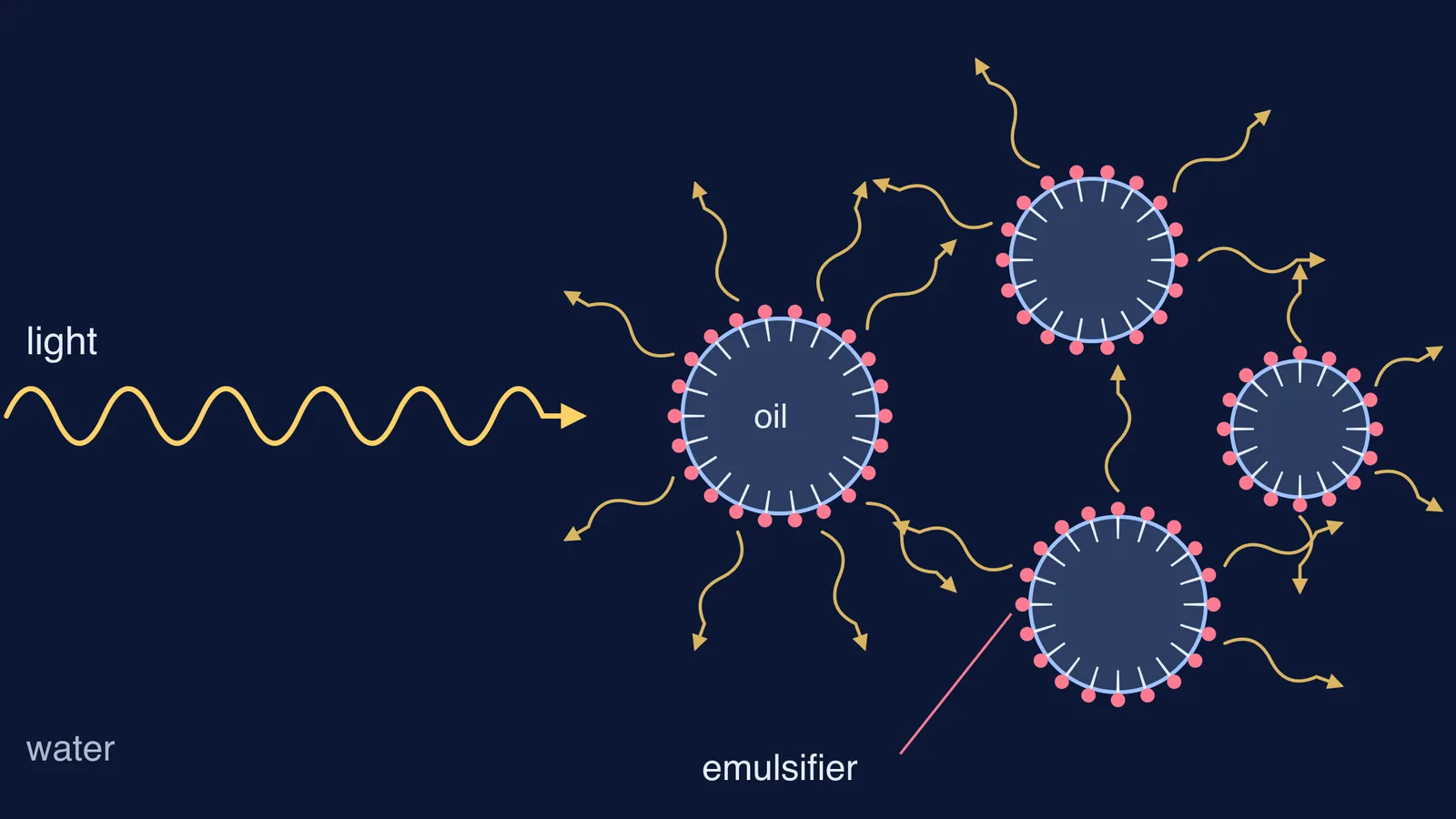
Soap is what keeps those droplets small. Each soap molecule has one end that likes water and one end that likes oil, so the molecules coat every droplet with their oily tails inside and their water-loving heads outside. Coated droplets do not easily merge back into a layer of oil. Our post on the difference between soap and detergent walks through it.
Chemists call the oil-coming-out-of-a-solvent step the ouzo effect, named after the Greek drink that clouds when water is added. Steven Vitale and Joseph Katz used the name in a 2003 paper in *Langmuir* titled "Liquid droplet dispersions formed by homogeneous liquid-liquid nucleation: the ouzo effect" (Langmuir, 2003). Dettol's own Wikipedia entry notes that it shows this effect when diluted.
Why is the mixture white and not clear?
It comes down to droplet size. In a review of nanoemulsions, Seung Jun Choi and David Julian McClements explain that droplets much smaller than the wavelength of light (under about 50 nm) scatter light only weakly and can look transparent (Choi and McClements, 2020). Droplets fairly similar in size to the wavelength scatter it strongly and look opaque, and conventional emulsions, with droplets larger than about 200 nm, look turbid to opaque (same source).
Droplets this size bounce light of every colour in many directions, so you see white. Milk is white for the same reason. Salt water stays clear because salt splits into ions far smaller than any droplet. To sort mixtures this way for an exam, see how to tell a true solution, colloid or suspension apart.
Worked example: how much chloroxylenol cannot dissolve?
Take a dilution printed in the leaflet: 12.5 mL of Dettol in a quarter litre of water (medicines.org.uk).
Chloroxylenol in 12.5 mL: 4.8 g per 100 mL × 12.5 mL = 0.6 g.
Total volume: 250 mL + 12.5 mL ≈ 0.26 litre.
Concentration: 0.6 g ÷ 0.26 L ≈ 2.3 g per litre.
Water's limit at 20 °C: about 0.25 g per litre (PubChem).
Ratio: 2.3 ÷ 0.25 ≈ 9.
There is roughly nine times more chloroxylenol than water can dissolve, before you count the pine oil. Most of it has to sit in droplets, so the mix turns white at once.
How do you write this as a chemistry answer?
A four-step answer that covers the marks:
The product contains oils (pine oil, creosote oil, chloroxylenol) that are insoluble in water.
In the bottle, a solvent and soap keep them mixed.
On dilution the oils separate as tiny droplets, and soap acts as an emulsifier, forming an oil-in-water emulsion, a colloid with a liquid dispersed in a liquid.
The droplets are large enough to scatter light strongly in all directions, so the liquid looks milky.
You can see step 4 at home. Shine a phone torch through a clear jar of very dilute Dettol and a jar of salt water: the beam shows up as a bright path only in the first. Do it with an adult, keep the jars away from food and small children, and pour the mixture away afterwards. Our post on spotting a colloid with a beam of light explains what you are seeing.
If the step from "droplet" to "white" is hard to picture, the Fermi Simulation Lab has interactive simulations for ideas that are easier to see than to read. For the theory behind colloids and emulsions, the Fermi Concept Library gives every chemistry concept its own lesson.