On this page
A firefly's glow is a chemical reaction you can write down and do energy sums on. It ties together three chapters you study separately: chemical reactions, enzymes and energy.
How do fireflies make their own light?
The light comes from a small molecule called luciferin and an enzyme called luciferase. The ENZYME database at Expasy gives the reaction catalysed by firefly luciferase (EC 1.13.12.7) as: D-luciferin + ATP + O2 → oxyluciferin + light + AMP + CO2 + diphosphate.
It runs in two steps, as a review in IUBMB Life by Marques and Esteves da Silva explains:
Activation: luciferin reacts with ATP (with Mg2+ present), releasing pyrophosphate and forming an intermediate, luciferyl adenylate.
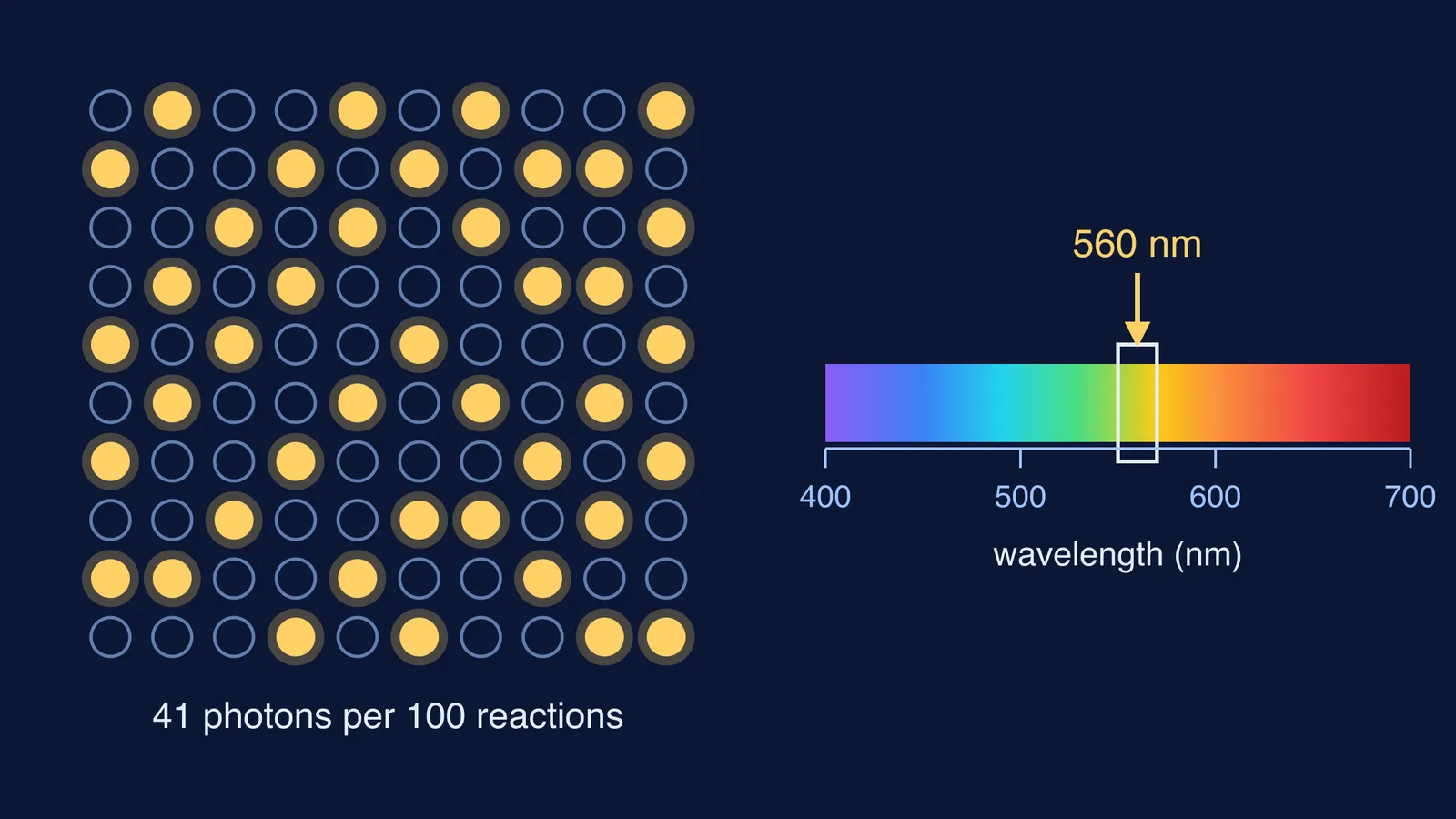
Oxidation: the intermediate reacts with oxygen, loses CO2, and becomes oxyluciferin, the molecule that emits yellow-green light of 550 to 570 nm.
The Expasy entry adds the key detail. The oxygen step forms a very short-lived peroxide that closes into a ring called a dioxetanone. When that ring breaks apart, releasing CO2, it gives out about 50 kcal/mol, the energy needed to leave oxyluciferin in an excited state. The excited molecule then emits a photon and drops back to its ground state.
Why is firefly light called cold light?
A filament bulb shines because it is hot. Firefly light is chemiluminescence instead: the energy from breaking a chemical bond goes straight into one excited molecule, which releases it as a photon, without heating anything to glowing temperature. The same idea powers a glow stick when you bend it, only without an enzyme.
Cold does not mean perfect, though. Quantum yield is the number of photons emitted per luciferin molecule that reacts. According to Niwa and colleagues in Biosensors (2023), Seliger and McElroy reported a quantum yield of 0.88 in 1959, Ando and colleagues re-measured it as 0.41 in 2008, and a later check with a calibrated luminometer gave 0.48.
What does the enzyme luciferase actually do?
Luciferase is a catalyst. It is not used up, holds luciferin, ATP and oxygen in position, and lowers the activation energy so the reaction runs fast at body temperature, as on an energy profile graph for enzymes.
Watch for one exam trap. ATP does not supply the energy for the light. Its job is to activate luciferin in step 1; the energy comes from oxygen and the breaking of the dioxetanone ring in step 2.
How does a firefly switch its flash on and off? Trimmer and colleagues reported in Science (2001) that nitric oxide gas, in the presence of oxygen, stimulated light production, and that the enzyme which makes nitric oxide is found in lantern cells that sit between the nerve endings and the light-producing cells. Their results suggest that making nitric oxide is a key part of flash control.
Worked example: is one reaction enough for one photon?
Use 560 nm, the middle of the 550 to 570 nm range in the IUBMB Life review, and the 50 kcal/mol from the Expasy entry. If moles of photons are new to you, our post on the energy of one mole of photons walks through the method.
Energy of one photon: E = hc/λ = (6.626 × 10^-34 × 3.00 × 10^8) / (560 × 10^-9) = 3.55 × 10^-19 J.
Per mole of photons: 3.55 × 10^-19 × 6.022 × 10^23 = 2.14 × 10^5 J, about 214 kJ/mol.
Energy from the dioxetanone: 50 kcal/mol × 4.184 = 209 kJ/mol.
The two numbers are about the same size: each reacting molecule releases roughly one yellow-green photon's worth of energy, so it can give at most one photon. A blue photon at 450 nm would need about 266 kJ/mol, well above the roughly 209 kJ/mol available.
Now scale it up. A 2026 paper in the American Journal of Physics by David Silver estimates that a firefly flash contains roughly 10^8 to 10^11 photons. At the 2008 quantum yield of 0.41, that needs about 2.4 × 10^8 to 2.4 × 10^11 luciferin molecules, or only 4 × 10^-16 to 4 × 10^-13 mol per flash.
How can you use fireflies in your revision?
Turn the firefly into a one-page summary that links three chapters:
Write the overall equation and label each part: substrate (luciferin), enzyme (luciferase), oxidant (O2), activator (ATP), products (oxyluciferin, AMP, CO2, diphosphate, light).
Explain cold light in one sentence: an excited molecule emits a photon; nothing is heated to glowing.
Redo the photon sum above for 550 nm and 570 nm.
The Fermi Simulation Lab has interactive simulations for ideas that are easier to see than to read, and the Fermi Concept Library gives each concept in chemistry and biology, from enzymes to oxidation, its own lesson.
Next time you see a firefly, picture a dioxetanone ring breaking apart and an excited oxyluciferin giving out its photon.