On this page
In Class 11 you learn that electric current is one of the seven SI base quantities, and charge is not. That feels backwards: current is just charge per second, so why isn't the coulomb the base unit? The answer is partly history and partly what laboratories could measure well.
Why is the ampere a base unit and not the coulomb?
The set of base units was a choice, not a law of nature. The official SI Brochure, published by the International Bureau of Weights and Measures (BIPM), says "the choice of the base units was never unique, but grew historically and became familiar to users of the SI" (BIPM SI Brochure, 9th edition).
Electrical units started with current and resistance. In 1893 the International Electrical Congress in Chicago "settled on two units to be the basis for the others: the ohm for resistance and the ampere for current" (NIST, ampere history). That early ampere was the current that deposits 0.001118 grams of silver per second from a silver nitrate solution.
In 1901 Giorgi showed that adding one electrical unit, "such as the ampere or the ohm", to the metre, kilogram and second gives one coherent system. The CIPM approved this MKSA system in 1946, and in 1954 electric current became a base quantity (BIPM SI Brochure, Appendix 4).
What did the old definition of the ampere say?
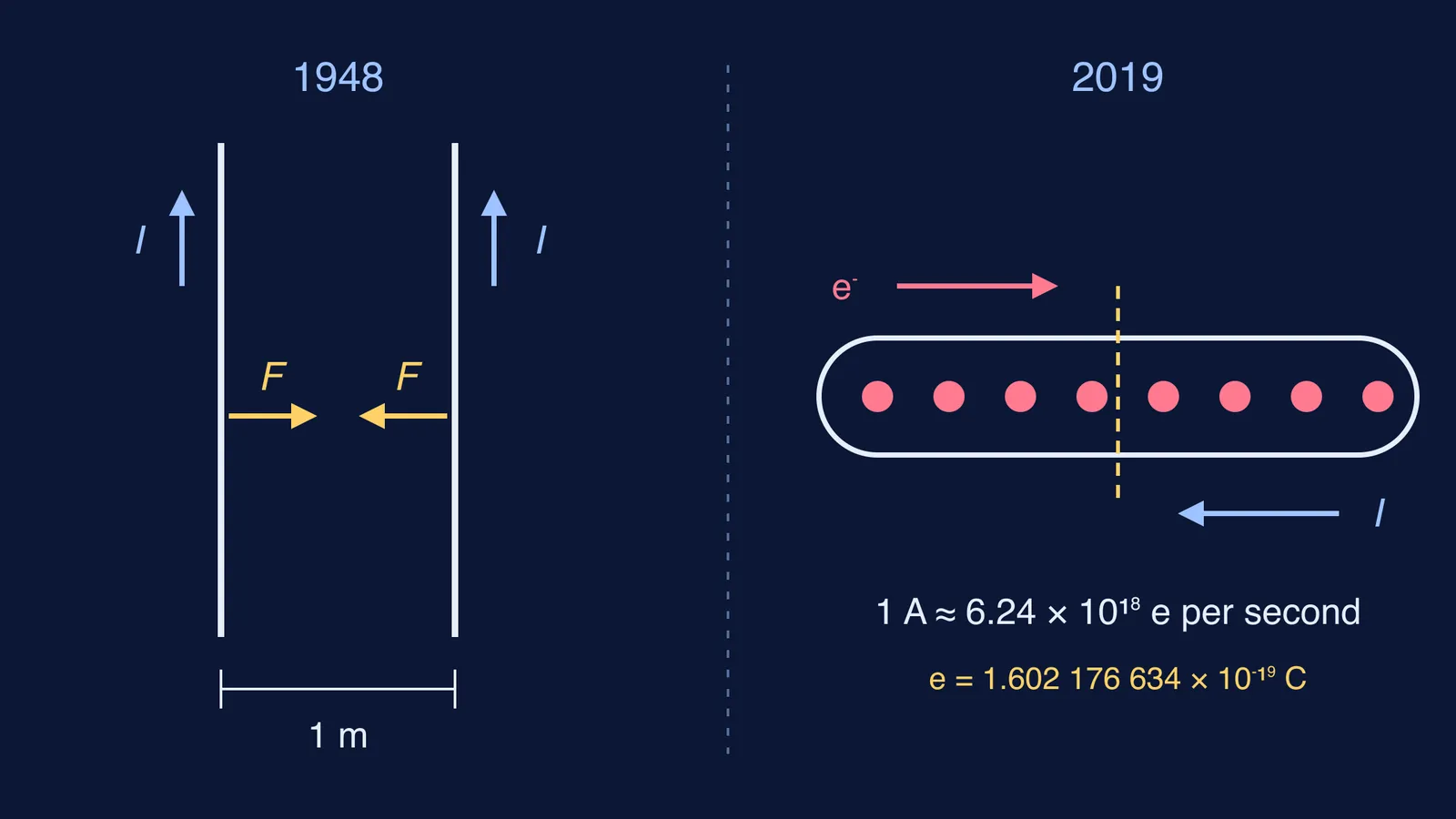
From 1948 to 2019 the ampere was "that constant current which, if maintained in two straight parallel conductors of infinite length, of negligible circular cross-section, and placed 1 meter apart in vacuum, would produce between these conductors a force equal to 2 x 10⁻⁷ newton per meter of length" (NIST, the ampere).
This shows the practical logic. A steady current produces a steady force, and a force can be weighed: in the ampere balance, current through coils moved an indicator on a mechanical scale (NIST, ampere history).
Even so, the BIPM says the 1948 definition "proved difficult to realize", and laboratories came to rely on Josephson and quantum Hall standards with Ohm's law instead (BIPM SI Brochure, Appendix 4).
What changed in the 2019 SI redefinition?
Since 20 May 2019 the ampere has been based on a fundamental constant, the elementary charge e (NIST, the ampere).
The ampere is now defined by fixing the numerical value of e at exactly 1.602 176 634 × 10⁻¹⁹ when expressed in coulombs, where one coulomb equals one ampere-second (BIPM, the ampere).
In the BIPM's words, one ampere is the current corresponding to the flow of 1/(1.602 176 634 × 10⁻¹⁹) elementary charges per second (BIPM SI Brochure, section 2.3.1). One side effect: the old definition fixed μ₀ at exactly 4π × 10⁻⁷ H/m, but μ₀ now has to be measured.
So is charge the real base quantity now? In a sense, yes: the defining constant is a charge. But the Brochure keeps base and derived units "because it is useful and historically well established", even though in principle the distinction "is not needed". The ampere stays base and the coulomb stays A s. For all seven units, see the seven SI base units and their 2019 redefinition.
Worked example: how many electrons is one ampere?
Using the fixed value of e from the BIPM definition:
Write the constant: e = 1.602 176 634 × 10⁻¹⁹ C, exactly.
One ampere for one second carries 1 C, because 1 C = 1 A s.
Number of elementary charges in 1 C = 1 / (1.602 176 634 × 10⁻¹⁹) ≈ 6.24 × 10¹⁸.
Scale it up: a charger delivering 2 A for one hour moves 2 × 3600 = 7200 C, about 4.49 × 10²² elementary charges.
We walk through a similar calculation step by step in how many electrons per second make 1 ampere.
How should you answer this in an exam or viva?
A three-line answer:
"Current was chosen as a base quantity for historical reasons: electrical standards were built around measuring current, first by silver deposition and later by the force between current-carrying wires."
"Charge is derived from it: Q = It, so 1 C = 1 A s and the dimensions of charge are [A T]."
"Since 2019 the ampere is defined by fixing e exactly, so 1 A corresponds to about 6.24 × 10¹⁸ elementary charges per second."
Three traps to avoid:
Saying charge is derived because it is "less fundamental". The choice of base units was never unique.
Quoting the parallel-wire rule as today's definition. It was replaced in 2019.
Writing the dimensions of charge as [Q]. With the ampere as base, it is [A T]. For more on changing base units, try finding the unit of mass when force, velocity and time are base units.
If definitions like this keep slipping, the Fermi Concept Library gives every concept in physics its own lesson and its place in the map. For practice on units and dimensions, the Fermi Problem Library has worked problems with a step-by-step solver that explains the reasoning rather than printing an answer.