

On this page
Physics normally builds every measurement from mass (M), length (L) and time (T). However, competitive exams like JEE and NEET often flip the script: what if you had to build everything from force, velocity and time?
Dimensional analysis breaks complex quantities down into fundamental parts. While the SI system is the standard, the mathematical rules of dimensions apply equally to any independent quantities you choose as your base.
Why change the base units?
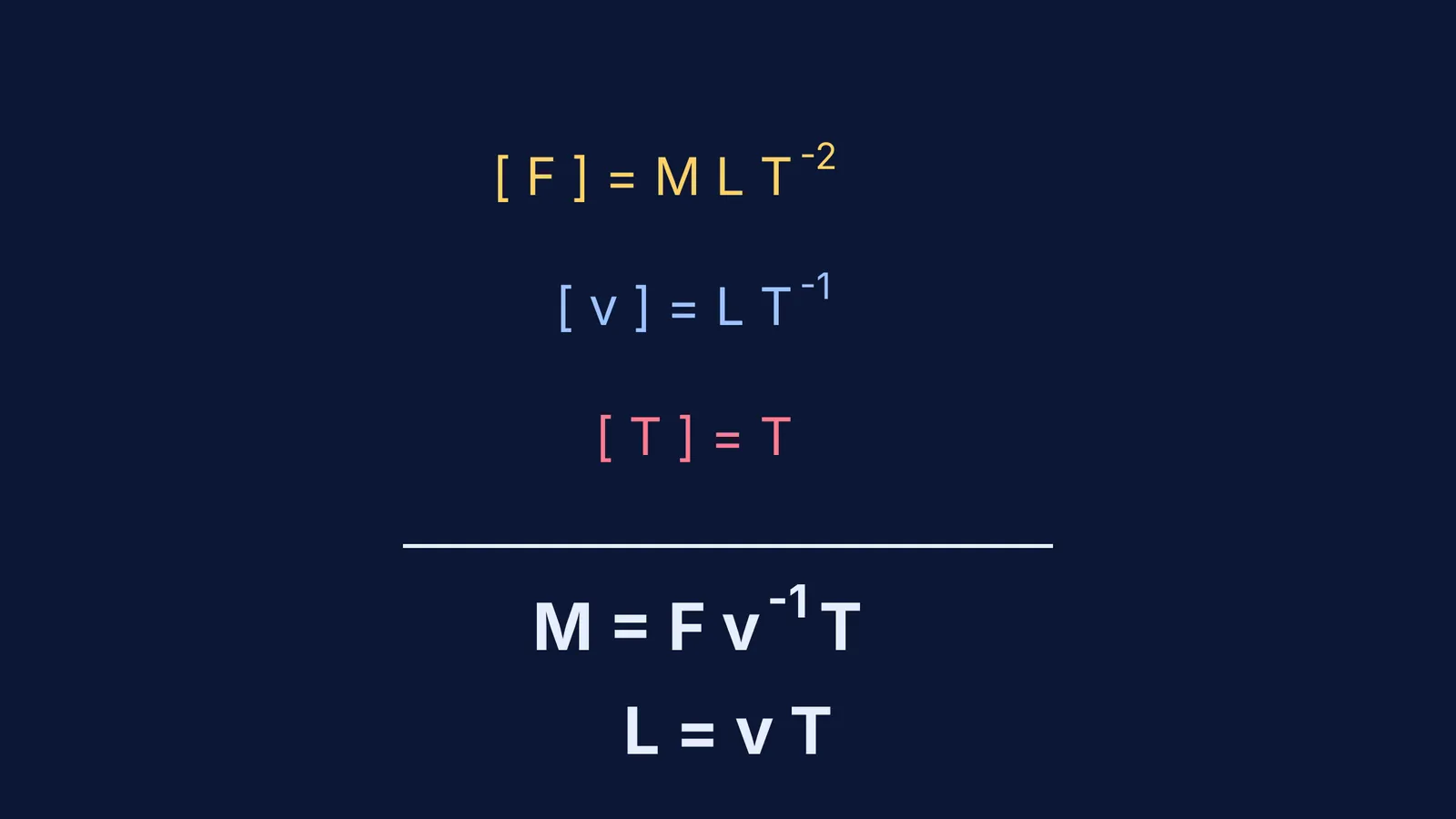
Dimensional analysis works with any foundation of independent quantities. A famous exam question asked students to find the dimensions of mass if force (F), velocity (v) and time (T) were taken as fundamental units.
These problems test whether you truly understand what a dimension is and how physical equations tie the world together, rather than just memorising standard lists. Once you understand how to manipulate dimensions, you can also use them for converting a quantity between unit systems using dimensions, another common exam topic.
If you struggle with concept gaps or recalling standard formulas, the Fermi Concept Library has every concept in physics, chemistry, biology, mathematics and computing, each with its own lesson and its place in the map.
How do you find the unit of mass when force, velocity and time are base units?
The fastest trick is to write down a basic physics equation linking your unknown target quantity directly to the new base quantities.
To find mass (M) using force (F), velocity (v) and time (T), start with Newton's second law: Force = mass × acceleration
Since uniform acceleration is the change in velocity divided by time (for non-constant motion, see acceleration given as a function of v or x: how to integrate it), substitute (v / T) for acceleration: F = M × (v / T)
Rearrange the equation to make mass the subject: M = (F × T) / v = F v⁻¹ T
The dimensional formula for mass is [F v⁻¹ T]. This substitution method saves you from solving a full system of linear equations during a timed exam.
How do you find the unit of length and energy?
Using direct substitution, you can quickly find the dimensions of other quantities without returning to M, L and T.
Length (L) Velocity is distance over time: v = L / T L = v × T The dimensional formula for length is therefore [v T], which can also be written formally as [F⁰ v¹ T¹].
Energy (E) Work or energy is defined mechanically as force multiplied by distance: E = F × L We already calculated that L = v T in the previous step, so we substitute it straight into the energy equation: E = F × v × T The dimensional formula for energy is [F v T].
If you find yourself making wrong-method mistakes on algebraic substitutions like these, the Fermi Problem Library has worked problems with a step-by-step solver that explains the reasoning rather than printing an answer.
How do you find the dimensions of pressure and power?
Try deriving more complex quantities like pressure and power using these building blocks.
Pressure (P) Pressure is defined as force divided by area. Area is a length squared (L²). P = F / L² Since we already found L = v T, we square it to get L² = v² T². P = F / (v² T²) P = F v⁻² T⁻² The dimensions of pressure are [F v⁻² T⁻²].
Power Power is the rate of doing work, which means energy divided by time. Power = E / T Using our earlier result for energy (E = F v T): Power = (F v T) / T The T cancels out completely, leaving: Power = F v The dimensions of power are [F v T⁰].
What is the general method for any new system of units?
Sometimes the physical relationship connecting the variables is not as obvious as F = ma. In those difficult cases, you should use the algebraic power method, which works universally for any set of base quantities.
Write the quantity proportional to the new base units raised to unknown powers (a, b, c): M = Fᵃ vᵇ Tᶜ
Substitute the standard [M L T] dimensions: [M¹ L⁰ T⁰] = [M L T⁻²]ᵃ [L T⁻¹]ᵇ [T]ᶜ
Group the terms on the right by adding their exponents: [M¹ L⁰ T⁰] = [Mᵃ Lᵃ⁺ᵇ T⁻²ᵃ⁻ᵇ⁺ᶜ]
Compare the powers to create linear equations: For M: a = 1. For L: a + b = 0 (so b = -1). For T: -2a - b + c = 0 (so -2 + 1 + c = 0, meaning c = 1).
Substitute these powers back into your first step: M = F¹ v⁻¹ T¹
This standard method takes slightly longer than the direct substitution trick, but it is completely foolproof and works reliably for any strange combination of quantities the examiners might invent.


