

On this page
"A wire carries 2 A; how many electrons pass a point each second?" is a standard opener in current electricity, from Class 10 to JEE practice. The answer rests on one line of reasoning, and once you see it you can run it forwards or backwards in seconds.
How many electrons flow per second for a given current?
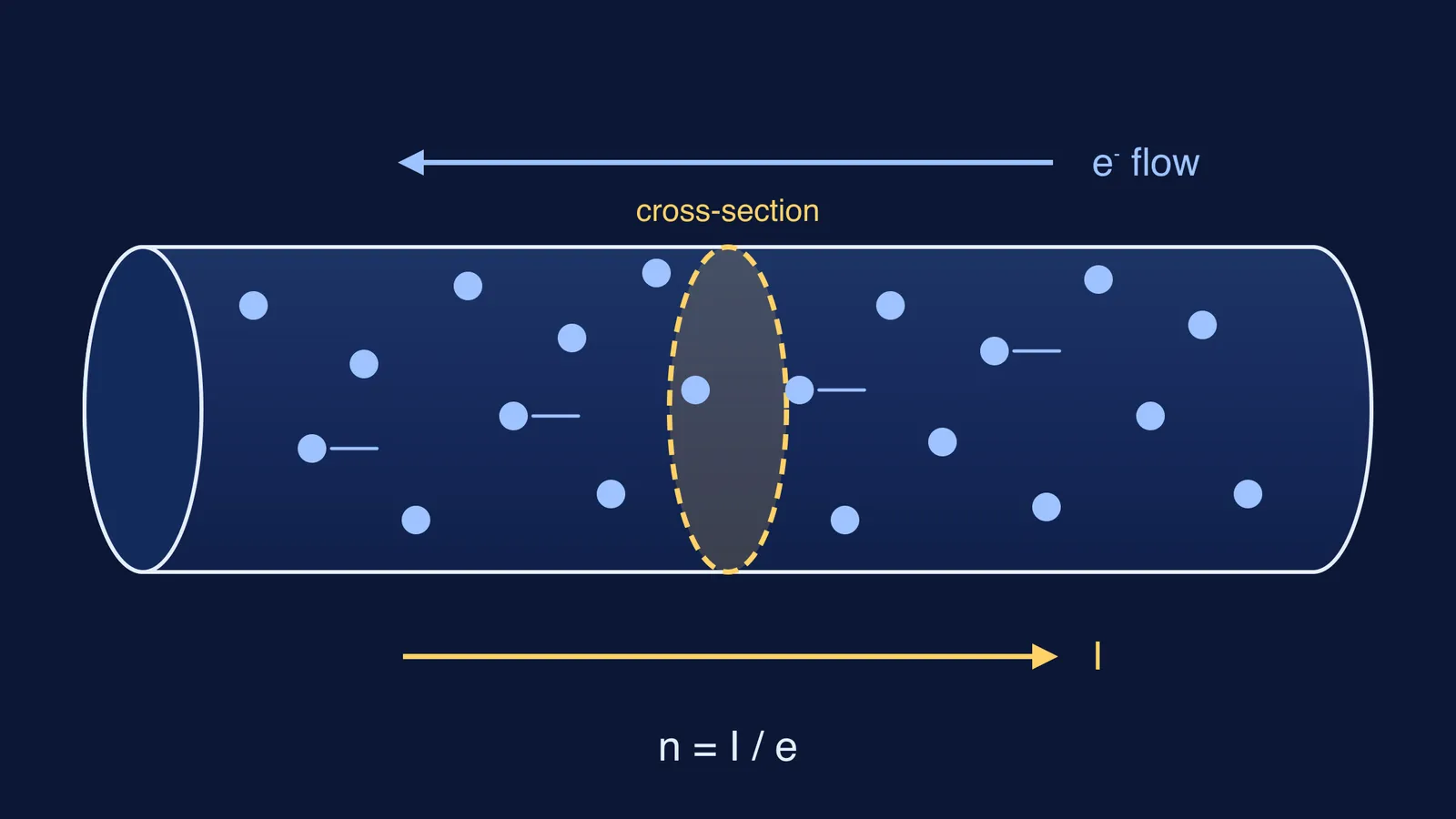
Current is the rate at which charge crosses a surface: I = q/t. Charge on the move comes in whole electrons, so q = Ne, where N is the number of electrons and e is the elementary charge. Put the two together and the number per second is n = N/t = I/e.
The ampere itself is defined this way. The BIPM, which maintains the SI, states that one ampere is the current corresponding to the flow of 1/(1.602176634 × 10^-19) elementary charges per second. The NIST CODATA value of the elementary charge is 1.602176634 × 10^-19 C, listed as exact.
So 1 A means 1/(1.602176634 × 10^-19), which is about 6.24 × 10^18 electrons crossing any cross-section every second.
Why do books say 6.25 × 10^18 and not 6.24 × 10^18?
It is rounding, not a different physics. Many school textbooks and exam papers use e = 1.6 × 10^-19 C, and 1/(1.6 × 10^-19) is exactly 6.25 × 10^18. With the full SI value of e from the BIPM definition, you get 6.2415 × 10^18.
The rule for exams is simple: use whatever value of e the question gives. If it says e = 1.6 × 10^-19 C, write 6.25 × 10^18. If it gives no value, 1.6 × 10^-19 C is the usual choice in school physics.
Worked examples: from current to electron count
All four use the rounded value e = 1.6 × 10^-19 C; the exact SI value listed by NIST is 1.602176634 × 10^-19 C.
Electrons per second for 2 A. n = I/e = 2 / (1.6 × 10^-19) = 1.25 × 10^19 electrons per second.
A milliampere. For 1 mA = 10^-3 A, n = 10^-3 / (1.6 × 10^-19) = 6.25 × 10^15 electrons per second. Convert mA and μA to amperes before dividing.
Total over a time. A 0.5 A current flows for 10 minutes. First t = 600 s, so q = It = 300 C. Then N = q/e = 300 / (1.6 × 10^-19) = 1.875 × 10^21 electrons.
Backwards: from electrons to current. If 3.2 × 10^19 electrons pass a point in 4 s, then n = 8 × 10^18 per second and I = ne = 8 × 10^18 × 1.6 × 10^-19 = 1.28 A.
A quick sanity check: for currents from 1 mA to 10 A, n runs from about 6 × 10^15 to 6 × 10^19 per second. If yours comes out near 10^-19, you multiplied where you should have divided.
If a problem mixes these steps with resistance or power, the Fermi Problem Library has worked problems with a step-by-step solver that explains the reasoning rather than printing an answer, so you can see which step you skipped.
Does the answer depend on the wire's thickness?
No. In a steady current, the same number of electrons crosses every cross-section of a series circuit each second, whether the wire is thick or thin, because charge does not pile up or disappear along it. We explain why in why current is not used up in a series circuit.
What does change with thickness is how fast each electron moves. A thinner wire carries the same n through a smaller area, so the drift speed rises. You can follow that in our post on how to derive drift velocity and Ohm's law. The drift speed is tiny even when n is huge, which leads to a classic puzzle: why a bulb glows instantly although electrons drift slowly.
What mistakes cost marks in these questions?
Forgetting to convert minutes to seconds, or mA to A.
Writing n = Ie instead of n = I/e.
Giving electrons per second when the question asks for the total number over a time, or the reverse.
Adding a minus sign to the count. The electron's charge is negative, but a number of electrons is positive; the sign only tells you electrons move opposite to conventional current.
Losing powers of ten. Divide the leading numbers and the powers of ten separately: 2 / 1.6 = 1.25, and 10^0 / 10^-19 = 10^19.
If the idea of charge as a flow still feels shaky, the Fermi Concept Library gives each concept in physics its own lesson and its place in the map, so you can go back to current and charge before trying harder circuits.
Try it now: work out how many electrons pass through a 5 A wire in one minute. (Answer: 1.875 × 10^21.)


