On this page
Stand up, and your hips, spine and shin bones take your body weight. Every step sends a load through them. In orbit that load disappears, and the skeleton does what the body does with anything it stops using: it trims it down.
Why do astronauts lose bone in space?
Bone is living tissue, rebuilt throughout your life. In the bone remodelling cycle, cells called osteoclasts dissolve old bone and osteoblasts lay down new bone, and the two are normally tightly coupled (Kenkre and Bassett, Annals of Clinical Biochemistry, 2018). The same review explains that when resorption and formation fall out of balance, the result is bone disease, most commonly osteoporosis.
Weight helps keep that balance. On the space station, gravity has not switched off: the station and the crew are falling around Earth together, so the floor no longer pushes up on anyone's feet (we explain this in why astronauts feel weightless in orbit). As NASA puts it, in microgravity the weight-bearing bones like the spine and hips do not need to be as strong to support the body (NASA Human Research Program).
So the body stops maintaining bone it is not using. In 13 space station crew members studied between 2006 and 2009, most markers of bone breakdown rose during flight (Smith et al., Journal of Bone and Mineral Research, 2012). When breakdown outpaces rebuilding, density falls.
How fast do astronauts lose bone and muscle in space?
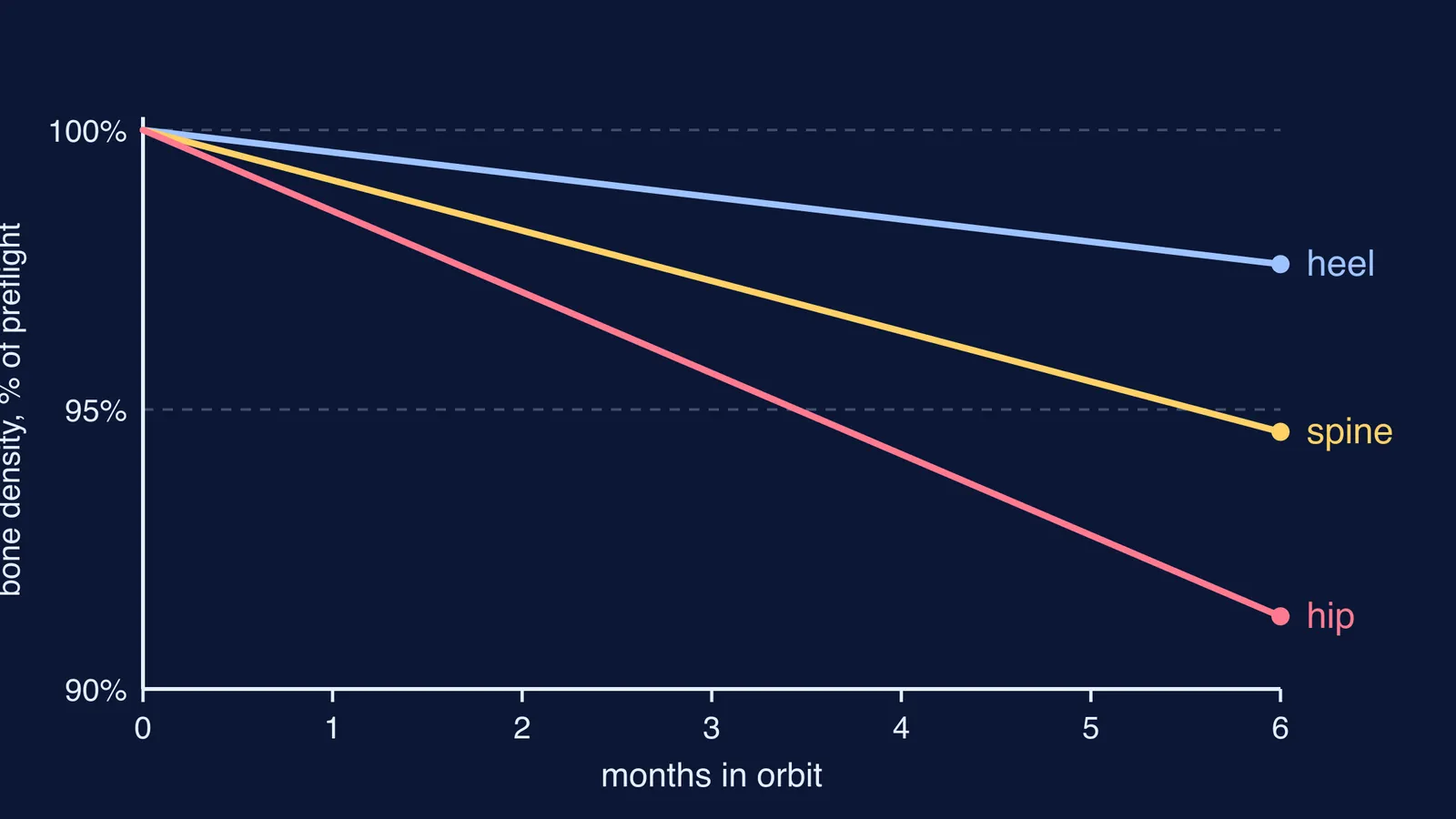
Space station crew on 4- to 6-month flights lost bone mineral density at 0.9% per month in the spine and 1.4-1.5% per month in the hip (Lang et al., Journal of Bone and Mineral Research, 2004). The heel lost less, about 0.4% per month. Inside the hip, spongy (trabecular) bone went fastest, at 2.2-2.7% per month, against 0.4-0.5% for the hard outer (cortical) shell; if those terms are hazy, see compact bone vs spongy bone.
Muscle shrinks too. In nine crew members who spent six months on the station, calf muscle volume fell by 13% and peak power was 32% lower after the flight, even though they had a treadmill, an exercise bike and a resistance device on board (Trappe et al., Journal of Applied Physiology, 2009).
Worked example: take the hip at 1.5% per month for a 6-month mission. The quick estimate is 6 × 1.5 = 9%. If you instead treat each month's loss as 1.5% of what is left, the figure is 1 − 0.985⁶ ≈ 0.087, or about 8.7%. Either way, close to a tenth of the hip's bone density is gone by landing.
Does the bone come back after astronauts return?
Only partly. Among 17 astronauts scanned a year after landing, shin-bone strength and density were still 0.9% to 2.1% below preflight values, and 9 of the 17 had not fully recovered their shin-bone total density (Gabel et al., Scientific Reports, 2022). Astronauts on missions longer than six months recovered worse. The authors suggest the lasting deficit is comparable to a decade or more of normal age-related bone loss on Earth.
How do astronauts protect their bones in orbit?
If gravity will not load the bones, a machine has to. Early station crews used a resistance device allowing loads up to 297 pounds-force, which gave bone little protection; its 2008 replacement, the Advanced Resistive Exercise Device, allowed up to 600 pounds-force (Smith et al., 2012). In that study, the five crew members who trained on the newer device, and who also ate enough and had adequate vitamin D, came home with hip and pelvis density unchanged from preflight. NASA also scans astronauts' bones before and after flight, and its studies suggest drugs called bisphosphonates could reduce some of the loss (NASA).
The physics is the same as on Earth: bone responds to the force pressing on it, whether that force comes from the floor pushing back on your weight or a cable pulling on a bar.
How do you explain astronaut bone loss in an exam answer?
This question joins the skeletal system to gravity. Use this five-step frame:
Name the load: on Earth, the normal force from the ground compresses the hips, spine and legs.
Name the cells: osteoclasts resorb bone, osteoblasts form it.
State the imbalance: in free fall the load is gone, so resorption outpaces formation.
Give one number: about 1.4-1.5% of hip density per month on 4- to 6-month flights (Lang et al., 2004).
Name the fix: heavy resistance exercise plus enough food and vitamin D.
Hormones such as parathyroid hormone and calcitonin also regulate remodelling (Kenkre and Bassett, 2018); revise them with parathyroid hormone vs thyrocalcitonin.
Free fall is hard to picture. The Fermi Simulation Lab has interactive simulations for ideas that are easier to see than to read, and the Fermi Concept Library gives each concept its own lesson, so you can check remodelling and normal force side by side.