On this page
At the start of a 400 m race, the runner in lane 8 crouches far ahead of the runner in lane 1. Nobody is getting a head start. Each runner is placed so that everyone covers exactly 400 m, and the reason is a formula you know from school: the circumference of a circle, C = 2πr.
Why do 400 metre runners start at different positions?
The World Athletics Technical Rules (Rule 14.1) say a standard running track is 400 m long, with two parallel straights and two bends of equal radius. Rule 14.4 says that in all races up to and including 400 m, each athlete has a separate lane 1.22 m wide.
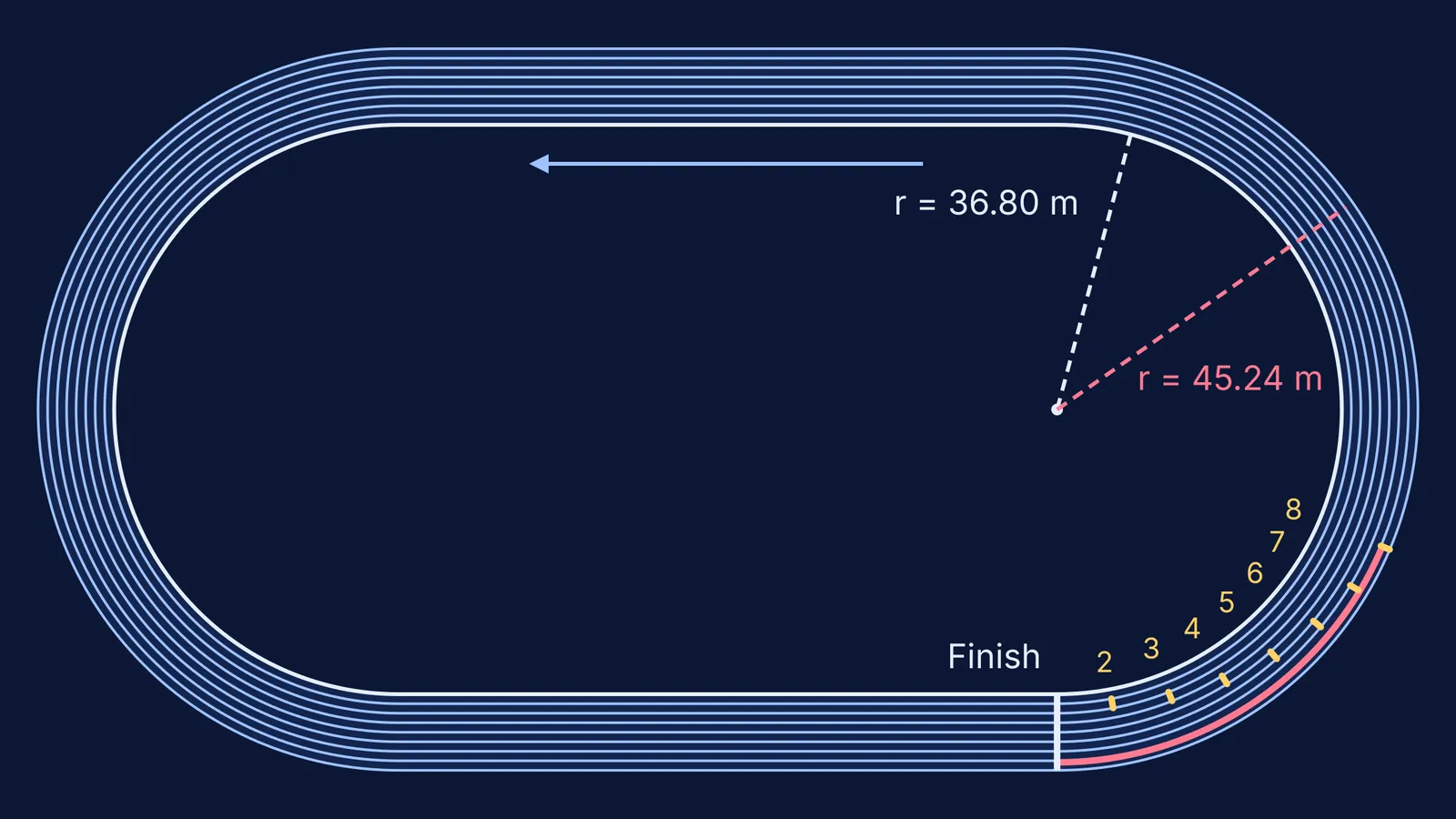
On the straights, every lane is the same length. On the bends, the lanes are curves around the same centre, and an outer curve has a bigger radius, so it is longer. If everyone started on one line, the runner in lane 8 would run tens of metres further than the runner in lane 1. Moving each outer runner forward by exactly that extra distance is called a staggered start.
How much longer is each outer lane?
The standard track has bends of radius 36.50 m and straights of 84.39 m each, as the Western Australian government's athletics track guide sets out from the IAAF (now World Athletics) facilities manual.
Distance is not measured along the kerb itself. Rule 14.2 of the Technical Rules measures lane 1 on a line 0.30 m outward from the kerb, and Rule 14.4 measures every other lane 0.20 m from the outer edge of the line on its inside. Here is the worked example:
Lane 1 running line: radius = 36.50 + 0.30 = 36.80 m. The two bends make one full circle, so one lap = 2 × 84.39 + 2π × 36.80 = 168.78 + 231.22 = 400.00 m.
Lane 2 running line: radius = 36.50 + 1.22 + 0.20 = 37.92 m. Extra length = 2π × (37.92 − 36.80) = 2π × 1.12 ≈ 7.04 m.
Each lane after that sits 1.22 m further out, so it adds 2π × 1.22 ≈ 7.67 m more.
Lane 8 running line: radius = 37.92 + 6 × 1.22 = 45.24 m. Extra length = 2π × 8.44 ≈ 53.03 m.
Now check against the official 400 m stagger table in the track guide: 7.038 m for lane 2 and 53.032 m for lane 8. The school formula lands within a few millimetres of the official figures.
If the circumference formula feels memorised rather than understood, our explainer on why circumference is π times the diameter builds it from scratch.
Why is lane 2's stagger smaller than the rest?
Lane 2 adds 1.12 m of radius, not 1.22 m. Under Rules 14.2 and 14.4 of the Technical Rules, lane 1 is measured 0.30 m from a raised kerb, while lane 2 is measured 0.20 m from a painted line. That 0.10 m difference makes the first stagger about 7.04 m instead of 7.67 m.
Why don't 1500 m runners start staggered?
In longer races, runners leave their lanes and head for the inside of the track. For races not run in lanes, Rule 16.1 of the Technical Rules says the start line is curved, "so that all the athletes start the same distance from the finish." Same goal, different shape of start line.
How can you work out a stagger yourself?
Use this method in an exam or on your school ground:
Find the radius of the running line in lane 1, not the kerb.
Work out how much of a full circle the race spends on bends. A standard 400 m lap has two semicircular bends, per the track guide, so one full circle.
Find how much further out the outer lane's running line is.
Extra length = (fraction of a full circle on bends) × 2π × (extra radius).
Ignore the straights. They are the same in every lane.
Try one. A school track has lanes 1 m wide, and the race goes once round both bends. How far ahead of lane 1 should lane 4 start? Ignoring the 0.30 m and 0.20 m offsets, the extra radius is 3 m, so the stagger is 2π × 3 ≈ 18.85 m, whatever the bend radius.
The usual trap is mixing up an arc with a full perimeter, the same slip students make with the perimeter of a semicircle. Questions on distance versus displacement on a circular track are worth revising alongside this one.
If an idea is easier to see than to read, the Fermi Simulation Lab has interactive simulations built for that. Next time you watch a 400 m start, look at lane 8 and think: 2π × 8.44.