

On this page
Distance and displacement often look like the same thing in everyday life, but in physics, they tell two different stories. When you run on a circular track, you can cover a large distance while ending up with a displacement of zero.
Understanding how to calculate these values for a circle—whether it is a half lap, a full lap, or several laps—is a classic way to test whether you know the difference between a scalar and a vector.
What is the difference between distance and displacement?
In physics, distance is a scalar quantity that measures how much ground an object has covered, meaning it only has a size (magnitude) and no direction. If you run forward and then backward, your total distance keeps adding up.
Displacement is a vector quantity that measures how far out of place an object is from its starting point. It is the shortest straight line between the initial and final positions. Because it is a vector, it must have a direction, and it does not care about the path you took to get there.
If you struggle to picture the difference between scalars and vectors, exploring the Fermi Concept Library can help you build the intuition for these ideas before you try to memorise formulas.
How to find distance and displacement for a full circle?
When a runner completes one full lap of a circular track, they travel along the entire boundary of the circle.
Distance: The distance for one full lap is the circumference of the circle, calculated as 2πr, where r is the radius.
Displacement: Because the runner returns exactly to their starting point, the displacement after one complete lap is zero.
What are the distance and displacement for a half circle?
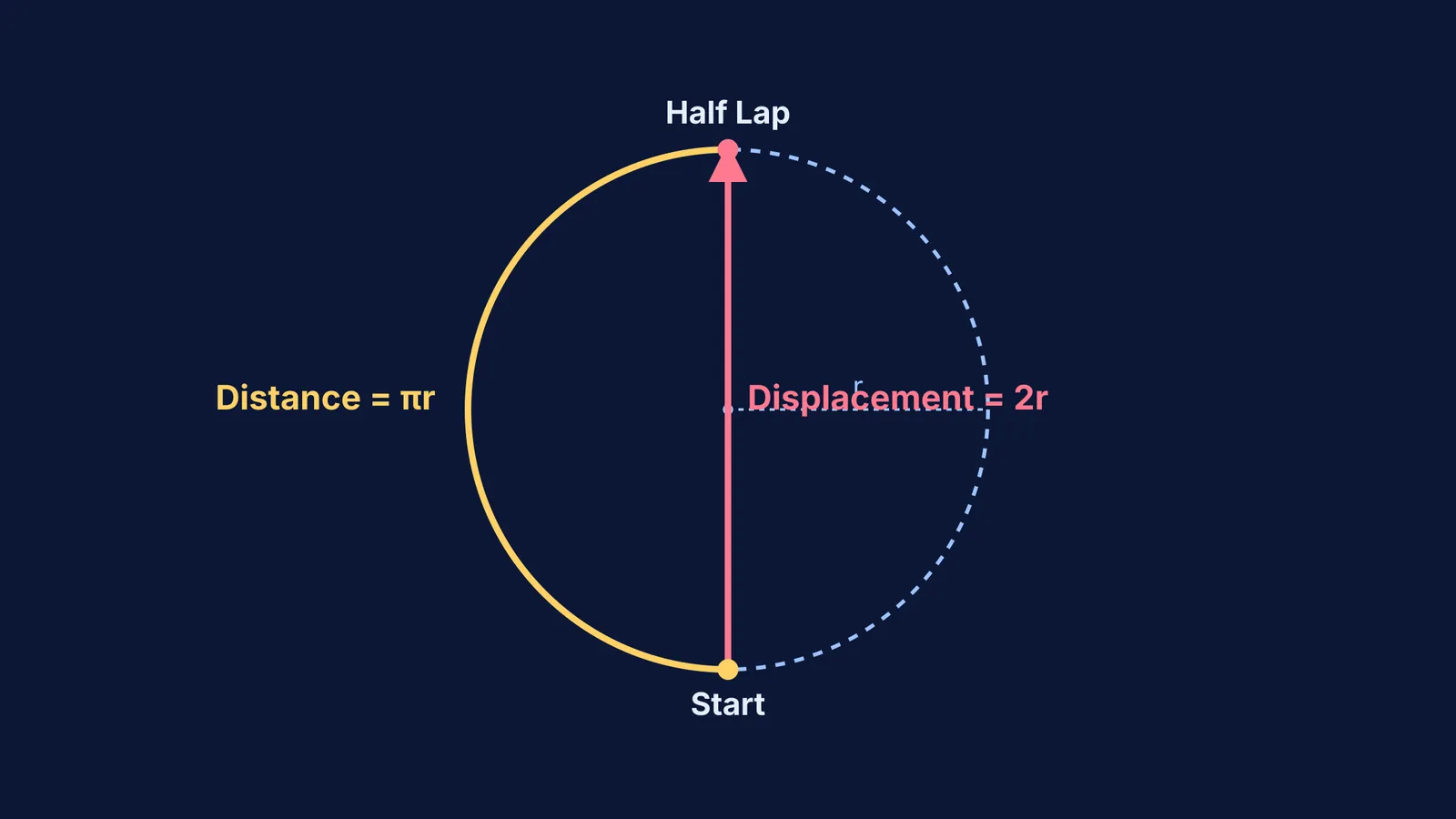
If the runner stops halfway around the track, they are standing at the diametrically opposite end of the circle from where they began.
Distance: The path travelled is exactly half of the circumference. Therefore, the distance is πr.
Displacement: The shortest straight line from the start to the opposite side of the circle cuts straight across the middle. The displacement for a half lap is the diameter of the circle, or 2r.
If you are just starting to learn about types of motion in physics, comparing the curved πr path with the straight 2r path is a great way to see why distance is always greater than or equal to displacement magnitude.
What are the distance and displacement for a three-quarter circle?
Things get more interesting if the runner completes three-quarters of a lap.
Distance: The runner has covered three-quarters of the circumference. The distance is ¾ × 2πr, which simplifies to 1.5πr.
Displacement: The runner's starting point, the centre of the circle, and their ending point now form a right-angled triangle. Both legs of this triangle are equal to the radius (r). Using Pythagoras' theorem, the straight-line displacement (the hypotenuse) is √(r² + r²), which equals r√2.
To really master this, it is better to learn physics from first principles. Once you know that displacement is just drawing a triangle from the start to the finish, you will never need a special formula for a quarter or three-quarter lap.
How to solve a multi-lap circular track problem?
A classic physics problem looks like this: *An athlete completes one round of a circular track of radius 50 m in 60 s. What will be the distance covered and the displacement at the end of 2 minutes 30 s?*
Here is how to solve it step by step:
Find the total time: 2 minutes and 30 seconds is equal to 150 seconds.
Find the number of laps: If one lap takes 60 seconds, then 150 seconds divided by 60 gives exactly 2.5 laps.
Calculate the distance: The track has a radius of 50 m. One full lap (the circumference) is 2π(50) = 100π metres. For 2.5 laps, the total distance is 2.5 × 100π = 250π metres (or about 785 metres).
Calculate the displacement: We ignore the 2 full laps because they bring the runner back to the start. The displacement depends entirely on the remaining 0.5 lap. As we saw earlier, a half lap leaves the runner on the opposite side of the track. Therefore, the displacement is the straight-line diameter: 2 × 50 = 100 m.
If you keep getting stuck on the math instead of the physics, the Fermi Problem Library has a step-by-step solver that explains the reasoning behind each jump rather than just printing the final number. Following a structured problem-solving method ensures you always check the difference between the path taken and the net position change.


