

On this page
Ask for the perimeter of a semicircle and plenty of answers stop at πr. That is half the circumference, so it feels right, but it leaves out one whole side of the shape. Here is why the diameter counts, how the rule extends to quadrants and tracks, and when to leave a straight edge out.
What is the perimeter of a semicircle?
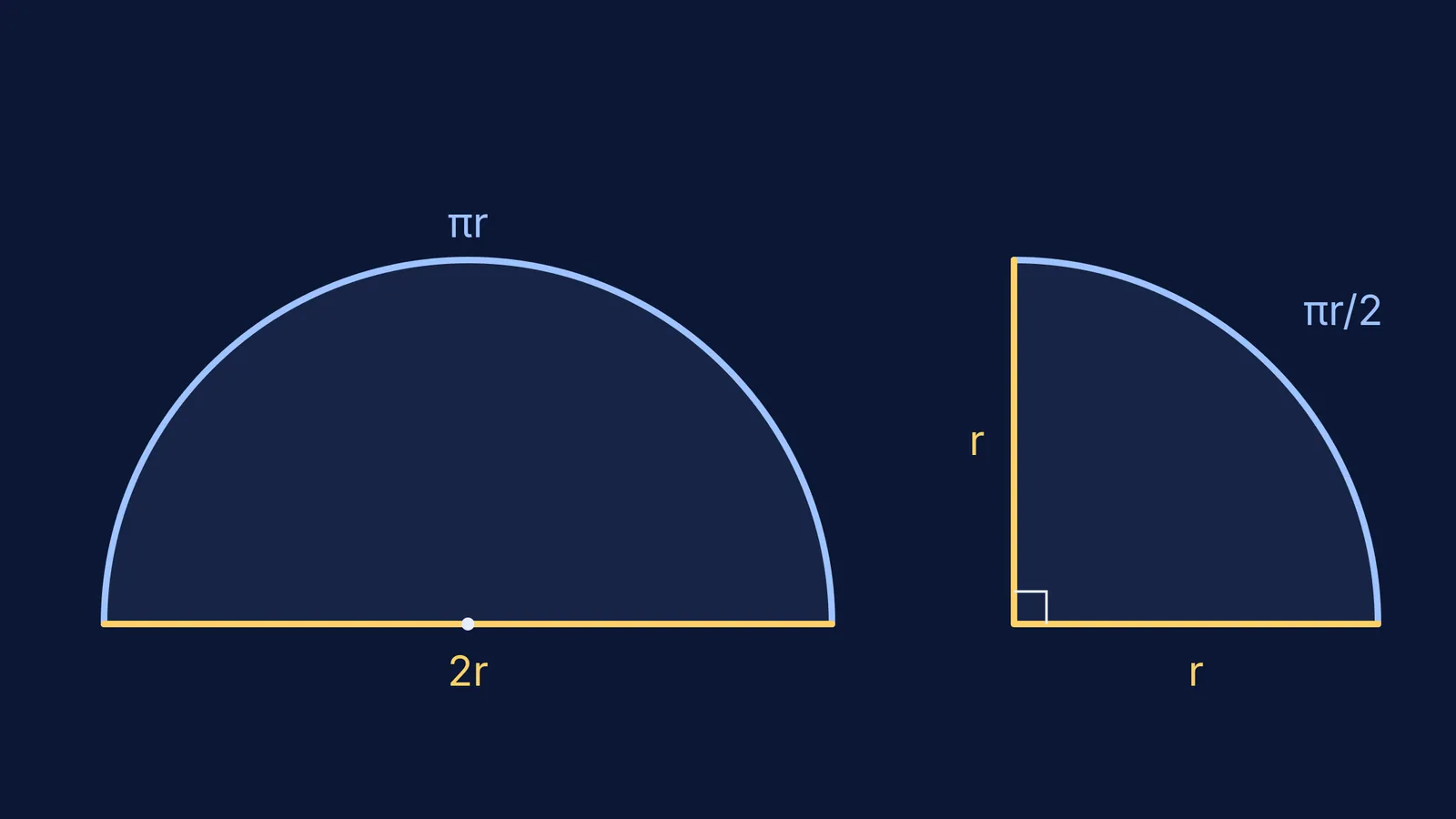
Perimeter is the total length of the boundary of a closed shape. A semicircular region is closed by two pieces: the curved arc and the straight diameter. Wolfram MathWorld calls the region bounded by a semicircle and its diameter a half-disk, and gives its perimeter as πr + 2r.
Curved part: half of 2πr, which is πr.
Straight part: the diameter, which is 2r.
Perimeter: πr + 2r = (π + 2)r, roughly 5.14r.
Worked example: a semicircular protractor has radius 7 cm. Take π = 22/7.
Arc = (22/7) × 7 = 22 cm.
Diameter = 2 × 7 = 14 cm.
Perimeter = 22 + 14 = 36 cm.
The trap answer, 22 cm, is the length of the arc alone.
Why do students write only πr?
Partly because the word itself is slippery. As Wikipedia's semicircle article notes, in strict mathematical use a semicircle is just the arc, while in everyday use the word also means the closed shape with its diameter, or the half-disk.
Exam questions settle it by what they ask. "Perimeter" of a semicircular field, window or protractor means the closed boundary, so add 2r. "Length of the arc" or "the curved part" means πr only. Read the noun before you reach for a formula.
How do you find the perimeter of a quadrant?
A quadrant is a quarter of a disc. Its arc is a quarter of 2πr, which is πr/2, and it is closed by two radii at right angles. So the perimeter of a quadrant is πr/2 + 2r.
Worked example with r = 14 cm and π = 22/7: arc = 22 cm, two radii = 28 cm, perimeter = 50 cm. Watch for 22 cm (arc only) and 36 cm (arc plus one radius). For other angles, the same idea gives the sector rule in our post on arc length and the area of a sector.
What is the perimeter of a ring-shaped track?
A full circular ring between outer radius R and inner radius r has two boundaries, the outer and inner circles, so its total boundary is 2πR + 2πr. Nothing was cut, so there are no straight edges.
Cut the ring in half, like one bend of a running track, and two straight ends appear, each of length R − r. The perimeter of a half-ring is π(R + r) + 2(R − r). With R = 21 cm, r = 14 cm and π = 22/7: 66 + 44 + 14 = 124 cm.
A real track shows why the straight pieces matter. The standard 400 m track is two semicircles of radius 36.50 m joined by two straights of 84.39 m, according to the Western Australian government's sports dimensions guide.
Around the inside edge: 2π(36.5) + 2(84.39) ≈ 229.34 + 168.78 = 398.12 m.
The official distance is measured 30 cm out from the inside edge, so the radius becomes 36.8 m, as Chalkdust magazine explains. Then 2π(36.8) + 168.78 ≈ 400.00 m.
The straights do the same job as the diameter in a semicircle. Leave them out and the lap comes up 168.78 m short.
When should you leave the diameter out?
When it is no longer on the outside. If a semicircle sits on one side of a 14 cm square, the shared side is inside the figure. The perimeter is three sides of the square plus the arc: 42 + 22 = 64 cm. Adding the diameter would count an edge you never walk along. Shaded-region questions use the same logic; see our guide to the area of a shaded region with circles and squares.
A four-step check for any curved-edge perimeter:
Sketch the shape and trace its outline with your pencil.
List every piece: each arc as a fraction of 2πr, each straight segment by length.
Cross out any edge shared with another part of the figure.
Add what is left and write the unit.
If you keep getting the arc right and the total wrong, the Fermi Problem Library has worked problems with a step-by-step solver that explains the reasoning rather than printing an answer, so you can see which edge went missing. And if the πr part itself feels like a rule you memorised rather than understood, start with why circumference is π times diameter or the circle lessons in the Fermi Concept Library.
Next time you see "perimeter" next to a curve, walk the whole boundary before you write a single π.


