On this page
Volts are printed on batteries and chargers, but few of us stop to ask what the number counts. In simple words, a volt tells you how much energy each coulomb of charge gains or gives up between two points. Here is the textbook definition and one NCERT numerical worked line by line.
What is potential difference?
NCERT's Class 10 Science textbook, Chapter 11 (Electricity), defines the electric potential difference between two points in a circuit as the work done to move a unit charge from one point to the other (NCERT Class 10 Science, Chapter 11). In symbols, V = W/Q, where W is work in joules and Q is charge in coulombs.
The chapter compares this to water, which flows along a tube only when one end is joined to a higher tank. Electrons in a wire likewise move only if there is a difference of "electric pressure" along it, which a cell's chemical action produces. If you want to see why a difference is needed at all, read can current flow without a potential difference.
The key word in the definition is "per". Potential difference is not the total energy a battery holds. It is the energy handed to each coulomb that passes.
What does 1 volt mean in simple words?
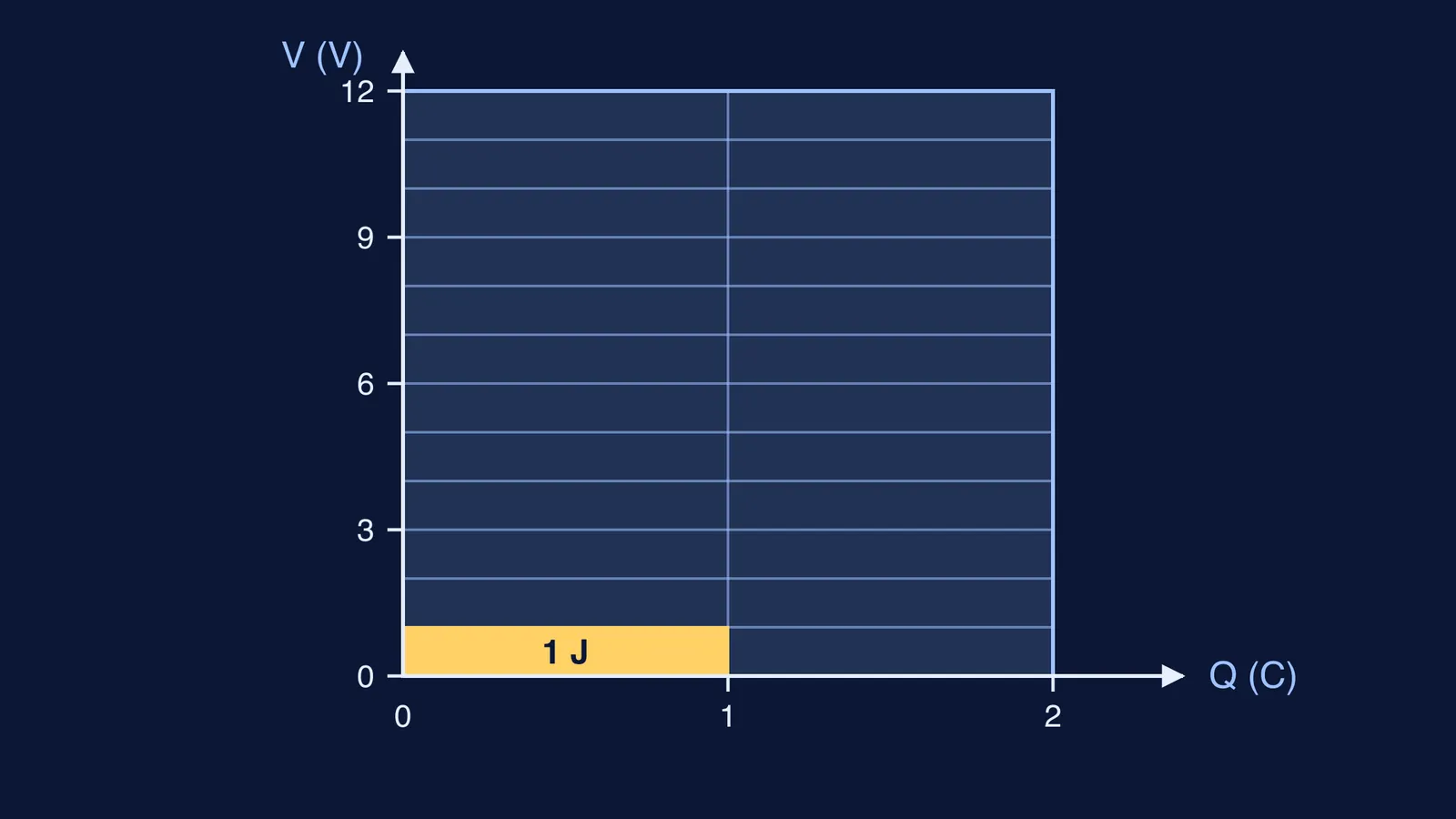
One volt is the potential difference between two points when 1 joule of work is done to move 1 coulomb of charge from one point to the other, so 1 V = 1 J/C (NCERT, Chapter 11).
Read it as a rate, like rupees per kilogram at a sabzi market. A 6 V battery gives 6 joules to every coulomb that passes through it, and 12 V means 12 joules per coulomb. That is the answer to one of the chapter's own in-text questions: how much energy is given to each coulomb of charge passing through a 6 V battery? Six joules.
A coulomb is a lot of charge. NCERT says it is the charge contained in nearly 6 × 10^18 electrons (NCERT, Chapter 11). The charge on one electron is exactly 1.602176634 × 10^-19 C (NIST CODATA value of the elementary charge). So a single electron crossing 1 V gains or loses only 1.602176634 × 10^-19 J, an amount physicists call one electron volt (NIST CODATA electron volt-joule relationship). You will meet this again in Class 12 when you find the speed of an electron accelerated through a potential difference.
How do you solve an NCERT numerical on work, charge and voltage?
NCERT Example 11.2 asks: how much work is done in moving a charge of 2 C across two points having a potential difference of 12 V (NCERT, Chapter 11)?
Write what is given, with units: Q = 2 C, V = 12 V.
Write what is asked: W, in joules.
Start from the definition, V = W/Q, and rearrange it: W = VQ.
Substitute with units: W = 12 V × 2 C.
Simplify the units: 1 V × 1 C = (1 J/C) × 1 C = 1 J.
Answer: W = 24 J.
Now read the answer back in words: each of the 2 coulombs needs 12 joules, so the total is 24 joules. If you got 6, you divided instead of multiplying, and the units warn you: 12 V ÷ 2 C gives volts per coulomb, not joules.
Which mistakes cost marks in voltage numericals?
Treating volts as energy. Voltage is energy per coulomb; the energy is V × Q.
Using current where the formula needs charge. If a question gives current and time, find Q = It first. NCERT Example 11.1 does this for 0.5 A flowing for 10 minutes: convert to 600 s, and Q = 300 C (NCERT, Chapter 11).
Rearranging from memory. Start from V = W/Q every time instead of a remembered triangle.
Dropping units halfway. Writing "12 V × 2 C" lets the joule appear on its own.
Can you solve three variations?
A charge of 5 C moves across a potential difference of 3 V. Find the work done.
60 J of work moves 10 C between two points. Find the potential difference.
Take the 300 C from Example 11.1 (NCERT, Chapter 11) and send it across 6 V. Find the work done.
Answers: 15 J, 6 V and 1800 J. In the third, the extra step is finding Q before you use W = VQ. For another unit puzzle in the same spirit, try converting battery mAh to coulombs and moles of electrons.
Where can you practise more?
If a numerical goes wrong because you picked the wrong formula, the Fermi Problem Library has worked problems with a step-by-step solver that explains the reasoning rather than printing an answer. If charges moving "downhill" through a potential difference still feels abstract, the Fermi Simulation Lab has interactive simulations for ideas that are easier to see than to read.
Next time you pick up a battery, read its voltage out loud as joules per coulomb.