On this page
Most people think a camel's hump holds water. It doesn't, and the real answer links three chapters: nutrition, excretion and body temperature.
Is a camel's hump full of water?
No. The San Diego Zoo Wildlife Alliance fact sheet on camels describes the hump as fibrous tissue and fat, and states plainly that it is not used for water storage.
The hump is an energy store. When food is short, the camel breaks down that fat for energy, and the hump shrinks.
So where did the water myth come from? Partly from a real piece of chemistry: burning fat does produce water.
How much water does burning fat make?
Here is a worked example you can check with a calculator. Take tripalmitin, a typical fat, with the formula C51H98O6. Its complete oxidation is:
2 C51H98O6 + 145 O2 → 102 CO2 + 98 H2O
Molar mass of tripalmitin: 51 × 12.011 + 98 × 1.008 + 6 × 15.999 = about 807 g per mole.
Each mole of fat gives 49 moles of water: 49 × 18.015 = about 883 g.
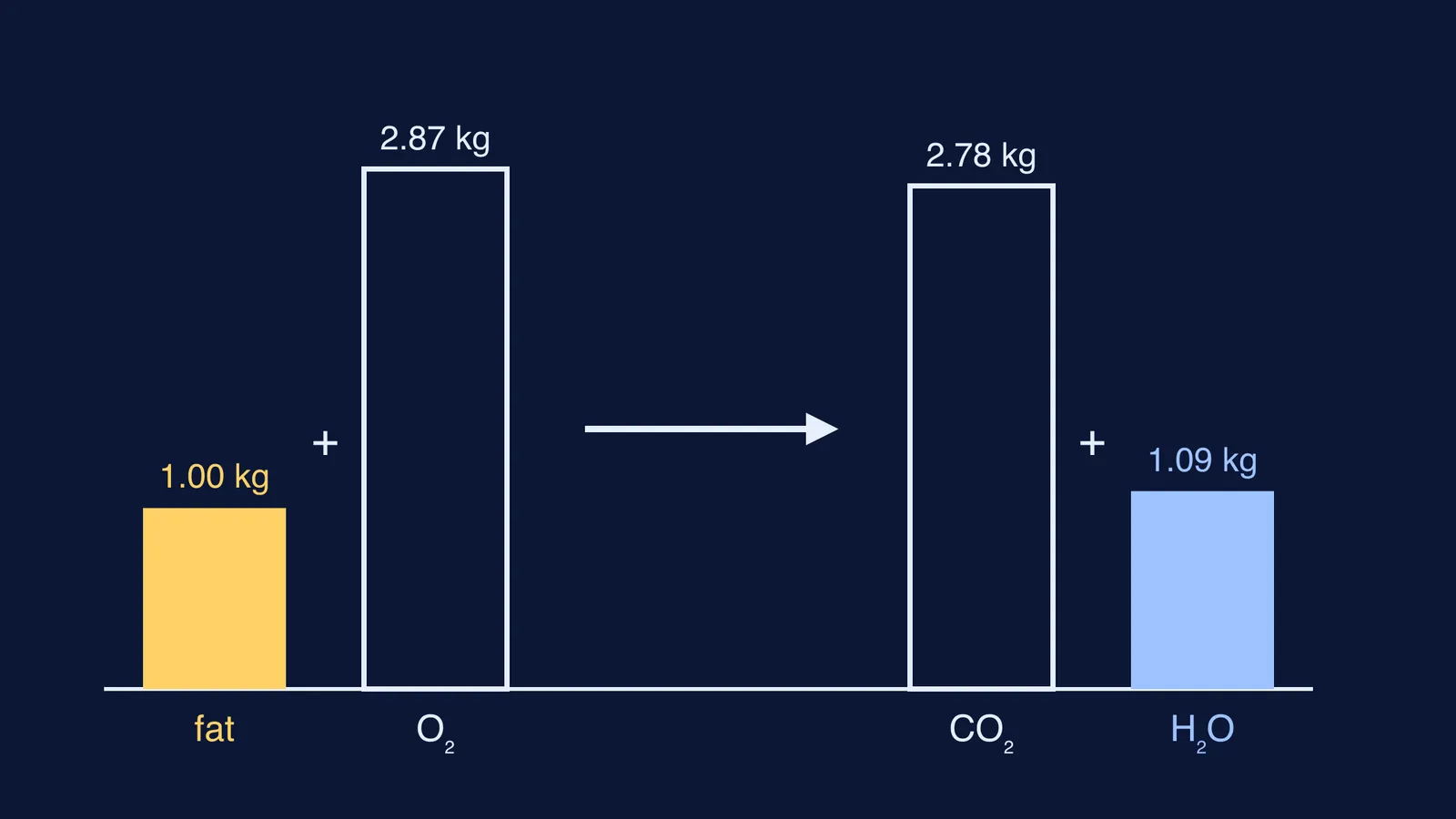
So 1 kg of fat gives about 883 ÷ 807 = 1.09 kg of water.
The same 1 kg of fat needs 72.5 moles of O2 per mole of fat, which is about 2.87 kg of oxygen.
That last line is the catch. To get oxygen, a camel has to breathe, and every breath out carries water vapour. So the water made from fat comes with a breathing cost, which is one reason the hump is not treated as a water tank.
Camels cut that cost with their noses. A study by Knut Schmidt-Nielsen, R. C. Schroter and A. Shkolnik, Desaturation of exhaled air in camels, found that in camels deprived of drinking water, exhaled air at night was at or near the outside air temperature, and its humidity could fall to about 75% relative humidity. Together, cooling and drying can save about 60% of the water compared with breathing out saturated air at body temperature.
How do a camel's kidneys save water?
In a classic Sahara study, Water balance of the camel, Bodil and Knut Schmidt-Nielsen and colleagues found camels could tolerate losing water equal to 30% of their body weight, passed only 0.5 to 1 litre of urine a day on a diet of dates and hay, and kept one camel on dry food without drinking for 17 days in summer.
That urine is very concentrated. When R. Yagil and G. M. Berlyne measured five female dromedaries after 10 days without water, their urine reached a mean maximum of 1,466 mosm/kg, and the highest single value was 2,372 mosm/kg.
A 2020 study of dromedary kidneys in Heliyon describes a thick renal crest with large numbers of long loops of Henle and vasa recta, and cites a relative medullary thickness of 7.89 for the dromedary. Longer loops build a stronger salt gradient in the medulla, so more water leaves the collecting ducts before urine forms. If the countercurrent idea is still fuzzy, read how Jacob Henle's loop concentrates urine.
Why does a camel let its body temperature swing?
Most mammals hold their body temperature within a narrow range. Camels bend the rule. In Body temperature of the camel and its relation to water economy, the same Schmidt-Nielsen team reported resting rectal temperatures from about 34°C to more than 40°C, with daily swings above 6°C in water-deprived camels in summer.
Here is why that saves water. A camel that starts the day cool can soak up heat for hours before it has to sweat. A hotter body also gains less heat from hot air. At night, the stored heat is given off without spending water. Their fur also blocks heat from the surroundings.
Ideas like countercurrent exchange and heat storage are easier to see than to read, which is what the interactive simulations in the Fermi Simulation Lab are for.
How do you write this in a biology exam?
For a three-mark question such as "How is a camel adapted to conserve water?", use one point per mark and tie each to a structure:
Hump: stores fat as an energy reserve; oxidation of fat releases metabolic water.
Kidneys: long loops of Henle and a thick medulla produce small volumes of concentrated urine.
Body temperature: allowed to rise during the day, so less water is spent on sweating; heat is lost at night.
Nose: cools and dries exhaled air, cutting water lost in breathing.
For a five-mark answer, add the numbers above with their units.
Camels also have unusual red blood cells; see why camels' red blood cells are oval. For more desert survivors, compare how desert rats, snakes and camels handle heat and little water. If a term like osmolality trips you up, the Fermi Concept Library has a lesson for every concept in biology and chemistry.