On this page
If a + b + c = 0, show that a × b = b × c = c × a. This classic vector exercise takes two lines once you know the move. Here is the proof, its geometric meaning and a numerical check.
How do you prove a × b = b × c = c × a?
You need three properties of the cross product, all stated in OpenStax Calculus Volume 3, section 2.4 (Theorem 2.6):
A vector crossed with itself is zero: a × a = 0.
The cross product is anticommutative: a × c = −(c × a).
It distributes over addition: a × (b + c) = a × b + a × c.
The move is to cross the given equation with one of the vectors, so a term vanishes.
Start with a + b + c = 0.
Cross both sides with a on the left: a × (a + b + c) = a × 0 = 0.
Distribute: a × a + a × b + a × c = 0.
Since a × a = 0, this leaves a × b + a × c = 0, so a × b = −(a × c).
By anticommutativity, −(a × c) = c × a. So a × b = c × a.
Now cross the original equation with b: b × a + b × b + b × c = 0.
Since b × b = 0, b × c = −(b × a) = a × b. So b × c = a × b.
Together, a × b = b × c = c × a. Crossing with c gives the same result a third way, a quick check on your algebra.
What does a × b = b × c = c × a mean geometrically?
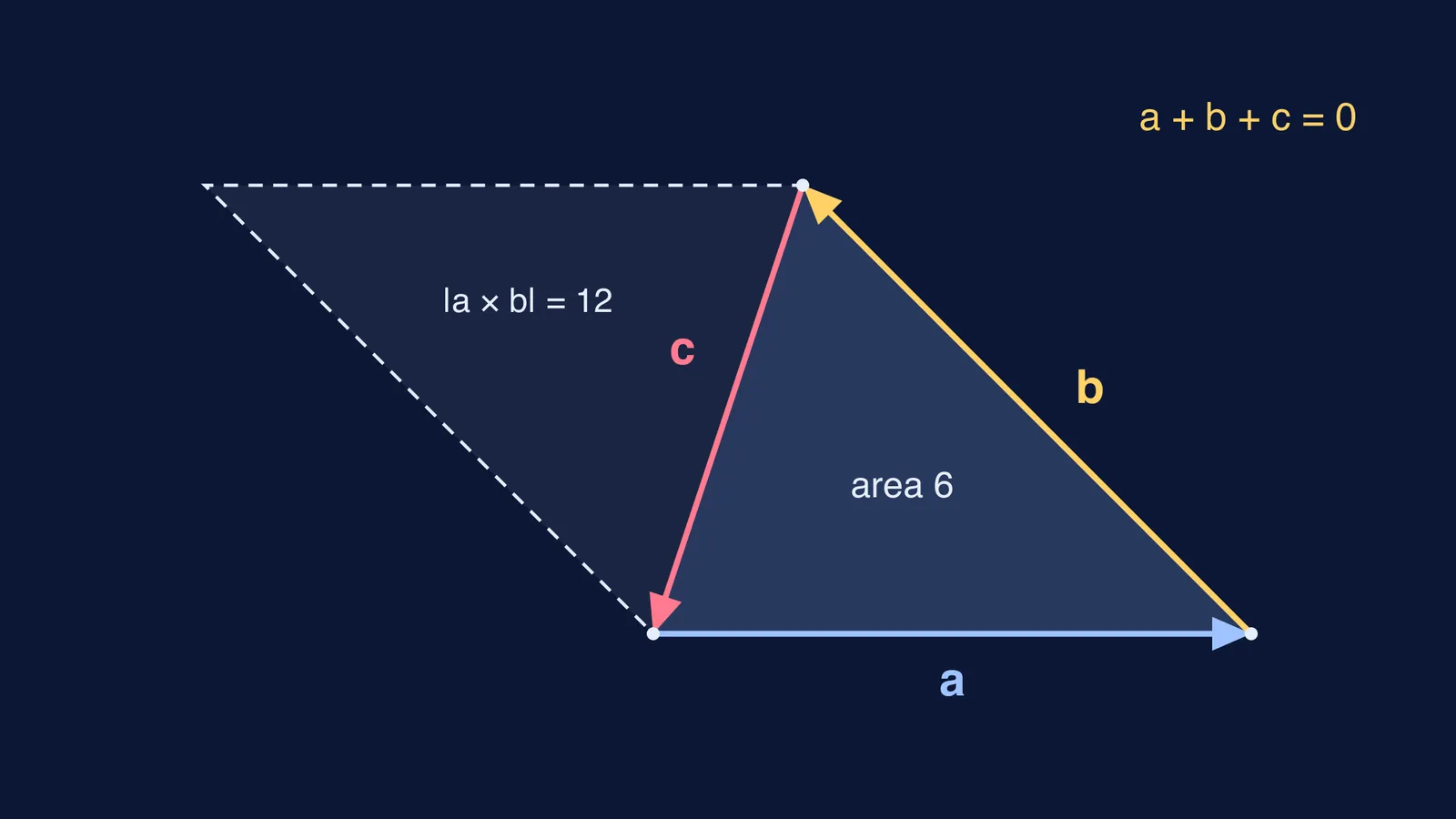
If a + b + c = 0, the three vectors placed head to tail close into a triangle (when three vectors can add to zero).
The magnitude |u × v| equals the area of the parallelogram spanned by u and v, and the triangle on two of its sides has half that area (OpenStax, Theorem 2.8 and Example 2.39). Any pair of sides, a and b, b and c, or c and a, spans a parallelogram built on the same triangle, so all three products have magnitude twice the triangle's area.
The direction matches too: going round the triangle in the order a, b, c, each product points along the same normal to its plane. The equal vectors say there is one triangle, with one area and one orientation. More on the formula: parallelogram area with cross products.
Does it work with real numbers?
Here is a check in 3D. Take a = (1, 2, 3) and b = (2, −1, 1). Then c = −(a + b) = (−3, −1, −4), so a + b + c = 0.
a × b = (2·1 − 3·(−1), 3·2 − 1·1, 1·(−1) − 2·2) = (5, 5, −5)
b × c = ((−1)(−4) − 1·(−1), 1·(−3) − 2·(−4), 2·(−1) − (−1)(−3)) = (5, 5, −5)
c × a = ((−1)·3 − (−4)·2, (−4)·1 − (−3)·3, (−3)·2 − (−1)·1) = (5, 5, −5)
All three products are equal. Their magnitude is √(25 + 25 + 25) = 5√3, about 8.66, so the triangle formed by a, b and c has area 5√3 / 2, about 4.33.
The diagram at the top is a flat case: a = (4, 0, 0), b = (−3, 3, 0), c = (−1, −3, 0). Each cross product is (0, 0, 12), and the triangle's area, ½ × base 4 × height 3, is 6.
Is the converse true?
Only partly. Suppose a × b = b × c = c × a.
From a × b = b × c you get (a + c) × b = 0, so a + c is parallel to b.
From b × c = c × a you get (a + b) × c = 0, so a + b is parallel to c.
If the common product is not zero, b and c are not parallel, and these two facts force a + b + c = 0. If it is zero, the converse fails: a = b = c = i gives every product 0, but a + b + c = 3i.
How do you practise this kind of proof?
Crossing with one vector so a term vanishes is a move you will reuse, so practise it on several problems rather than memorising one result. The Fermi Problem Library has worked problems with a step-by-step solver that explains the reasoning rather than printing an answer. If the cross product properties themselves are shaky, rebuild them first in the Fermi Concept Library.