On this page
Every summer, a high valley in Chamoli district, Uttarakhand, fills with flowers. That is what plants do when they have only a few warm weeks to grow, flower and set seed before the snow returns. Here is the ecology behind the bloom, who pollinates flowers that high up, and the species that carry the valley's name.
Why does the Valley of Flowers bloom all at once?
The short answer is time pressure. A 2021 study in Alpine Botany states that alpine plants complete their seasonal cycle during two to three snow-free months. That study, by Vorkauf and colleagues, shifted the snowmelt date on plots of alpine grassland in the Alps. In the seven main species, flowering responded strongly to when the snow melted; in three of them, day length also shaped the timing.
The valley fits that pattern. The IUCN World Heritage Outlook describes its herb communities as blooming “in profusion during the growing season” and notes that their “growth cycle is very short”.
Different species also take turns. The same IUCN page says these communities “give way to other communities later in the season”, which is why the meadow changes colour as the summer goes on.
How big and how high is the Valley of Flowers?
The Valley of Flowers National Park covers 8,750 hectares and ranges from 3,200 m to 6,590 m, according to its Key Biodiversity Area factsheet. Most of that is not meadow. IUCN records that about 73% of the park is perpetual snow and ice, 6% is forest and 21% is alpine meadow (IUCN World Heritage Outlook).
IUCN lists 609 plant species from 277 genera and 70 families in the park, with 31 threatened species recorded. It also places the valley in a transition zone between the eastern and western Himalayan plant regions. If you are revising how India's richest areas are chosen, our explainer on biodiversity hotspots in India and the criteria behind them gives the bigger picture.
Who pollinates flowers at high altitude?
Cold limits insects. A 2018 study in Scientific Reports by Lefebvre and colleagues notes that the cross-pollination of most alpine plants depends on insects, and that how high those insects live is limited by temperature. The team sampled flower visitors from 970 m to 2,700 m in the Alps. It found that flies were the main potential pollinators from 1,500 m upward, because bees and beetles decreased rapidly above that height.
The valley's meadows sit higher than the top of that gradient, so it is reasonable to expect flies to matter there too. That is an inference, though, not a measurement from the valley itself. For how flowers attract any insect in the first place, read how flowers attract insect pollinators with signals and rewards.
Which plants and animals are named after the valley?
Two recent species descriptions tie names directly to the valley.
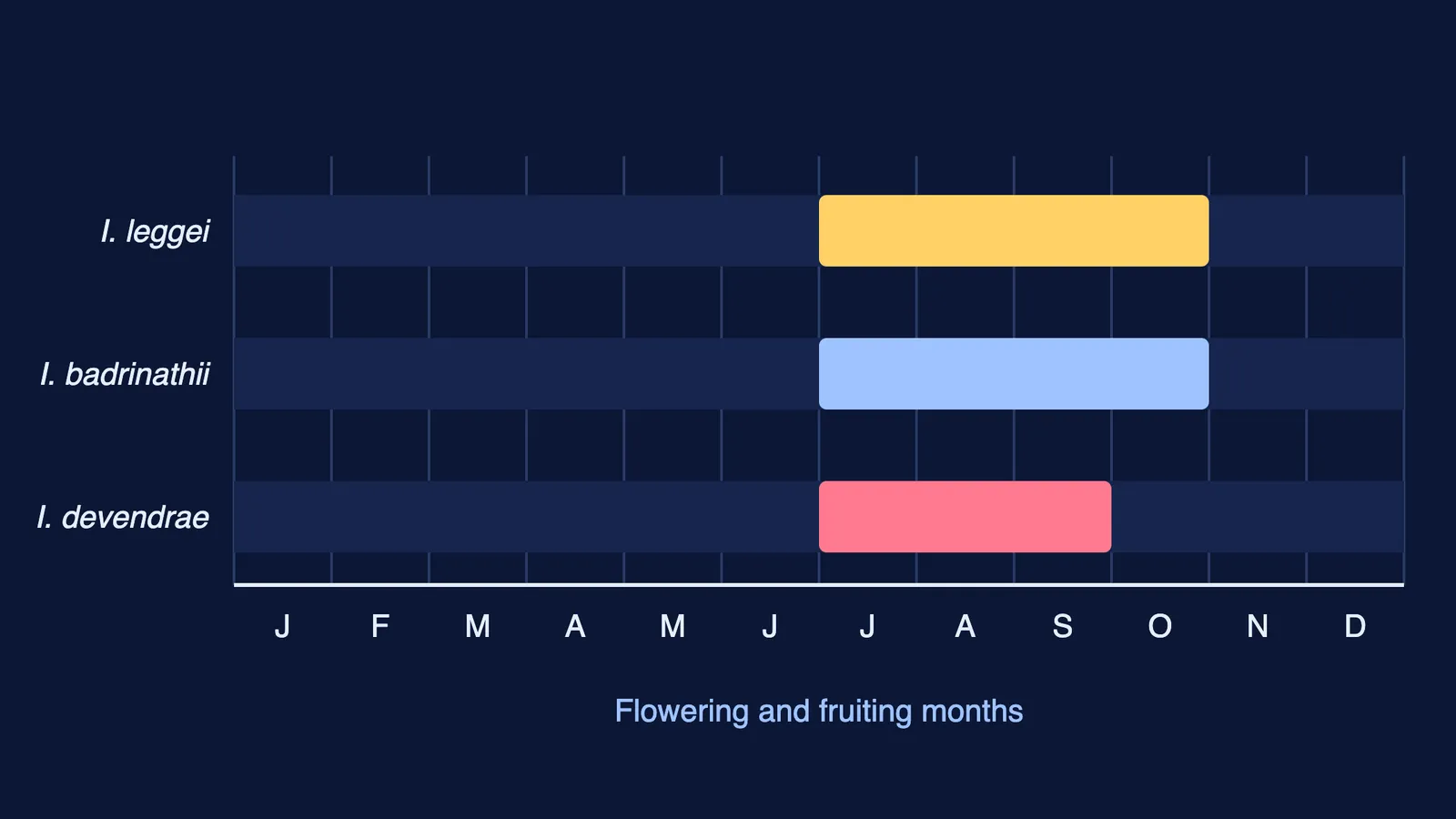
Impatiens leggei, a balsam described in Taiwania in 2010 by Pusalkar and Singh of the Botanical Survey of India. Its type specimen was collected at about 3,100 m at Ghangaria, near the Valley of Flowers National Park entrance. The paper names it for the botanist Margaret Legge, sent by the Royal Botanic Garden Edinburgh in 1939, who slipped from a rocky slope and died in the valley. It flowers and fruits from July to October.
Nandicius vallisflorum, a jumping spider described in ZooKeys in 2018. Its holotype came from 3,567 m in the valley, and its name comes from “vallis florum”, Latin for valley of flowers.
Older residents matter more for conservation. IUCN notes that the sacred Brahm Kamal (Saussurea obvallata), a threatened species, “has been particularly affected by trampling”, and it lists the blue Himalayan poppy among the globally threatened plants found in the valley (IUCN World Heritage Outlook).
How can you use the valley to revise ecology?
Here is a worked check using the two sources above.
Meadow area from the IUCN share: 21% of 8,750 ha is 0.21 × 8,750 = 1,837.5 ha, about 18 square kilometres.
The KBA factsheet gives alpine pastures as 1,863 ha. As a share: 1,863 ÷ 8,750 = 21.3%. The two sources agree.
Snow: the factsheet gives 6,358 ha under permanent snow. 6,358 ÷ 8,750 = 72.7%, which rounds to IUCN's 73%.
Then link the numbers to ideas: the short season to snowmelt and to the day-length control explained in short-day and long-day plants, and pollinators to temperature.
If a term such as phenology or pollination syndrome is shaky, the Fermi Concept Library has a lesson for every concept in biology, each placed on a map of related ideas. If you are not sure where to start on ecology, Fermi's AI tutor can work out what you already know and build a plan for the session.