On this page
Problems about two radioactive samples with different half-lives usually ask one of two things: when will the samples hold the same number of nuclei, or when will they have the same activity? Both come down to one equation and a logarithm. Here is the method, a worked example with half-lives in a 1:2 ratio, and a common trap.
What equations do you need?
You need just three results, all in the OpenStax textbook's section on radioactive decay:
Decay law: N = N0e^(−λt), where N is the number of undecayed nuclei left after time t.
Half-life and decay constant: λ = 0.693/T½, because 0.693 is ln 2.
Activity: A = λN = λN0e^(−λt), the number of decays per unit time, measured in becquerels (1 Bq is one decay per second).
The HyperPhysics decay page points out that the same exponential applies to any quantity proportional to N, so activity falls with the same half-life as the number of nuclei. If you need a refresher on why the curve is exponential, read our guide to radioactive decay and half-life.
When do two radioactive samples have equal nuclei?
Say sample 1 starts with N1 nuclei and decay constant λ1, and sample 2 starts with N2 and λ2. Set the two decay laws equal:
N1e^(−λ1t) = N2e^(−λ2t)
Divide both sides by N2e^(−λ1t) to get N1/N2 = e^((λ1 − λ2)t). Take natural logs:
t = ln(N1/N2) / (λ1 − λ2)
If you substitute λ = ln 2/T½, this becomes t = [T1T2/(T2 − T1)] × log2(N1/N2), which is often quicker when the half-lives are tidy numbers.
Check the sign before you trust the answer. For t to be positive, the sample that starts with more nuclei must also decay faster. If the bigger sample also has the longer half-life, the two curves never cross, and the honest answer is "never".
When do two samples have equal activity?
Activity is A = λN, so this time each side carries its own λ:
λ1N1e^(−λ1t) = λ2N2e^(−λ2t)
The same steps give:
t = ln(λ1N1/λ2N2) / (λ1 − λ2)
The only change is that the ratio inside the log now includes λ1/λ2. That extra factor means equal activity always comes later than equal nuclei when sample 1 decays faster. At the moment the nuclei are equal, the faster sample is still decaying more often, so its activity is still higher. For the units and what one becquerel means, see activity, becquerel and curie explained.
Worked example: half-lives in a 1:2 ratio
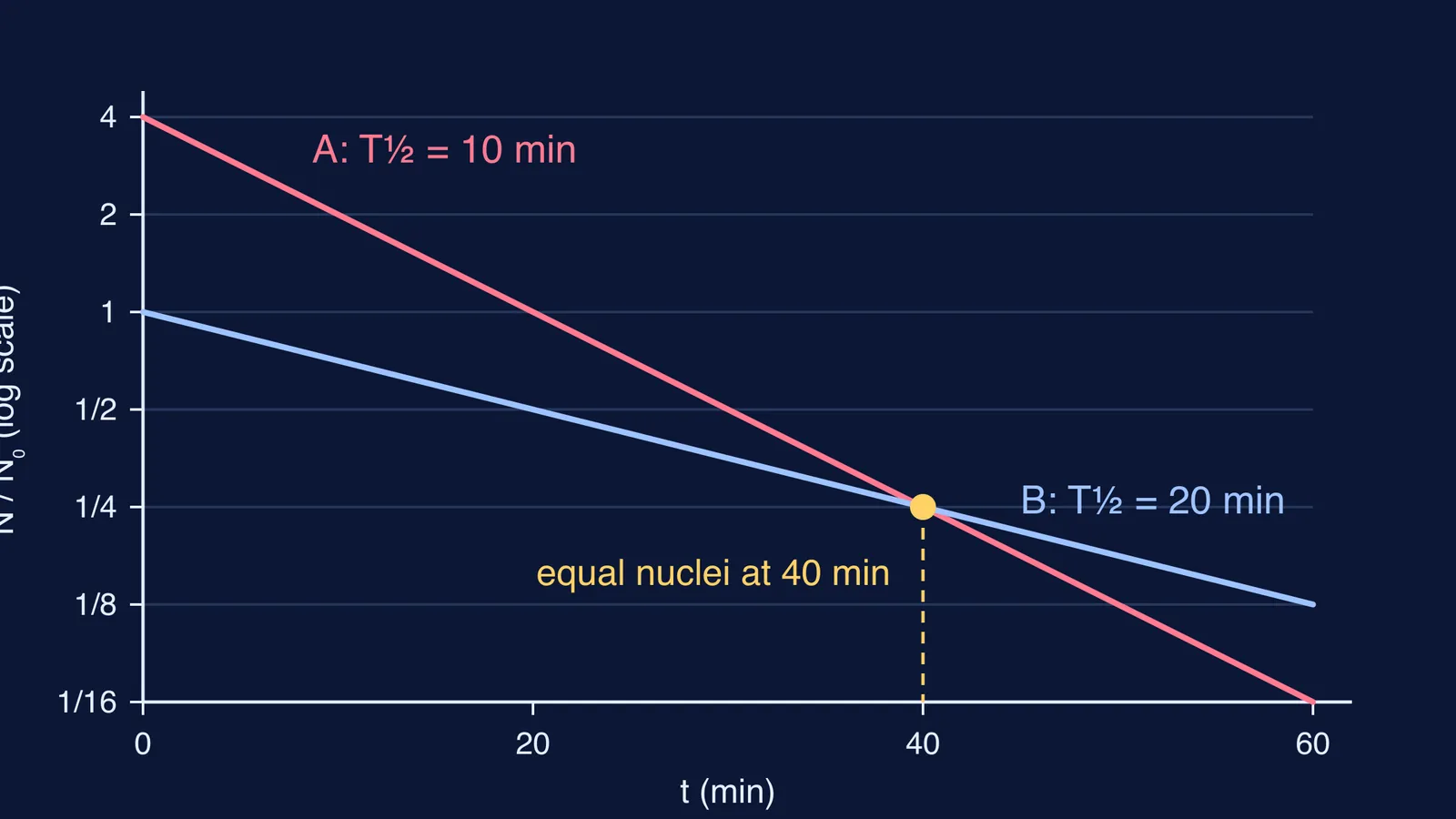
Sample A has a half-life of 10 minutes. Sample B has a half-life of 20 minutes. At t = 0, A has four times as many nuclei as B: NA = 4N0 and NB = N0.
Start with the time for equal nuclei.
Decay constants: λA = ln 2/10 per minute and λB = ln 2/20 per minute, so λA − λB = ln 2/20 per minute.
Ratio: NA/NB = 4, so ln 4 = 2 ln 2.
t = 2 ln 2 ÷ (ln 2/20) = 40 minutes.
Check by counting half-lives. In 40 minutes A goes through 4 half-lives, so 4N0/16 = N0/4. B goes through 2, so N0/4. They match.
The 1:2 ratio gives a neat way to see it. Every 20 minutes A halves twice and B halves once, so the gap between them halves. Start 4 times apart, then 2 times apart at 20 minutes, then level at 40.
Now the time for equal activity.
λA/λB = 2, so the ratio inside the log is 2 × 4 = 8, and ln 8 = 3 ln 2.
t = 3 ln 2 ÷ (ln 2/20) = 60 minutes.
Check: at 60 minutes, NA = 4N0/64 = N0/16 and NB = N0/8. Activities are λA × N0/16 = 2λB × N0/16 = λB N0/8, and λB × N0/8. They match.
How do you avoid mistakes on these questions?
Write down which quantity the question means: nuclei, mass or activity. Mass is proportional to N, so it behaves like nuclei, not activity.
Keep λ in the same time unit as the answer you want.
Check the sign of t before you write it down.
Confirm with half-life counting whenever the answer is a whole number of half-lives.
If you mixed up λ and T½, our post on mean life versus half-life sorts out the three time constants. For more practice, the Fermi Problem Library has worked problems with a step-by-step solver that explains the reasoning rather than printing an answer, and the Fermi Concept Library gives every concept in physics, chemistry, biology, mathematics and computing its own lesson and its place in the map.