On this page
Close your eyes and ask a friend to touch your fingertip with two pencil tips a few millimetres apart. You feel two points. Now ask them to do the same on your back with the tips several centimetres apart. Often you feel only one. You have just run a classic test in sensory biology, and it hints at how densely packed the touch receptors are in each patch of skin.
What is the two-point discrimination test?
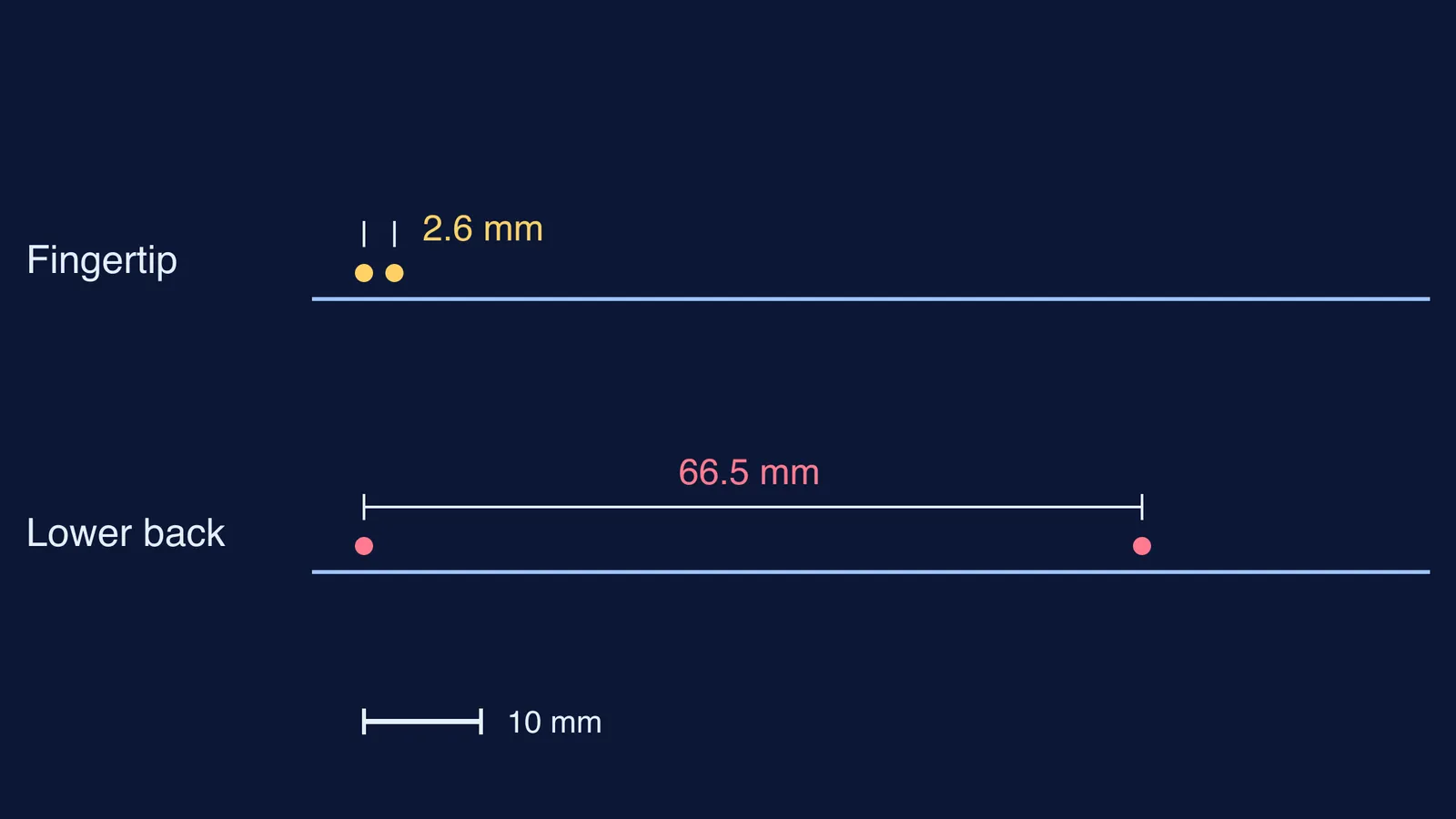
The two-point discrimination threshold is the smallest gap between two touches at which a person can still tell there are two points, not one. In healthy young adults, the threshold on the tips of the thumb, middle and little fingers was 2.6 mm, and on the arm and forearm it ranged from 30.7 to 45.4 mm (Nolan, 1982).
The back is coarser still. In 79 healthy adults aged 18 to 59, the average lower-back threshold was 67.3 mm on the right and 65.7 mm on the left (Falling and Mani, 2016). Put the two studies side by side and your lower back needs a gap roughly 25 times wider than your fingertip before it reports two touches.
Why are fingertips more sensitive than the back?
The fingertip has more touch sensors, packed closer together. Swedish researchers recorded single nerve fibres in the median nerve of awake volunteers and studied 334 touch-sensing units in the hairless skin of the hand (Johansson and Vallbo, 1979). Density rose from the palm towards the fingertips, in the ratio 1 : 1.6 : 4.2 for palm, main part of the finger and fingertip.
The same researchers estimated 241 low-threshold touch units per square centimetre at the fingertip, against about 58 in the palm (Johansson and Vallbo, 1979). Most of that difference came from units with small, sharply defined receptive fields, the patch of skin each sensor responds to.
Think of a phone camera: more pixels in the same area means finer detail. If both pencil tips land in the receptive field of the same sensors, your brain gets something close to one blurred signal. If they land on separate sensors with a quieter one between, you are more likely to feel two. A later paper, drawing on earlier recordings, related fingertip acuity to a spacing of about 1.2 mm between neighbouring SA-1 receptive fields, against 3.53 mm on the palm and 5.00 mm on the forearm (Tong, Mao and Goldreich, 2013).
A whole-body study found the fingertip was the area of highest spatial acuity for both touch and pain (Mancini and colleagues, 2014). For the layers these receptors sit in, see the structure of human skin, epidermis and dermis; for how a receptor turns pressure into a nerve signal, read about Ardem Patapoutian and the Piezo touch receptors.
How do you do the two-point test at home?
You need two pencils that are not freshly sharpened, a ruler, a partner and a notebook. Press lightly, and skip skin that is cut or sore.
The tested person closes their eyes.
The tester sets the tips at a measured gap and touches both down at the same moment.
Mix in single touches at random. The tested person answers "one" or "two".
Start wide (10 mm on the fingertip, 100 mm on the back) and narrow step by step: 1 mm at a time on the fingertip, 2 mm on the palm, 10 mm on the back.
At each gap give five two-point touches and a few single ones. Your threshold is the smallest gap where at least four of five pairs are called "two" and single touches are still called "one".
Test the fingertip, the centre of the palm and the middle of the back, then swap roles.
In one study, healthy adults scored about 80% correct on the fingertip in the traditional two-point test even with the two tips at zero separation, because two close points produce a weaker nerve response than one point pressed equally hard (Tong, Mao and Goldreich, 2013).
What do your results tell you about receptor density?
Say your palm threshold is three times wider than your fingertip threshold. If the threshold tracked the spacing between sensors, density, which counts sensors per area, would drop by about 3 x 3 = 9 times. The estimated fingertip-to-palm density ratio is 241 to 58, about 4.2 (Johansson and Vallbo, 1979).
A mismatch is not a failure. Three things blur the link:
The test measures perception, so the brain's processing adds to what receptors report.
Pencil tips are thick, so your gaps can be off by a millimetre or more.
People differ: age, body mass index and waist-to-hip ratio were each linked to the lower-back threshold (Falling and Mani, 2016).
This is a school experiment, not a health check.
If receptive fields or sensory neurons feel shaky, the Fermi Concept Library gives every biology concept its own lesson and its place in the map, so you can trace the path from fingertip receptor to nerve to brain.
Next, try finding your blind spot with a card test.