

On this page
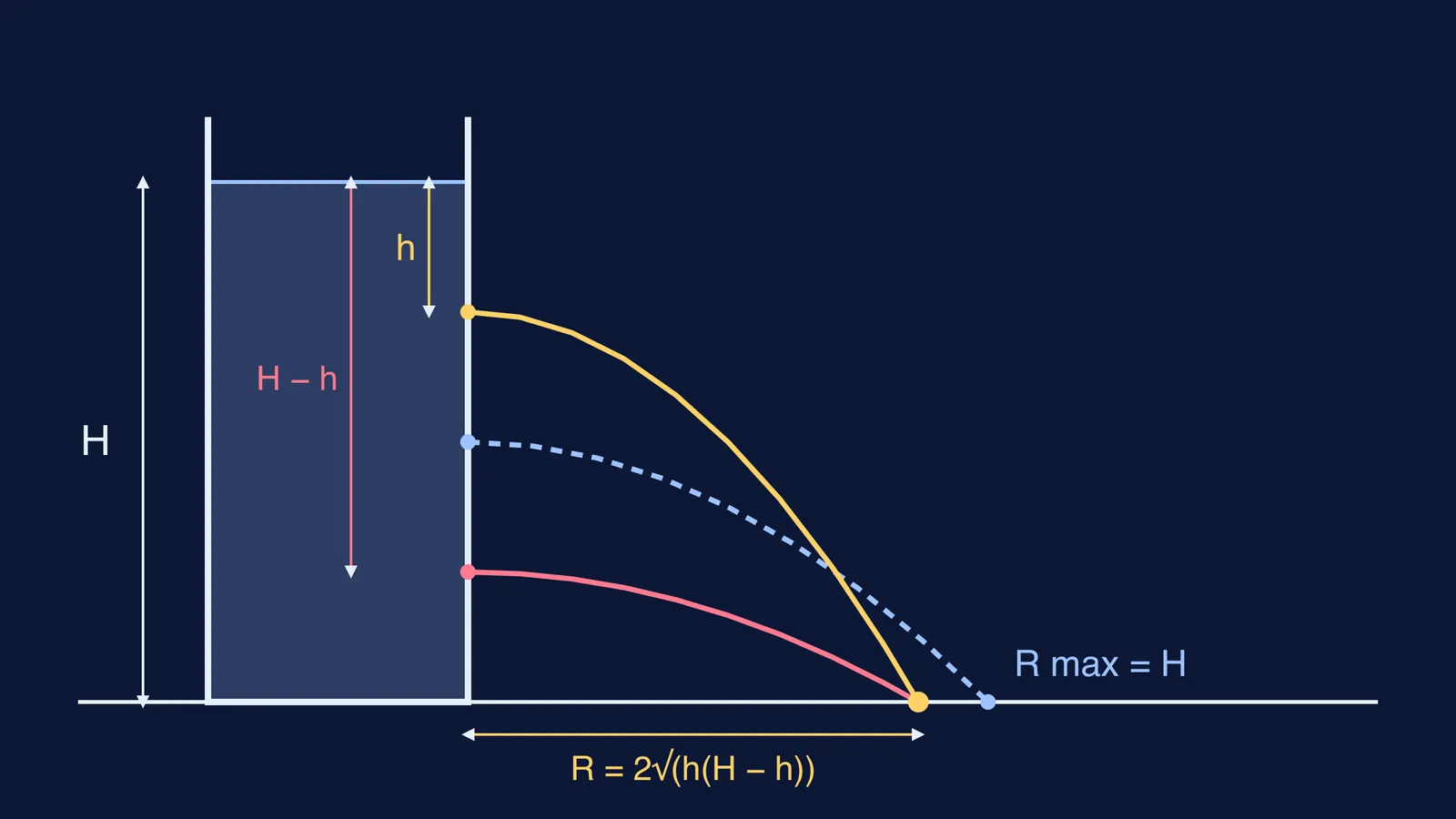
Poke two holes in a full tank: the upper jet is slow but falls for a long time, the lower jet is fast but lands almost at once. At matched heights the two effects cancel and both jets hit the same spot. It is a classic Class 11 fluids problem that takes four lines once you split it into two pieces you already know.
How fast does water leave a hole in a tank?
The speed of the jet comes from Torricelli's law. In the NCERT Class 11 Physics chapter on mechanical properties of fluids (Section 9.4.1, Eq. 9.15), the speed of efflux from a hole at depth h below the surface of an open tank is v = √(2gh), the same speed a body gains by falling freely through h. NCERT derives it from Bernoulli's equation and assumes the tank is much wider than the hole, so the water surface is nearly at rest.
Torricelli found the result in 1643, and it assumes an incompressible fluid with negligible viscosity, as the summary of Torricelli's law on Wikipedia notes. The stream narrows just outside the hole (the vena contracta), but that page says this cuts the flow rate, not the jet speed, which experiments find matches the law closely. Treat the numbers below as the ideal exam answer. For a sealed, pressurised tank, see the speed of efflux from a tank with pressure above the liquid.
How far does each jet land?
Water leaves the hole horizontally, like a ball thrown sideways off a ledge: horizontal speed stays v, and fall time depends only on the hole's height, as in a ball dropped versus a ball thrown horizontally.
Let H be the height of the water surface above the ground and h the depth of the hole below that surface. Then:
Jet speed: v = √(2gh).
Height of the hole above the ground: H − h.
Fall time: t = √(2(H − h)/g).
Range: R = v × t = √(2gh) × √(2(H − h)/g) = 2√(h(H − h)).
The g cancels, and the product h(H − h) is unchanged if you swap h and H − h.
At what heights do two holes give the same range?
Take an overhead tank on a flat roof with water 2.0 m deep, and use g = 9.8 m/s². Make one hole 0.5 m below the surface.
Upper hole, depth 0.5 m: v = √(2 × 9.8 × 0.5) ≈ 3.13 m/s. It is 1.5 m above the roof, so t = √(2 × 1.5 / 9.8) ≈ 0.553 s. Range ≈ 3.13 × 0.553 ≈ 1.73 m.
Partner hole, depth 2.0 − 0.5 = 1.5 m: v = √(2 × 9.8 × 1.5) ≈ 5.42 m/s. It is 0.5 m above the roof, so t = √(2 × 0.5 / 9.8) ≈ 0.319 s. Range ≈ 5.42 × 0.319 ≈ 1.73 m.
The range formula derived on Wikipedia agrees: 2√(0.5 × 1.5) ≈ 1.73 m. The lower jet is about 1.7 times faster; the upper jet flies about 1.7 times longer.
This is the same symmetry as projectiles launched at 30° and 60°, which you can see in why complementary angles give the same projectile range.
Which hole throws water the farthest?
For a fixed sum h + (H − h) = H, the product h(H − h) is largest when the two parts are equal. So the farthest jet comes from the hole at depth H/2, halfway up the water column, and its range is 2√((H/2)(H/2)) = H. The Wikipedia derivation of the jet's range reaches the same result: maximum range with the hole at half the liquid height, equal to the height of the liquid.
In the 2.0 m tank, a hole 1.0 m down throws water 2.0 m. Every shorter range comes in a matched pair: one hole above the middle, one the same distance below.
A quick check before you write the answer
Did you measure h from the free surface, not from the bottom?
Is H the height of the surface above the landing level?
Is the partner depth H − h, and does your range formula come out symmetric?
Is the maximum-range hole at H/2, with range H?
If your working breaks at the fall-time step, the Fermi Problem Library has worked problems with a step-by-step solver that explains the reasoning rather than printing an answer. If pictures help you more than algebra, the Fermi Simulation Lab has interactive simulations for ideas that are easier to see than to read.
Next time a tank problem asks for a second hole, write R = 2√(h(H − h)) first and the answer is H − h.


