

On this page
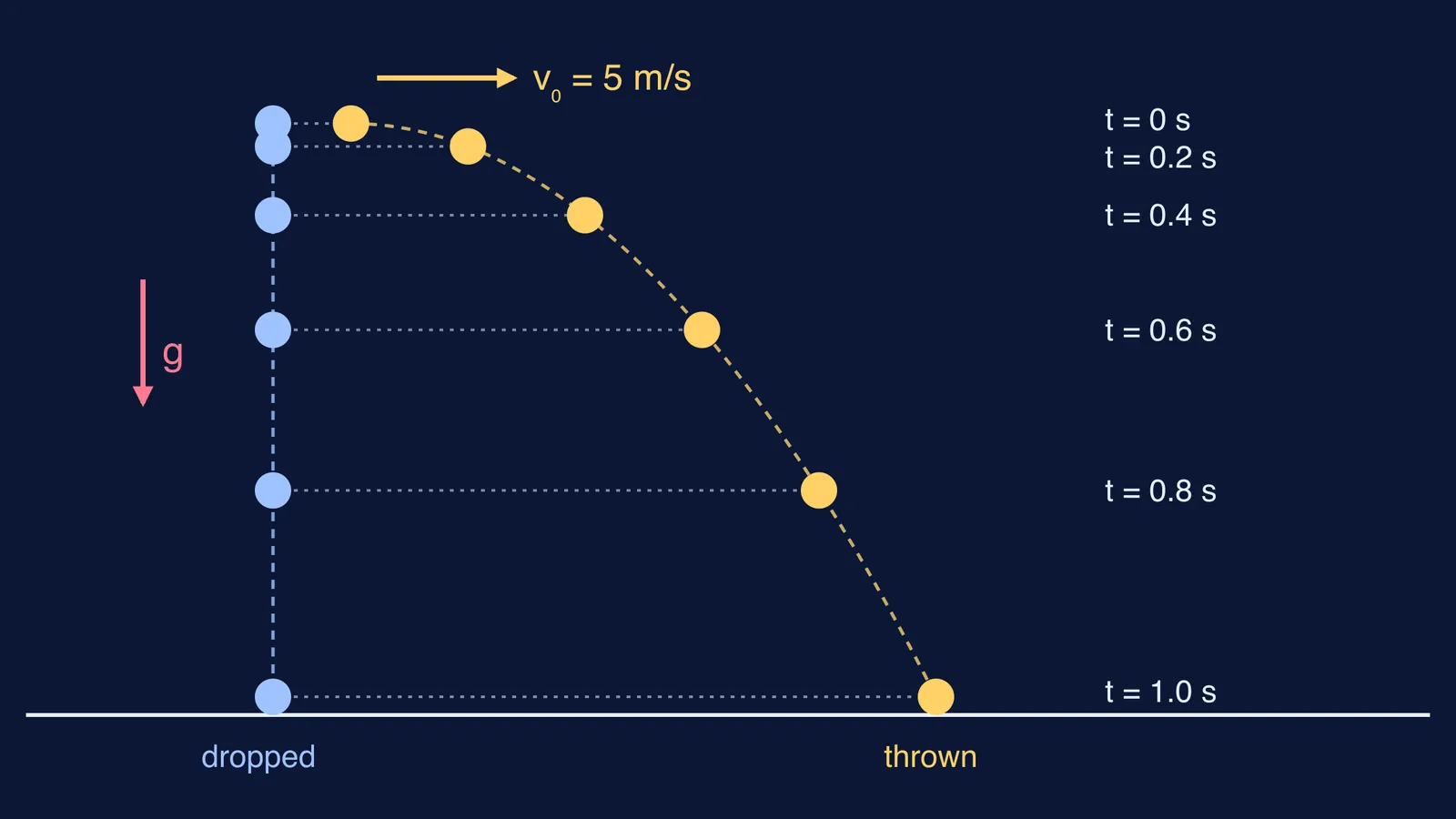
Flick one ball sideways off a table and let another simply fall at the same instant. Many students guess the dropped ball wins because its path is "shorter". It does not. Both land together, and the reason is one of the most useful ideas in Class 11 kinematics.
Why do both balls land at the same time?
The key rule is that motion along perpendicular directions can be handled separately. The OpenStax *University Physics* chapter on projectile motion puts it plainly: "motions along perpendicular axes are independent and thus can be analyzed separately".
Now apply that to each direction, using the same OpenStax chapter, which neglects air resistance:
Horizontal: gravity acts straight down, so the horizontal acceleration is zero. The thrown ball keeps its sideways speed the whole way down. The dropped ball has no sideways speed at all.
Vertical: both balls have acceleration g downward, about 9.8 m/s², and both start with zero vertical velocity.
So vertically the two balls do exactly the same thing: same height, same starting vertical velocity, same acceleration. They must reach the floor together.
The exact standard value of g is 9.80665 m/s², as listed by NIST; textbooks round it to 9.8 m/s².
Has anyone actually tested it?
Yes, and you can hear the result. In the UCSB lecture demonstration "Simultaneous release", a spring device shoots one billiard ball horizontally while releasing a second ball to drop straight down. The demonstration notes tell the instructor to ask the class to listen: because the balls arrive together, the room hears a single crack when they hit the floor, whichever launch setting is used.
You can try a rough version at home: flick one coin off a desk edge while nudging a second coin off to fall straight down at the same instant, and listen for one click, not two.
How do you work it out? A worked example
A ball rolls off a 1.25 m high table at 4 m/s. A second ball is dropped from the same table edge at the same moment. Take g = 9.8 m/s² and ignore air resistance, as the OpenStax projectile chapter does.
Vertical motion, both balls. Using y = y₀ + v₀ᵧt − ½gt² with v₀ᵧ = 0, the fall is h = ½gt². So 1.25 = 4.9t², giving t² ≈ 0.255 and t ≈ 0.51 s. This is the same for both balls.
Horizontal motion, thrown ball. With no horizontal acceleration, distance = speed × time = 4 × 0.51 ≈ 2.0 m from the foot of the table.
Horizontal motion, dropped ball. Zero sideways speed, so it lands right at the foot of the table.
Landing speeds. Both arrive with the same vertical velocity, √(2gh) = √(2 × 9.8 × 1.25) ≈ 4.9 m/s. The thrown ball also still has its 4 m/s sideways, so its total speed is √(4² + 4.9²) ≈ 6.4 m/s. Same landing time, different landing speed.
If you want more practice of this kind, the Fermi Problem Library has worked problems with a step-by-step solver that explains the reasoning rather than printing an answer, so you can check whether you split the motion into x and y the right way.
When does the rule stop working?
The result depends on its conditions. Check these before you use it in an exam:
Thrown at an angle, not horizontally. A ball thrown slightly upward has a positive starting vertical velocity and lands later; one thrown slightly downward lands sooner. The rule needs zero starting vertical velocity for both.
Different heights or uneven ground. Equal times need equal vertical drops.
Air resistance. Real air drag can change fall times, especially for light or fast objects. We explain that case in whether air resistance makes a ball take longer to fall.
A moving launch point. A packet released from a moving aeroplane already has the plane's horizontal speed, which is the same idea in disguise; see where a bomb dropped from a moving aeroplane lands.
A related trap is thinking the vertical acceleration changes during flight. It is g the whole way, even at the top of an upward throw, as we show in why acceleration is not zero when a thrown ball reaches the top.
A quick checklist for projectile questions
Draw the x and y axes and mark the starting point.
Split the initial velocity into horizontal and vertical parts.
Solve the vertical motion first to get the time.
Use that time in the horizontal motion to get the range.
Combine the components only at the end, if the question asks for speed or direction.
If the split into x and y still feels shaky, start with the idea itself in the Fermi Concept Library, where each concept has its own lesson and its place in the map.


