

On this page
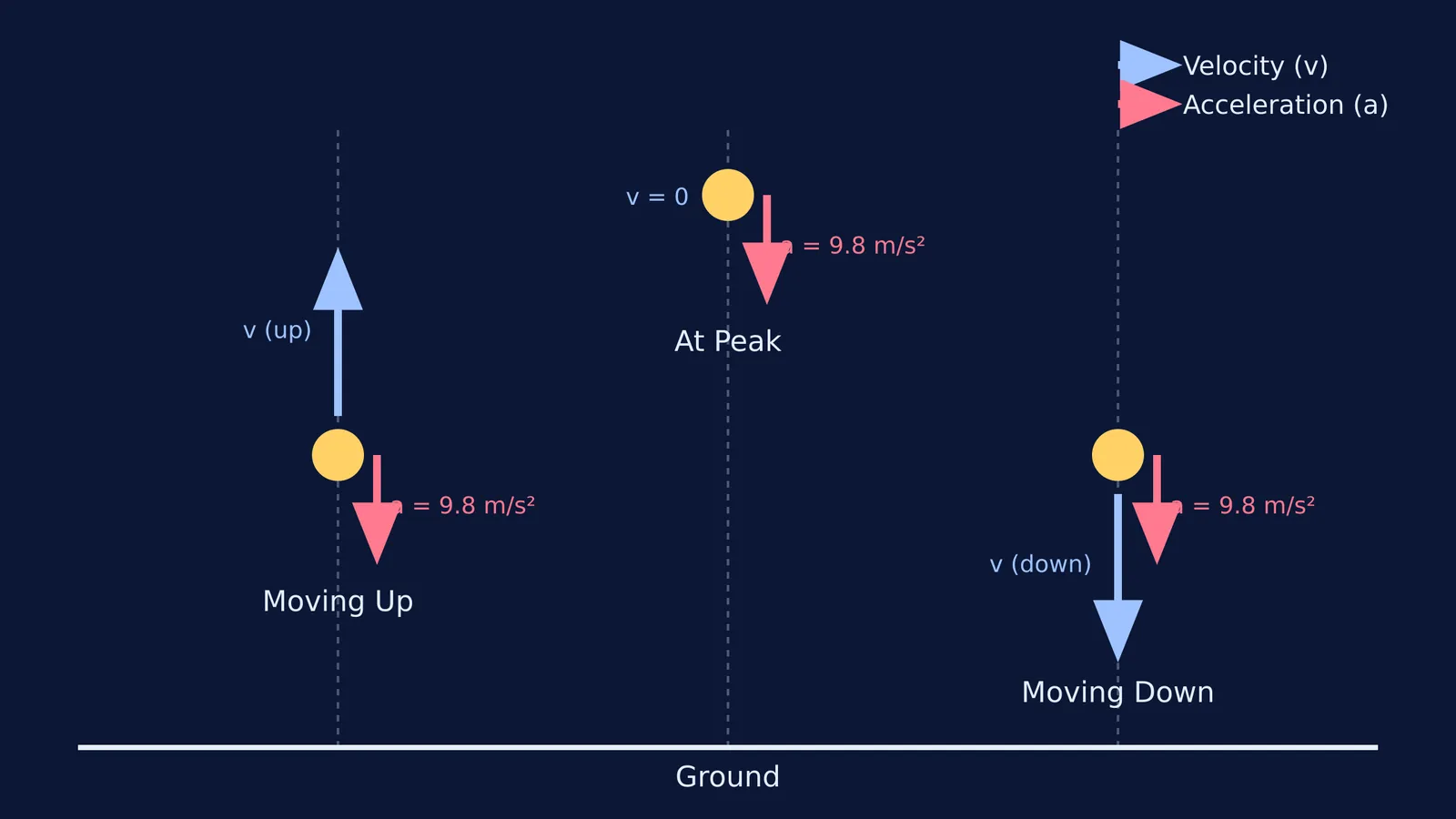
When you throw a ball straight up into the air, it slows down, stops for a split second at its maximum height, and then falls back down. Because the ball is momentarily motionless at the peak, it is easy to assume that all its motion-related properties—including acceleration—have also dropped to zero.
But physics does not work that way. The velocity is zero, but the acceleration is not. Here is why gravity continues to act even when the ball stops moving.
Why does the velocity become zero?
Velocity is a measure of how fast an object is changing its position, and in which direction. When you toss a ball upward, you give it a positive initial velocity.
As soon as the ball leaves your hand, it is in free fall. In physics, free fall means that gravity is the only significant force acting on the object (OpenStax University Physics). Gravity pulls downward, acting in the opposite direction to the ball's upward motion. This causes the ball to slow down steadily until its upward velocity runs out completely.
At the exact peak of its trajectory, the velocity reaches 0 m/s. The ball is changing its direction from moving up to moving down, and to reverse direction, it must pass through zero.
Why is acceleration not zero at the top when velocity is zero?
Acceleration is not about how fast you are going; it is the rate at which your velocity is changing.
According to OpenStax University Physics, the acceleration of an object in free fall is 9.8 m/s² everywhere, even when the velocity is zero at the top of its path. Although the velocity is zero at that exact instant, it is changing at the rate of 9.8 m/s² downward.
Think about what would happen if the acceleration were actually zero at the highest point. If both velocity and acceleration were zero, the ball's velocity would stop changing entirely. It would never become negative, meaning the ball would simply hover in mid-air forever. Because the ball begins to fall immediately after stopping, its velocity is clearly still changing, which means the acceleration must be non-zero.
The difference between velocity and acceleration
A common reason students struggle with this concept is that we often use "speeding up" and "accelerating" interchangeably in everyday language. If a car is stopped at a red light, its speed is zero and its acceleration is zero. When the light turns green, the driver presses the pedal, and the car accelerates to increase its velocity.
In physics, however, acceleration is simply any change in velocity. Because velocity is a vector, it has both a magnitude (speed) and a direction. A change in speed, a change in direction, or a change in both all count as acceleration.
When the ball is at the top of its flight, its speed is zero, but its direction is actively flipping from upward to downward. The gravitational force from the Earth is constantly pulling on the ball, ensuring that this change happens smoothly. If the Earth's gravity suddenly switched off at the exact moment the ball reached the peak, the acceleration would become zero, and the ball would indeed float there indefinitely. But since gravity never stops pulling, the acceleration remains a constant downward 9.8 m/s² (OpenStax University Physics) from the moment the ball leaves your hand until it hits the ground.
If you find it hard to picture how velocity and acceleration behave independently, the Fermi Concept Library breaks down these foundational physics ideas step by step so you can see the difference.
A worked example: tracking the numbers
The easiest way to see why acceleration remains constant is to trace the ball's velocity second by second.
Imagine you throw a ball straight up with an initial velocity of 19.6 m/s. As described in OpenStax University Physics, gravity reduces this velocity by 9.8 m/s every second.
At 0 seconds: Velocity is 19.6 m/s (moving up fast).
At 1 second: Velocity is 9.8 m/s (moving up slower).
At 2 seconds: Velocity is 0 m/s (the ball is at the top).
At 3 seconds: Velocity is -9.8 m/s (the ball is moving down).
Between second 1 and second 2, the velocity dropped by 9.8 m/s. Between second 2 and second 3, the velocity again dropped by 9.8 m/s. The change in velocity is steady and constant throughout the entire flight, right through the turnaround point.
How this applies to exam kinematics
For students preparing for exams like JEE Main or NEET-UG, the top of a trajectory is your most useful anchor point for solving problems. Because you know that v = 0 at the maximum height, you can use standard kinematic equations—such as v = u + at or v² = u² + 2as—to find the initial speed, the time taken to reach the top, or the total height. If you need to find how far the ball travels right before or after it turns around, you can use the formula for the distance in the nth second.
When solving kinematics problems, getting the signs of velocity and acceleration right is where most students trip up. If you are stuck on a textbook question and keep dropping minus signs, you can run it through the Fermi Problem Library to see the step-by-step reasoning rather than just checking a printed answer.
Finally, remember that this zero-velocity rule only applies strictly to objects thrown straight up. If a ball is thrown at an angle, it follows a parabolic curve (which you can model using the equation of trajectory of a projectile). In a parabolic arc, the vertical velocity is zero at the peak, but the ball continues to move forward, so its total velocity is not zero. However, the acceleration remains exactly the same—9.8 m/s² straight down (OpenStax University Physics)—which determines the radius of curvature of a projectile's path at the top of the curve.


