On this page
Pure water has exactly one temperature and pressure at which ice, liquid and vapour sit together in balance. That is why it anchored the kelvin from 1954 until 2019.
What is the triple point of water?
The triple point of water is the condition where solid, liquid and vapour coexist, used because it is unique and can be precisely reproduced (IAPWS).
In 1954 the General Conference on Weights and Measures made it the fundamental fixed point and assigned it 273.16 kelvin exactly (CGPM 1954, Resolution 3).
The vapour pressure at the triple point was measured at the US National Bureau of Standards as 611.657 Pa ± 0.010 Pa, counting random errors only (Guildner, Johnson and Jones, 1976). That is about 0.61 kPa, well under 1% of one standard atmosphere, 101 325 Pa (NIST Guide to the SI).
Why do 273.16 K and 0.61 kPa fix a unique state?
The Gibbs phase rule says F = C − P + 2, where F counts the variables you can change freely, C the components and P the phases (LibreTexts, Criterion for Phase Equilibrium/08%3A_Phase_Equilibrium/8.03%3A_Criterion_for_Phase_Equilibrium)). For pure water C = 1, so F = 3 − P.
One phase: F = 2. Temperature and pressure vary independently, giving a region.
Two phases: F = 1. Pick the temperature and the pressure is fixed, giving a line.
Three phases: F = 0. Nothing is free, giving a single point.
Zero freedom is what a standards lab wants: build the state and the temperature is set for you.
How do you read the phase diagram of water?
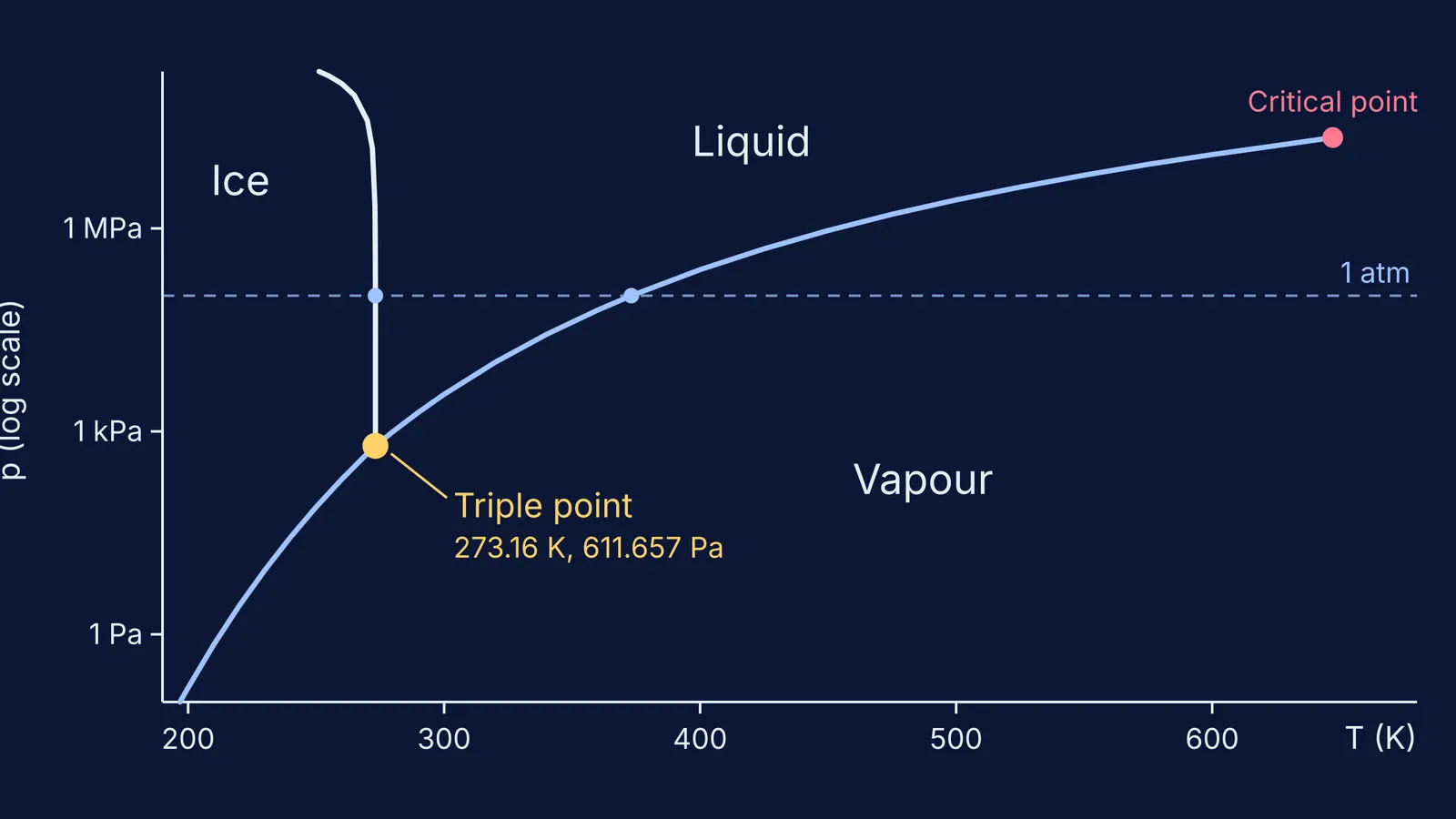
In the diagram above (log pressure against temperature), three curves meet at the triple point.
Sublimation curve (lower left): ice turns straight into vapour. Below 611.657 Pa, liquid water cannot exist stably at any temperature.
Vapour-pressure curve (rising right): liquid and vapour coexist, up to the critical point at 647.096 K and 22.064 MPa (IAPWS SR1-86). At one atmosphere water boils at about 99.974 °C, not exactly 100 °C (IAPWS FAQ). To calculate along it, use the Clausius-Clapeyron equation for water's boiling point.
Melting curve (almost vertical): ice and liquid coexist. It leans left, from 273.16 K down to 251.165 K at about 209 MPa (IAPWS R14-08), so squeezing ice lowers its melting point: see regelation, or why pressure melts ice.
Where does ice melt at 1 atm? A worked example
The IAPWS R14-08 melting equation is p/p_t = 1 + Σ a_i(1 − θ^b_i), with θ = T/273.16 K, p_t = 611.657 Pa, a = 1.19539337 × 10^6, 8.08183159 × 10^4, 3.33826860 × 10^3 and b = 3, 25.75, 103.75.
At 1 atm, p/p_t = 101 325 / 611.657 ≈ 165.66.
Near the triple point, write θ = 1 − δ, so 1 − θ^b ≈ bδ.
Then 164.66 ≈ δ(3a_1 + 25.75a_2 + 103.75a_3) ≈ 6.01 × 10^6 δ, so δ ≈ 2.74 × 10^-5.
ΔT = 273.16 K × δ ≈ 0.0075 K.
So pure, air-free ice at one atmosphere melts at about 273.1525 K: pressure alone covers three-quarters of the 0.01 K gap to 0 °C. The slope, about −13.5 MPa per kelvin, is why the line looks vertical.
How did the triple point define the kelvin, and what changed in 2019?
In 1967 the definition was written out in full: "The kelvin, unit of thermodynamic temperature, is the fraction 1/273.16 of the thermodynamic temperature of the triple point of water" (CGPM 1967, Resolution 4).
Labs realise this in a sealed glass triple-point cell. NIST describes filling it with Vienna Standard Mean Ocean Water, which has fixed isotope ratios, and annealing the ice mantle for at least 10 days.
Today the kelvin is defined by fixing the Boltzmann constant at exactly 1.380 649 × 10^-23 J/K (BIPM). The BIPM mise en pratique for the kelvin says this came into force on 20 May 2019. The triple point's best estimate is still 273.16 K, now with a standard uncertainty of 0.1 mK, and cells reproduce it to better than 50 µK, so experiments needing the highest accuracy near that temperature still rely on it. Celsius temperature is T − 273.15 K. For the other units, see the seven SI base units and their 2019 redefinition.
A five-step checklist for phase-diagram questions
Read the axes: linear or log pressure, K or °C?
Mark the triple and critical points, then label the regions.
Draw the process: horizontal is heating at fixed pressure, vertical is compressing at fixed temperature.
Each line crossed is a phase change. F = 3 − P: region 2, line 1, triple point 0.
Check the solid–liquid slope. Water's tilts left, so compressing ice just below its triple-point temperature can melt it.
If the phase rule still feels shaky, the Fermi Concept Library gives each concept its own lesson and its place in the map. For numericals, the Fermi Problem Library has a step-by-step solver that explains the reasoning rather than printing an answer.
Try it now: redo the worked example at 10 atm and check that ΔT comes out about ten times larger.