On this page
If you can count from 0 to 4, you can rebuild the whole trigonometric table for 0°, 30°, 45°, 60° and 90°. You don't need to memorise thirty separate values. Every value below matches Table 8.1 in Chapter 8, Introduction to Trigonometry, of the NCERT Class 10 mathematics textbook, so you can check each line against the book you already use.
How do you write the sine row for 0, 30, 45, 60 and 90?
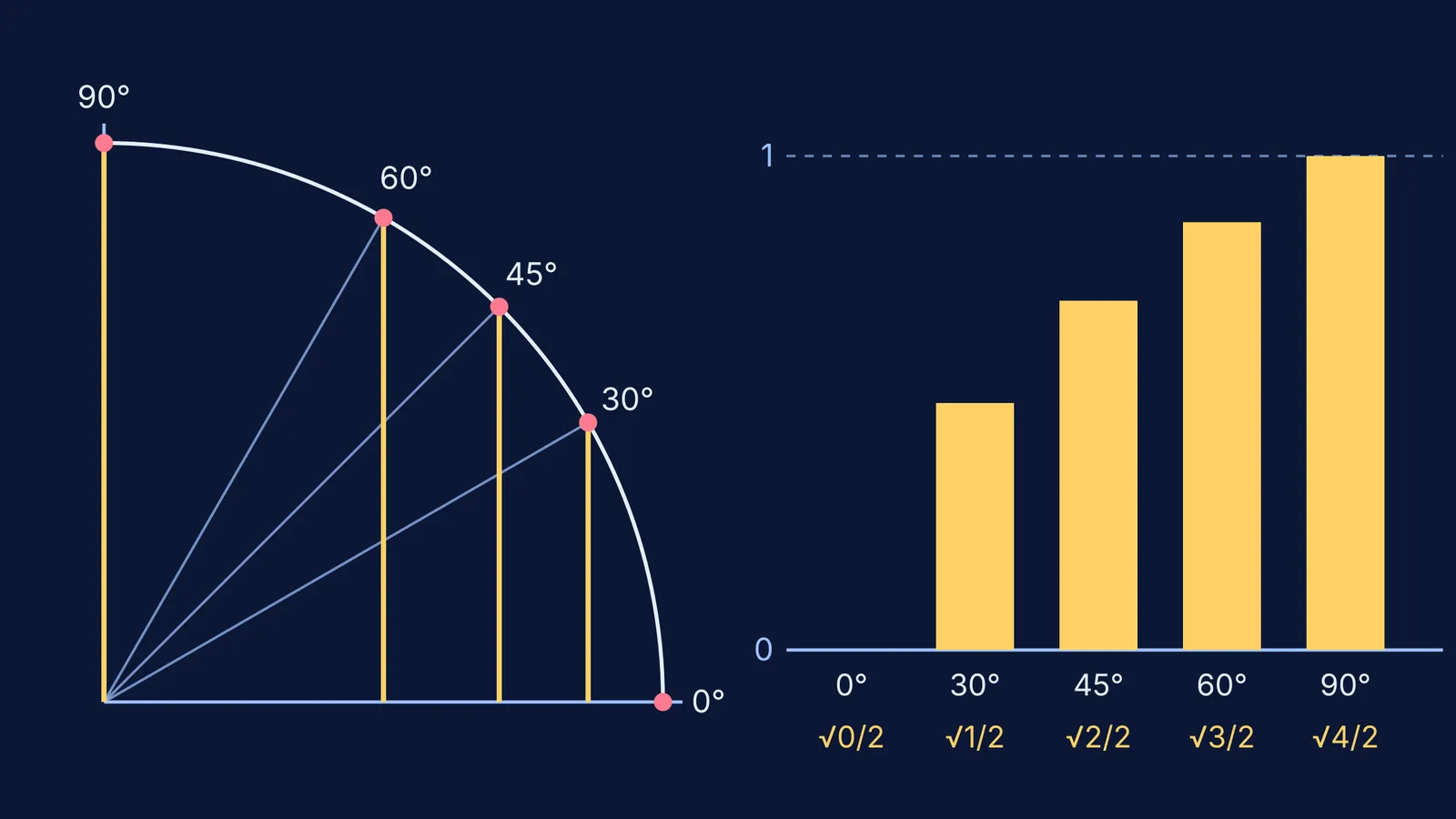
Write the five angles in a row. Under them, write the numbers 0, 1, 2, 3 and 4. Put each number under a square root, divide by 2, then simplify.
0°: √0/2 = 0
30°: √1/2 = 1/2
45°: √2/2 = 1/√2 (multiply the top and bottom of 1/√2 by √2 to see that they are equal)
60°: √3/2
90°: √4/2 = 2/2 = 1
That is the sine row, exactly as NCERT's Table 8.1 gives it. It also fits the remark printed under that table: as the angle grows from 0° to 90°, sine increases from 0 to 1 and cosine decreases from 1 to 0.
How do you get cos and tan from the sine row?
Cosine is the sine row written backwards. Read the sine row from right to left: cos 0° = 1, cos 30° = √3/2, cos 45° = 1/√2, cos 60° = 1/2 and cos 90° = 0. This works because cos θ = sin (90° − θ). So 30° and 60° swap, 0° and 90° swap, and 45° stays where it is.
Tan is sine divided by cosine. Divide column by column:
tan 0° = 0 ÷ 1 = 0
tan 30° = (1/2) ÷ (√3/2) = 1/√3
tan 45° = (1/√2) ÷ (1/√2) = 1
tan 60° = (√3/2) ÷ (1/2) = √3
tan 90° = 1 ÷ 0, which is not defined
The last three rows are flips. Cosec, sec and cot are 1 divided by sin, cos and tan. Wherever the original value is 0, the flipped value is not defined. That is why the NCERT chapter lists cosec 0°, sec 90° and cot 0° as not defined, along with tan 90°.
Why are these the values, and not just a trick?
A pattern you understand is harder to get wrong under exam pressure. Section 8.3 of the same NCERT chapter works the values out from two triangles. Half a square is a right triangle with two equal sides a and a hypotenuse of a√2, so sin 45° = cos 45° = 1/√2. Half an equilateral triangle with side 2a has a short side of a and a height of a√3, so sin 30° = 1/2 and sin 60° = √3/2.
On the unit circle, sine is the height of the point at each angle; our post on watching sine and cosine unroll from the unit circle shows those heights rising. If a step feels shaky, such as why the height is a√3, the Fermi Concept Library covers every concept in mathematics, each with its own lesson.
How can you check the table in one minute?
Write the table from memory on a blank page, then run these five checks.
Pattern check: the sine row goes up, the cosine row goes down, and each is the other written backwards.
45° check: sin 45° and cos 45° are equal, and tan 45° = 1.
Square check: in every column, sin² + cos² = 1. At 30°, 1/4 + 3/4 = 1.
Tan check: tan 30° × tan 60° = (1/√3) × √3 = 1.
Worked check: sin 30° cos 60° + cos 30° sin 60° = 1/4 + 3/4 = 1. That equals sin 90°, just as the formula for sin (A + B) says it should.
If a check fails, you know exactly which cell to fix. When you're ready for more, our guide to finding sin 15° and tan 75° without a table builds new exact values from these five. The ASTC rule for the signs of trig functions takes them past 90°.
Writing the table out from memory is the practice. In a 2006 study in Psychological Science, Henry Roediger and Jeffrey Karpicke found that students who took recall tests on prose passages remembered more two days and one week later than students who spent the time restudying them, although restudying did better on a test given five minutes later (Roediger and Karpicke, 2006). Rebuilding the table on a blank page puts that idea to work; rereading a printed table doesn't.
If you know the table but your heights-and-distances answers still come out wrong, the Fermi Problem Library has worked problems with a step-by-step solver that explains the reasoning, so you can see where your method went a different way.