On this page
If a JEE Main or NEET-UG question asks you to arrange o-, m- and p-toluidine and aniline by basic strength, the answer is p > m > aniline > o. The tricky part is the last place. A methyl group donates electrons, so you would expect every toluidine to beat aniline. The ortho isomer does not, and the reason is worth learning because it shows up again in other substituted anilines.
What are the pKb values of aniline and the toluidines?
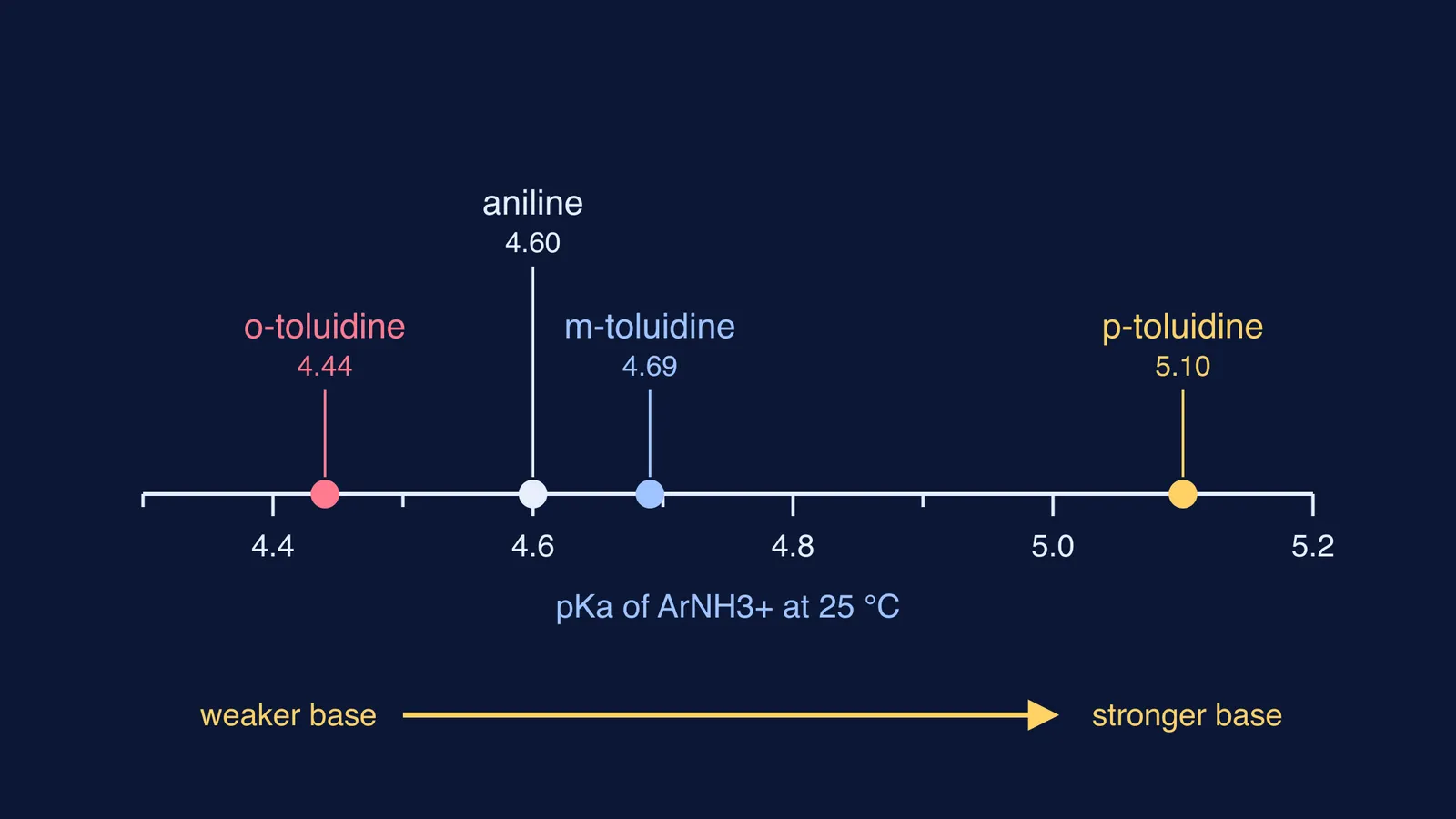
Data tables usually give the pKa of the conjugate acid (ArNH3+), not the pKb of the amine. At 25 °C the two are linked by pKa + pKb = 14 for any conjugate pair, as LibreTexts explains/14%3A_Ionic_Equilibria_in_Aqueous_Solutions/14.07%3A_Conjugate_Acid-Base_Pairs_and_pH). A higher conjugate-acid pKa means a stronger base, and a lower pKb means the same thing.
Here are the PubChem values at 25 °C, with pKb worked out as 14 minus pKa:
p-toluidine: pKa 5.10, so pKb about 8.90
m-toluidine: pKa 4.69, so pKb about 9.31
aniline: pKa 4.6, so pKb about 9.4
o-toluidine: pKa 4.44, so pKb about 9.56
Different books round these a little differently. PubChem's aniline record also quotes a pKb of 9.30, for example. The order does not change.
Why is p-toluidine more basic than aniline?
Aniline is a weak base to begin with. Its nitrogen lone pair is delocalised into the benzene ring, so it is less available to bond to H+, as the LibreTexts chapter on arylamines/24%3A_Amines_and_Heterocycles/24.04%3A_Basicity_of_Arylamines) puts it. The same chapter notes that electron-donating groups such as methyl add electron density to the ring and the amine, which makes the arylamine more basic.
At the para position, the methyl group feeds electrons into the ring through hyperconjugation and its +I effect. That makes the ring less hungry for the nitrogen lone pair, so the lone pair takes a proton more easily. At the meta position, the methyl cannot feed electrons onto the carbon that carries NH2 in the same way, so only the weak inductive push remains. That is why m-toluidine is only slightly stronger than aniline: the gap is 0.09 pKa units, against 0.5 for the para isomer, using the PubChem values above.
Why is o-toluidine less basic than aniline?
This is the ortho effect. When the amine takes a proton, nitrogen changes from roughly planar to tetrahedral (sp3), and the new NH3+ hydrogens crowd the neighbouring ortho group. The Wikipedia summary of the ortho effect describes this steric hindrance as making the conjugate acid less stable, and a less stable conjugate acid means a weaker base.
So the methyl group's electron push is still there in o-toluidine, but crowding wins. The net result is a pKa of 4.44, below aniline's 4.6.
How do you rank any substituted aniline by basicity?
Use the same four steps every time. Aniline is your reference point.
Ask what the group does to electron density. Donating groups (CH3, OCH3, NH2) raise basicity. Withdrawing groups (NO2, CN, halogens) lower it.
Check the position. Para lets the group act through resonance and hyperconjugation as well as induction. Meta gives mostly the inductive effect. For CH3, OCH3 and NO2 the para effect is the bigger one; for halogens the resonance push partly cancels the pull, so p-haloanilines end up more basic than m-haloanilines.
Apply the ortho effect. For ortho groups, start by assuming the compound is weaker than aniline because of steric crowding, then check whether the question gives data that says otherwise.
Convert any data you are given. If a table gives conjugate-acid pKa, the higher number is the stronger base. If it gives pKb, the lower number is the stronger base.
Worked example: the three toluidines and aniline. Step 1: CH3 is electron-donating, so the para and meta isomers should beat aniline. Step 2: para beats meta, because para can act through hyperconjugation and meta cannot. Step 3: the ortho isomer drops below aniline. Step 4: the PubChem pKa values (5.10, 4.69, 4.6, 4.44) confirm p > m > aniline > o.
Try the method on p-nitroaniline next. NO2 is strongly withdrawing, and at the para position it pulls the lone pair into the ring by resonance, so p-nitroaniline is a much weaker base than aniline.
Where should you practise this?
Basicity orders reward a fixed routine more than memorised lists. If you want to check your reasoning on more substituted amines, the Fermi Problem Library has worked problems with a step-by-step solver that explains the reasoning rather than printing an answer. If inductive effect or hyperconjugation still feels shaky, each has its own lesson in the Fermi Concept Library.
To place this inside the bigger picture, read our guides to the basicity order of methylamines in water, why benzylamine is more basic than aniline, and the ortho effect in substituted benzoic acids, which shows how an ortho group changes acid strength.