On this page
A pea plant has no muscles, yet its tendrils wrap round a stick. They do it by growing unevenly. Here is how, in pea and cucumber, with a calculation and a board answer.
What is thigmotropism?
Thigmotropism is the movement of a plant subjected to constant directional pressure, such as touch. The name comes from the Greek "thigma" (touch) and "tropism" (direction), as Biology LibreTexts explains.
The NCERT Class 10 Science chapter Control and Coordination puts tendrils under "Movement Due to Growth". The touch-me-not is different: its leaves move with no growth, because cells change shape as they gain or lose water (see why touch-me-not leaves fold when touched). For the other tropisms in that chapter, read phototropism, geotropism and other tropic movements in Class 10.
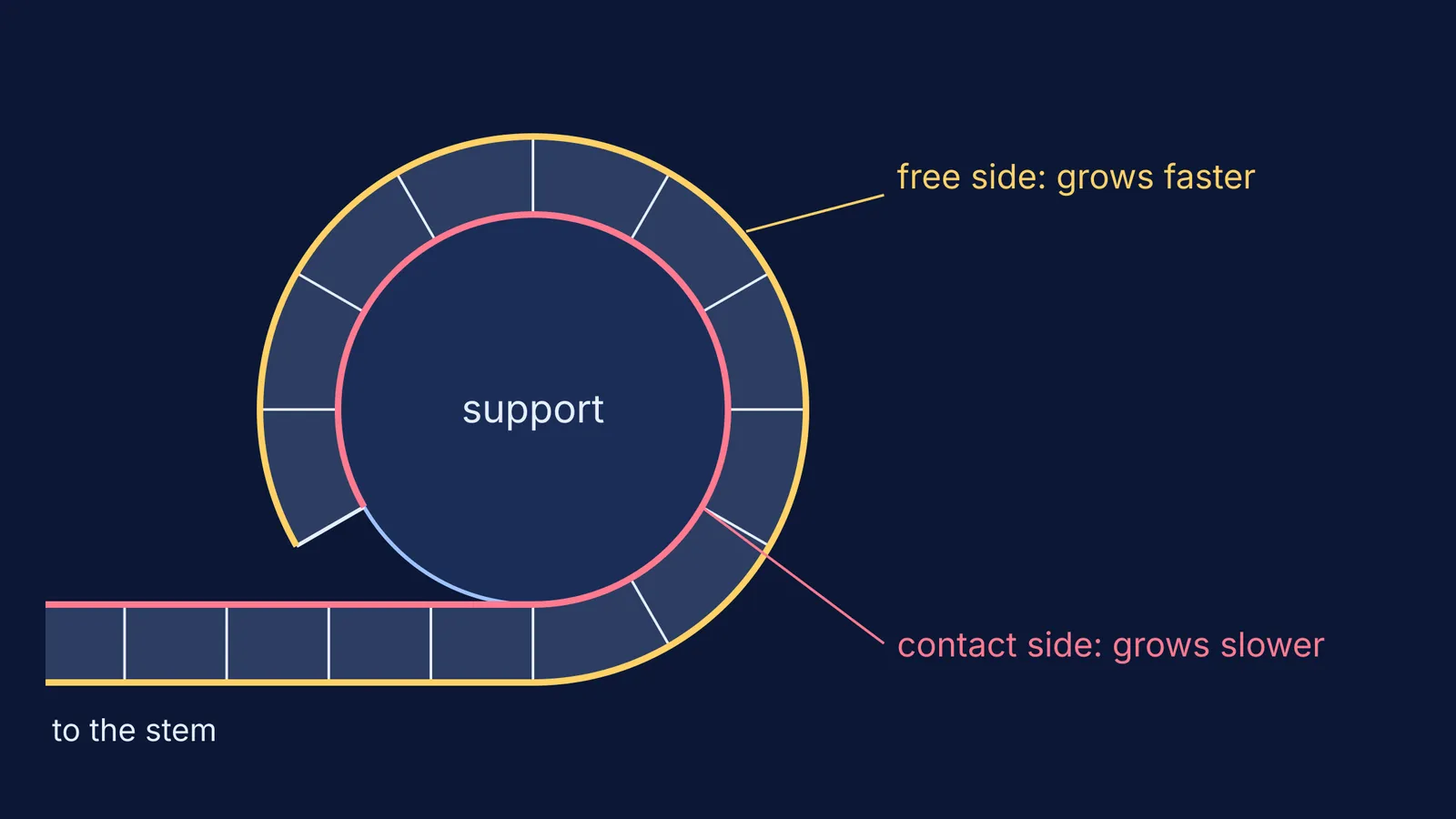
Why does the side touching the support grow slower?
NCERT puts it in two sentences: "When they come in contact with any support, the part of the tendril in contact with the object does not grow as rapidly as the part of the tendril away from the object. This causes the tendril to circle around the object and thus cling to it." (NCERT Class 10 Science, Chapter 6)
At the level of cells, those in contact with the support contract while cells on the opposite side expand (Biology LibreTexts). A strip with a short side and a long side cannot stay straight. It curves towards the short side, the one touching the stick.
NCERT asks how auxins promote this growth, so board answers use auxin. Research adds more: LibreTexts notes that applying jasmonic acid can trigger coiling without any touch, and a 1966 pea study found that several growth substances changed tendril curvature differently in light and in darkness (Jaffe and Galston, Plant Physiology).
How does a pea tendril wrap around a stick?
In pea, the tendril is a modified leaflet: a 2009 study found that a gene called Tendril-less stops it from developing into a flat leaflet (Hofer and colleagues, The Plant Cell). See also leaf modifications such as tendrils, spines and phyllodes.
Jaffe and Galston timed the response in Alaska pea plants (Plant Physiology, 1966):
Tendrils from the fifth node were mature at 10 days old.
When stroked, they coiled rapidly, peaking half an hour to 3 hours after the touch.
They stayed maximally sensitive to touch for at least 3 days.
Cutting the vascular bundles on the dorsal side reduced coiling; cutting the ventral ones had no effect.
How does a cucumber tendril coil?
A cucumber tendril begins as a straight stem that grows until it finds something to latch onto (Harvard SEAS). Then it coils to shorten and pull the plant up towards sunlight, according to a 2012 paper by Sharon Gerbode, Joshua Puzey, Andrew McCormick and L. Mahadevan (Science). The coiling depends on a thin layer of cells inside the tendril that becomes lignified, stiffened with lignin.
Once it is secured at both ends, the tendril forms a left-handed and a right-handed helix joined by a "perversion", Charles Darwin's term for the point where the coiling changes direction (Harvard SEAS). Gerbode, a former postdoctoral fellow at Harvard SEAS, contrasted it with a telephone cord, which straightens when pulled: "if you pull on the ends, it actually overwinds, adding more turns to both helices."
Worked example: how much faster must the free side grow?
Imagine a tendril 1 mm thick wrapping once round a stick 5 mm across. These are practice numbers, not measurements.
The contact side follows a circle of radius 2.5 mm: 2π × 2.5 ≈ 15.7 mm.
The free side follows a circle of radius 3.5 mm: 2π × 3.5 ≈ 22.0 mm.
Divide: 3.5 ÷ 2.5 = 1.4, so the free side must end up 40% longer.
On a stick 20 mm across (radius 10 mm): 11 ÷ 10 = 1.1, only 10% longer.
The rule is free side ÷ contact side = (r + t) ÷ r, with r the support's radius and t the tendril's thickness. The thinner the support, the bigger the growth difference. The diagram above is drawn to the 5 mm case. If a figure like this helps, Fermi's AI tutor can draw the figure and check your understanding as it goes.
How do you answer this in a board exam?
Tendrils are sensitive to touch; their growth response to touch is thigmotropism.
When a tendril touches a support, the side in contact grows less rapidly than the side away from it.
The free side grows more (NCERT asks you to explain this with auxin), so the tendril bends towards the support.
It circles the support and clings, as in pea, whose tendrils are modified leaflets.
To see where tendrils sit among plant movements and hormones, the Fermi Concept Library gives every biology concept its own lesson and its place in the map. Next time you pass a cucumber vine, look for the spot where its coil changes direction.