On this page
The three orders are the backbone of Theme 4, “The Three Orders” in NCERT’s Class 11 book *Themes in World History*. It covers western Europe from the ninth to the sixteenth century, and it rewards students who can tell one story: land, then loyalty, then crisis.
What are the three orders in Class 11 history?
The three orders were the clergy, the nobility and the peasantry, the three social categories into which French priests sorted medieval society, according to the NCERT chapter. A bishop summed up the idea: “Here below, some pray, others fight, still others work.” Priests ranked themselves first, but nobles held real power because they controlled land.
The word feudalism comes from the German “feud”, meaning “a piece of land”, and NCERT says feudalism as an established way of life emerged in the eleventh century. The chapter names Marc Bloch (1886–1944) as one of the earliest French scholars of feudalism; his *Feudal Society* studied European, especially French, society between 900 and 1300.
What did the clergy, the nobility and the peasants each do?
Every point is from the NCERT chapter:
First order, the clergy: the Church had its own laws, owned land and could levy taxes. It was entitled to a tithe, a tenth of whatever peasants produced in a year.
Second order, the nobility: nobles were vassals of the king. Under vassalage, the lord protected the vassal and the vassal stayed loyal. A noble could raise troops called “feudal levies”, hold his own courts and even coin money. A knight received a fief of 1,000 to 2,000 acres or more and promised to fight for his lord.
Third order, the peasants: free peasants held farms as tenants, and the men owed at least forty days of military service a year. Families worked the lord’s land on set days, usually three a week but often more, and that output, called labour-rent, went to the lord. Kings sometimes imposed a direct tax, the taille, on peasants; clergy and nobles were exempt. Serfs got no wages and could not leave the estate without the lord’s permission.
How did the manor work?
The manor was the lord’s house and the estate around it. A small manorial estate could hold a dozen families and a larger one fifty or sixty, says NCERT. It was not fully self-sufficient: salt, millstones and metalware came from outside, and serfs had to use the lord’s mill, oven and wine-press.
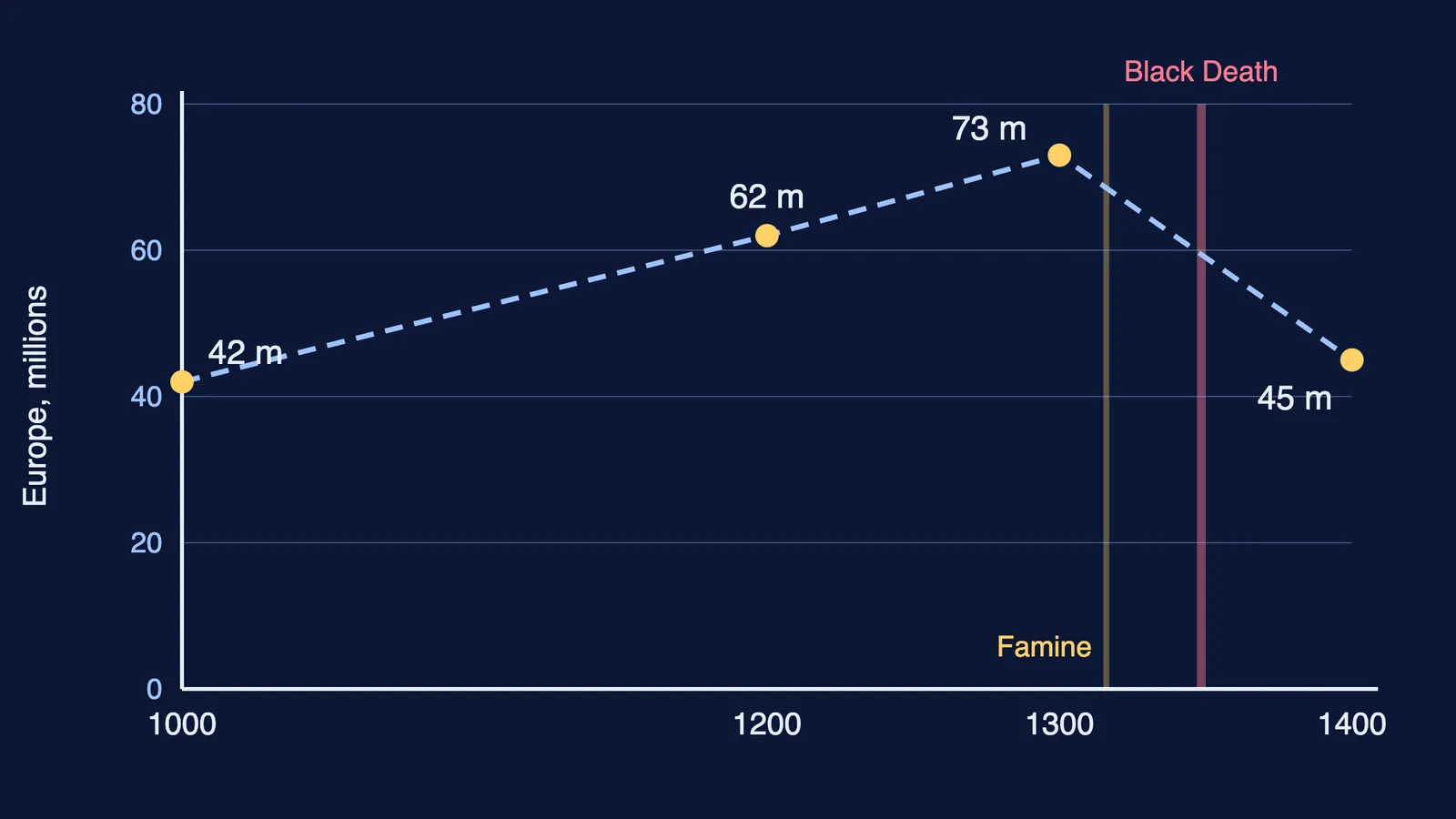
From the eleventh century, heavy iron-tipped ploughs, the shoulder-harness, iron horseshoes and the three-field system raised output. Europe’s population grew from roughly 42 million in 1000 to 62 million around 1200 and 73 million in 1300, according to the same chapter. Money crept in as lords asked for rent in cash, which loosened the personal bonds that feudalism rested on.
What caused the fourteenth-century crisis?
NCERT explains why Europe’s expansion slowed, then the blow that followed:
Climate: by the end of the thirteenth century, warm summers gave way to bitterly cold ones and growing seasons shrank by a month.
Soil and famine: intensive ploughing without soil conservation wore out the land, and severe famines struck between 1315 and 1317.
Money: a shortfall in the silver mines of Austria and Serbia left too little metal money for trade.
The Black Death: plague hit western Europe between 1347 and 1350 and killed an estimated 20 per cent of Europe’s people, with some places losing 40 per cent.
Europe’s population fell from 73 million in 1300 to 45 million in 1400, according to NCERT. Demand for labour, particularly agricultural labour, rose in England by as much as 250 per cent, and surviving workers could demand twice their earlier wages. Lords tried to bring back labour services, and peasants revolted in Flanders (1323), France (1358) and England (1381). The revolts were crushed, but the old feudal relations could not be reimposed.
How do you write a long answer on this chapter?
A question like “Explain the crisis of the fourteenth century” is about causes and consequences, so plan the chain before you write. Here is an outline built from the NCERT chapter:
Open with context: by the early fourteenth century, Europe’s expansion slowed.
Give the causes in order: cold climate, exhausted soil and famine, the silver shortage, the Black Death.
Put one date or figure beside each: 1315–17, 1347–50, a fifth of Europe dead, 73 million down to 45 million.
Give the effects: labour shortage, higher wages, falling incomes for lords.
Close with the turn: the revolts of 1323, 1358 and 1381, and why feudal ties could not come back.
Turn this outline into a cause-and-effect chart for a history chapter, and when a date feels shaky, check it against NCERT before you write it. For land and labour in India, compare peasants, zamindars and the state in Class 12.
If your timetable also carries physics, chemistry or maths, Fermi’s AI tutor works out what you already know and builds a plan for the session, so those subjects start with a clear next step too.