On this page
Ogden Nash's The Tale of Custard the Dragon is a funny story-poem about a pet dragon everyone mocks as a coward, until a pirate climbs through the window. It is poem 9 in the First Flight poetry list in the CBSE Class 10 English Language and Literature syllabus for 2026-27, so expect it in extract questions and short answers.
What is The Tale of Custard the Dragon about?
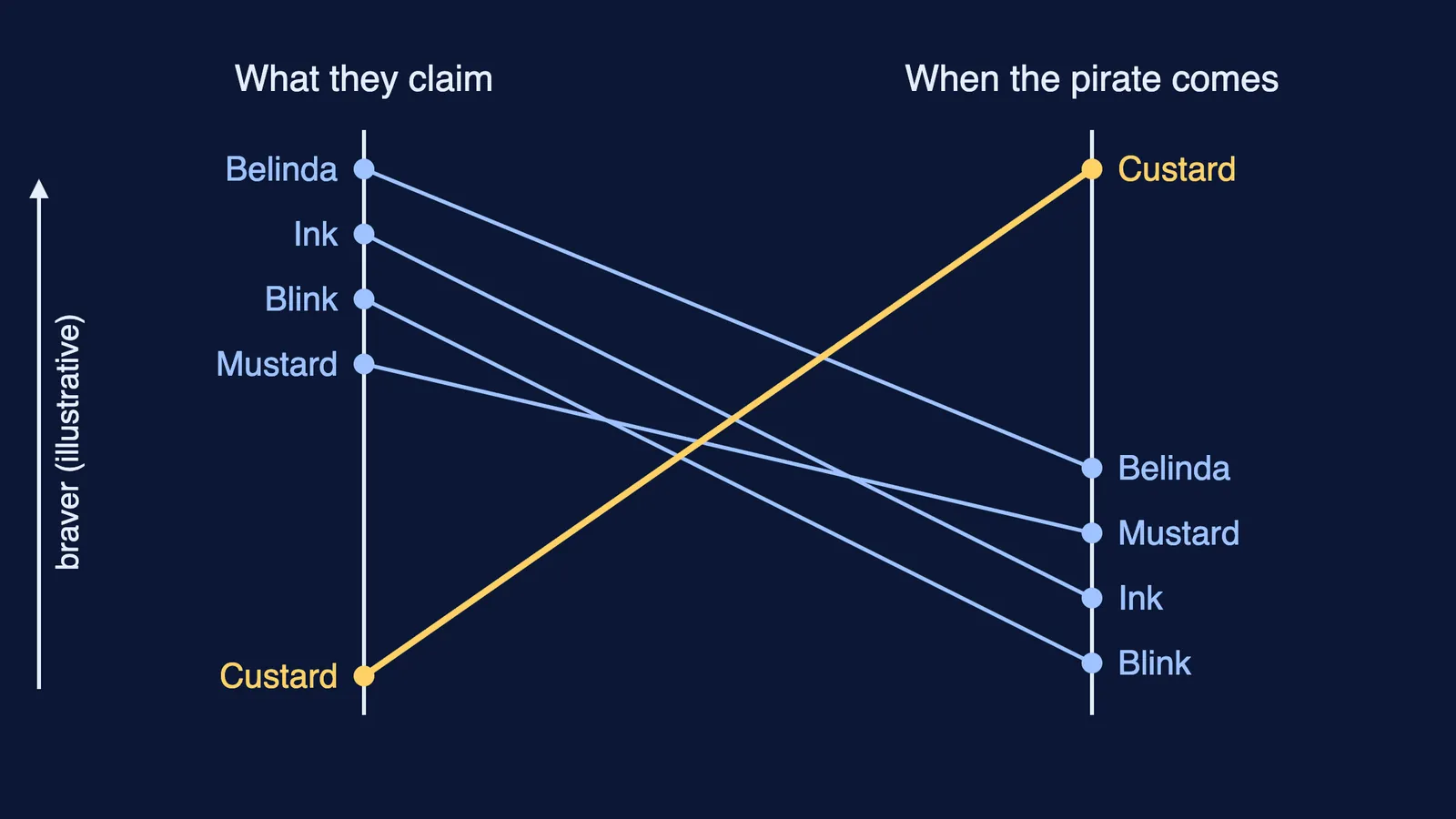
Belinda lives in a little white house with four pets: a black kitten called Ink, a grey mouse called Blink, a yellow dog called Mustard and a dragon called Custard. The dragon looks terrifying, with sharp teeth, spikes, scales, a mouth like a fireplace and claws like daggers, yet he is the timid one. The poem describes Belinda and the other pets as fearless, and they tease and laugh at Custard because he keeps asking for a safe cage.
Then a real danger arrives. A pirate with two pistols and a cutlass climbs in. Belinda turns pale and screams, Mustard runs, Ink hides at the bottom of the house and Blink dives into a mousehole. Only Custard charges. The pirate's two shots miss, and Custard swallows him whole.
The twist comes at the end. Mustard says he would have been twice as brave if he had not been flustered, Ink and Blink claim they would have been three times as brave, and Custard politely agrees that everyone is braver than him. Life goes back to normal: the last two stanzas repeat the opening picture and the bravery lines, now in the present tense.
Why is the poem funny?
The NCERT textbook introduces the poem as a humorous ballad that is close to a parody (First Flight, chapter 7, NCERT). A parody copies a serious style, here the old ballads of courage and heroism, and turns it upside down. The dragon is the hero, and the people who should be heroes run away.
Nash builds the comedy in a few ways you can name in an exam:
Irony: the creature that looks the most dangerous is called a coward, and the boasters fail the test.
Made-up and bent words: "realio, trulio" is nonsense made to sound like "really, truly", and "winda" bends window to rhyme with Belinda.
Funny similes: Belinda is as brave as a "barrel full of bears", and Custard attacks the pirate "like a robin at a worm", a huge dragon compared to a small bird.
Teasing names: the pets mock Custard by calling him Percival.
Sound words: the mouse's giggle and the kitten's cry are spelled out as noises.
The same NCERT page notes that Nash wrote over four hundred pieces of comic verse, and the best of it was published in 14 volumes between 1931 and 1972 (NCERT First Flight).
What is the rhyme scheme and why is it a ballad?
The poem has 15 stanzas in the NCERT text. Most have four lines, and each pair of lines rhymes, so the rhyme scheme is aabb (rhyming couplets). The stanza where the pets make their excuses runs to six lines, and keeps the same pairing: aabbcc. Some rhymes are deliberately strained, which adds to the joke.
It counts as a ballad because it tells a complete story with a beginning, a crisis and an ending, uses a strong beat meant to be read aloud, and repeats lines, like Custard's request for "a nice safe cage". The closing two stanzas echo the first and fourth, making a frame: nothing has changed, which is the final joke.
If you are reading several First Flight poems together, compare this with our Amanda! explanation and the very different, serious tone of The Ball Poem line-by-line guide.
How do you answer exam questions on Custard the Dragon?
The 2026-27 syllabus sets one poetry extract (one out of two, 5 marks) with objective and short questions, and four out of five short answers of 40-50 words from First Flight worth 3 marks each (CBSE syllabus).
Use this three-step frame for a 3-mark answer:
Point: answer the question in one sentence.
Proof: give one event from the poem, in your own words.
Meaning: say what it shows about courage or about the poet's purpose.
Worked example. Question: Is Custard really a coward? Answer: No. Custard is called a coward because he is timid and wants a cage, but when the pirate breaks in, he is the only one who fights while the others flee or hide. Nash uses this irony to show that true bravery appears in action, not boasting. (47 words)
Before the exam, check you can do these from memory:
Name each pet and its animal.
Explain the irony of the ending in two sentences.
Find two similes and one invented word.
State the rhyme scheme and give one reason the poem is a ballad.
For more practice spotting devices, see Fog and The Trees: meaning and metaphors. And when English is done and physics or maths is next, Fermi's AI tutor can work out what you already know and build a plan for the session, so you sit down to a clear next step.