

On this page
Unit 2 of Kaveri, the new NCERT English textbook for Class 9, pairs a story about a girl learning a craft with a poem about every kind of work.
What is The Pot Maker about?
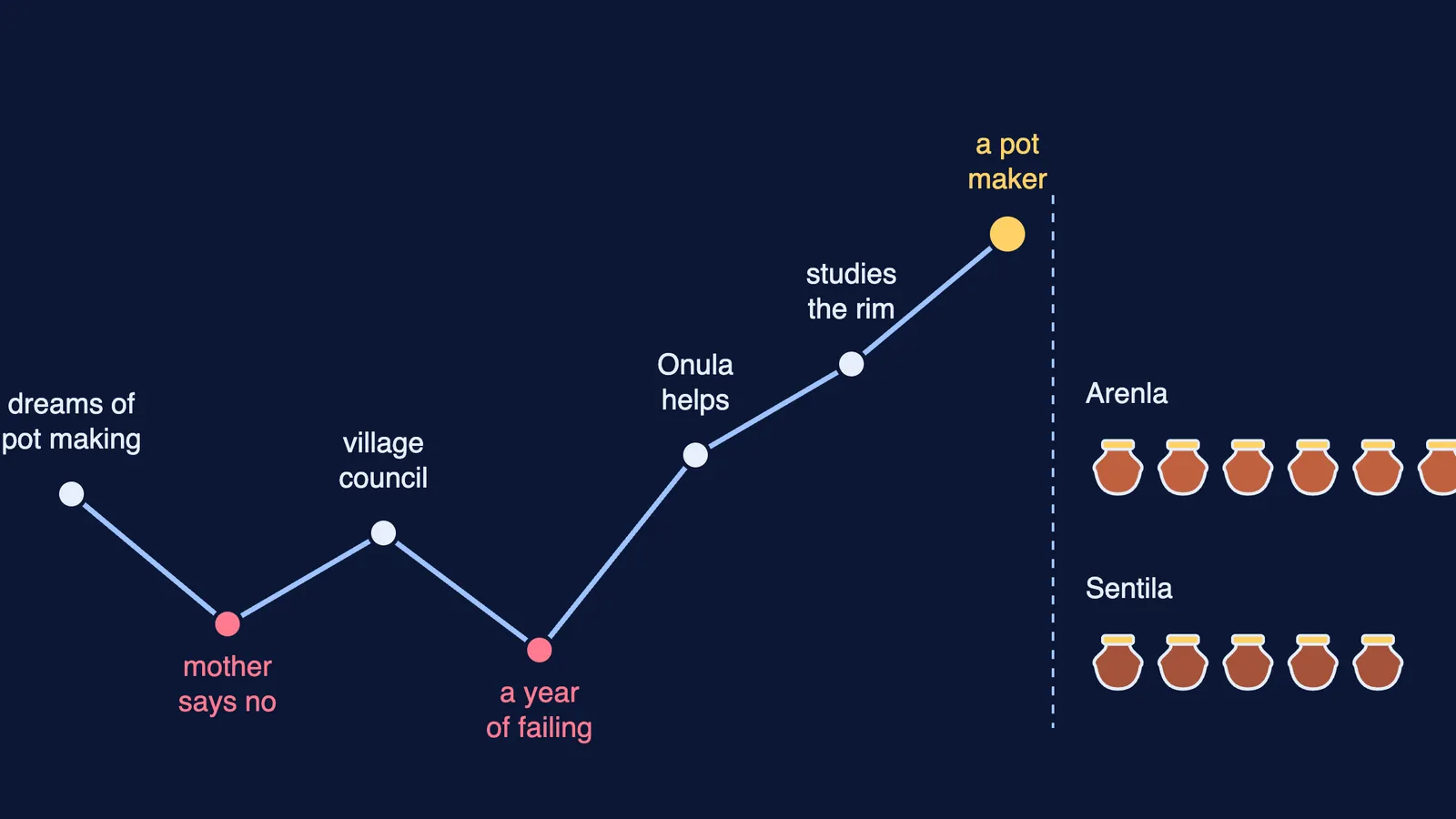
Sentila grows up wanting to make pots like her mother Arenla and her grandmother. Arenla wants her to weave instead. In the chapter, Sentila overhears Arenla telling her husband why: the clay lies far from the village, carrying it uphill hurts her back, pounding it is tiring, and months of work earn very little, while weaving can be done indoors and pays better.
Sentila secretly watches the village potters: pounding the clay, shaping it with a spatula, sun-drying the pots and firing them in a kiln, where too much or too little heat ruins the batch. The village council calls her father Mesoba and reminds him that such a skill does not belong to any one person and must be passed on to anyone who wishes to learn.
Arenla then teaches Sentila, but for almost a year the girl cannot shape a pot. Onula, the kind woman who supervises the girls' dormitory, sees that Sentila is too tense, shows her how, and tells her to study how her mother shapes a pot's mouth. One sunny day Arenla leaves Sentila alone in the shed, and Sentila makes pot after pot, ending one short of her mother's count. Then she finds her mother has died. Later Onula sees the two rows of pots and cannot tell them apart. The story ends: "A new pot maker was born."
Who wrote The Pot Maker, and where is it set?
Temsula Ao was a writer and scholar from Nagaland who documented the customs of the Ao Naga people, as Outlook's obituary records. Kaveri's front matter notes that she received the Padma Shri and the Sahitya Akademi Award, and that the story comes from her collection These Hills Called Home: Stories from A War Zone (Zubaan, 2007). The textbook prints an abridged version.
The story shows village life as Ao presents it: elders who speak for the community, a girls' dormitory, and a craft that carries the people's history. Read these as her portrayal, not as true of every Naga community.
What are the themes of The Pot Maker?
Skill belongs to everyone. The elders treat pot making as shared heritage.
Failure before mastery. A year of failure comes before success.
Learning by watching. Sentila improves when she relaxes and studies her mother's hands.
Passion versus earning. Arenla's money worry is real; the story shows her side.
Handing on. The matching rows suggest the skill has passed from mother to daughter.
What is the poem paired with The Pot Maker?
The poem is Gifts of Grace: Honouring Our Vocations, printed with no named poet. In free verse, it moves through craftspeople, musicians, carpenters, electricians, boatmen, shoemakers, cooks, designers and masons, and it opens and closes with almost the same line about hearing Bharat celebrate (the first ends on vocations, the last on voices). Its central idea is that the work people do is part of who they are.
The link: the story shows one craft from inside one family; the poem honours all work at once. Both say skilled work deserves respect, not only payment. The unit's grammar covers noun clauses, relative clauses and determiners, so revise types of clauses with a quick test alongside the chapter.
How will The Pot Maker come in the Class 9 exam?
In the CBSE Class 9 English curriculum for 2026-27, Language through Literature carries 30 marks. In the R1 paper that means two extracts (one prose or drama, one poetry) worth 10 marks together, five short answers of 40-50 words (five of six) for 10 marks, and two 120-150 word answers worth 5 marks each: one going beyond or across texts, one on theme, plot or character. The R2 paper splits the 30 marks differently, so check which paper your school follows.
Practice questions:
Was Arenla wrong to steer Sentila towards weaving? Give two reasons from the story. (40-50 words)
What did Onula notice about Sentila that her mother did not? (40-50 words)
How do the village elders and the poem agree about the value of skilled work? (120-150 words)
Write Sentila's diary entry for the evening Onula first helped her. Use a Class 9 diary entry format.
A worked plan for question 3
Claim (1 sentence): Both treat skilled work as part of a people's identity, not just a way to earn.
Story evidence (2-3 sentences): The elders say pot making belongs to the community and must be taught to anyone willing.
Poem evidence (2-3 sentences): The poem names many workers and ties each one's work to who they are.
Contrast (1-2 sentences): Arenla's money worries show the cost the poem leaves out.
Close (1 sentence): Respect for a craft keeps it alive.
For the science of clay, read why a clay kulhad stays cooler to hold, and when your science chapters need the same care, the Fermi Concept Library has a lesson for every concept in physics, chemistry, biology, mathematics and computing.


