

On this page
One question on your Class 9 English paper may say: write a diary entry. Here is the layout, the tense and tone rules, a worked sample with its word count, and a self-check that parents can use too.
What is the diary entry format for Class 9?
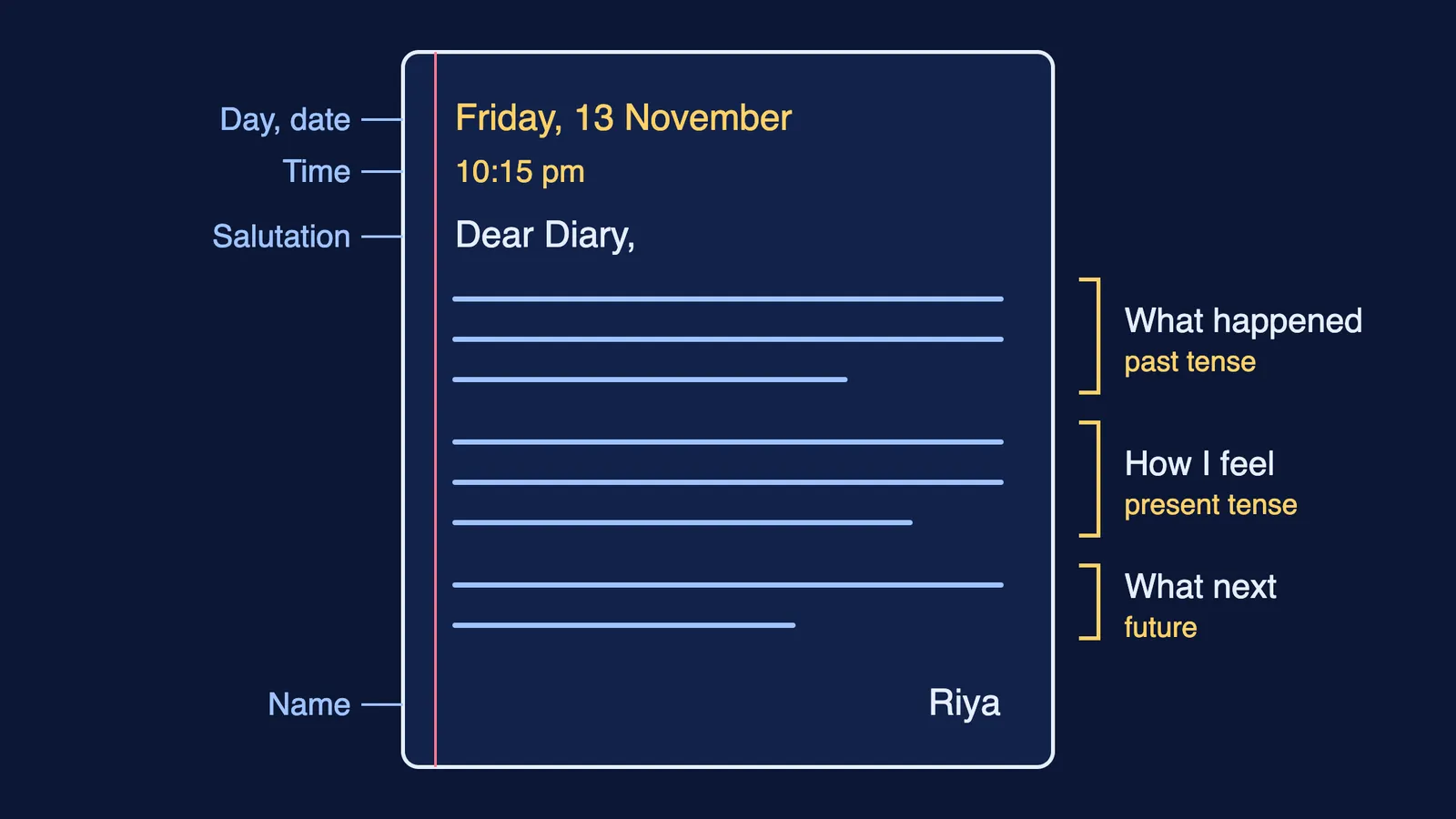
A diary entry is a private, first-person record of a day: what happened and how you felt about it. The form is light, but a diary entry usually has these parts, in this order:
Day and date, top left, for example Friday, 13 November 2026.
Time, just below the date, for example 10:15 pm. Optional, but it shows you know the form.
Salutation: "Dear Diary," is optional. Use it or leave it out.
Body: two or three short paragraphs covering what happened, how you feel, and what you will do next.
Name: your first name at the end, or the character's name if the question asks you to write as someone from a chapter.
No address, subject line or "Yours sincerely": those belong to a formal letter, as our line-by-line check of the CBSE formal letter format shows.
Is diary entry still in the CBSE Class 9 syllabus?
It depends on the year. In CBSE's English Language and Literature curriculum for 2025-26, the Class IX writing section asked for "a Story (on a given cue/title)/Diary Entry, in 100-120 words", one of two questions, for 5 marks.
The CBSE Class IX English curriculum for 2026-27, which prescribes the textbook Kaveri, lists four writing tasks instead: a notice or informal invitation, a letter to the editor or formal e-mail, a factual description or magazine article, and a descriptive or narrative essay. Diary entry is not one of them.
It has not disappeared. The same 2026-27 document lists journals among formative assessment techniques and says a portfolio, worth 5 of the 20 internal assessment marks, may include them. Some schools may still set diary entries in their own tests, so ask your teacher for this year's paper pattern.
Which tense and tone should a diary entry use?
Let the tense follow time:
Past tense for what happened today: "The results were announced after assembly."
Present tense for how you feel now, as you write: "I still feel a knot in my stomach."
Future for plans: "Tomorrow I will ask Ma'am about a retest."
A common tense error is drifting: "I go to school, I see the notice", then a slip into the past halfway through. The 2026-27 curriculum lists sequence of tenses as a grammar item. Subject-verb agreement is another common slip; our ten rules of subject-verb agreement make a quick refresher.
The tone is personal, honest and informal, but not slangy. Contractions such as I'm and didn't are fine; SMS spellings and emojis are not. To describe feelings beyond "happy" and "sad", build a word bank with a ten-word weekly vocabulary routine.
Sample diary entry for Class 9
Question: You acted in your school's Annual Day play for the first time and forgot a line. Write a diary entry describing the day and your feelings.
Friday, 13 November 2026
10:15 pm
Dear Diary,
Today was Annual Day, and I finally stood on stage as the village headman in our class play. My hands were cold all morning, and I kept repeating my lines in the corridor.
In the second scene, I looked at the crowd and my mind went blank. For three long seconds nobody spoke. Then Aarav whispered the first word, and everything came back. After that the audience laughed in the right places, and Ms Mehta smiled at me from the wings.
I am still embarrassed about that pause, but I am proud that I did not freeze completely. Next time I will rehearse on the stage, not just in the classroom.
Riya
The body is 111 words. Past tense carries the play, present tense the feeling, future the plan. Specific details (cold hands, three seconds, a whisper) do more work than "very nervous".
How is a diary entry marked?
CBSE's 2025-26 curriculum lists the competencies its writing and grammar section assesses as "creative expression" with "appropriate style and tone, using appropriate format and fluency" and "accuracy". It gives no separate mark split for a diary entry, so use this as a self-check, not an official scheme:
Format: day, date, time if used, optional salutation, name at the end, and no letter features.
Content: the event, at least two feelings, and one reflection or plan, all on the question's cue.
Organisation: two or three paragraphs with a clear beginning, middle and end.
Expression and accuracy: consistent tenses, correct agreement and spelling, within the word limit.
If English practice is squeezing out science revision, Fermi's AI tutor can work out what you already know in a STEM topic and build a plan for the session.
Write one practice entry tonight about something that happened today, and run the four checks above.


