On this page
A thin ring of radius R carries charge Q spread evenly around it. You place a small charge q at its centre. A common JEE-style question asks how much the tension in the ring increases. The whole problem comes down to one free-body diagram of a tiny piece of the ring. Once you can draw that, the answer takes four lines.
Why does a charge at the centre increase the ring's tension?
Coulomb's law says the force between two point charges is F = (1/4πε₀)·|q₁q₂|/r², directed along the line joining them, with like charges repelling (OpenStax University Physics, Volume 2).
Every bit of the ring is the same distance R from the centre, so if q and Q have the same sign, every bit is pushed straight outward. The ring cannot simply fly apart, so the material stretches slightly and pulls back. That pull is the tension. If q and Q have opposite signs, every bit is pulled inward instead and the tension drops by the same amount.
How do you draw the free-body diagram of a small arc?
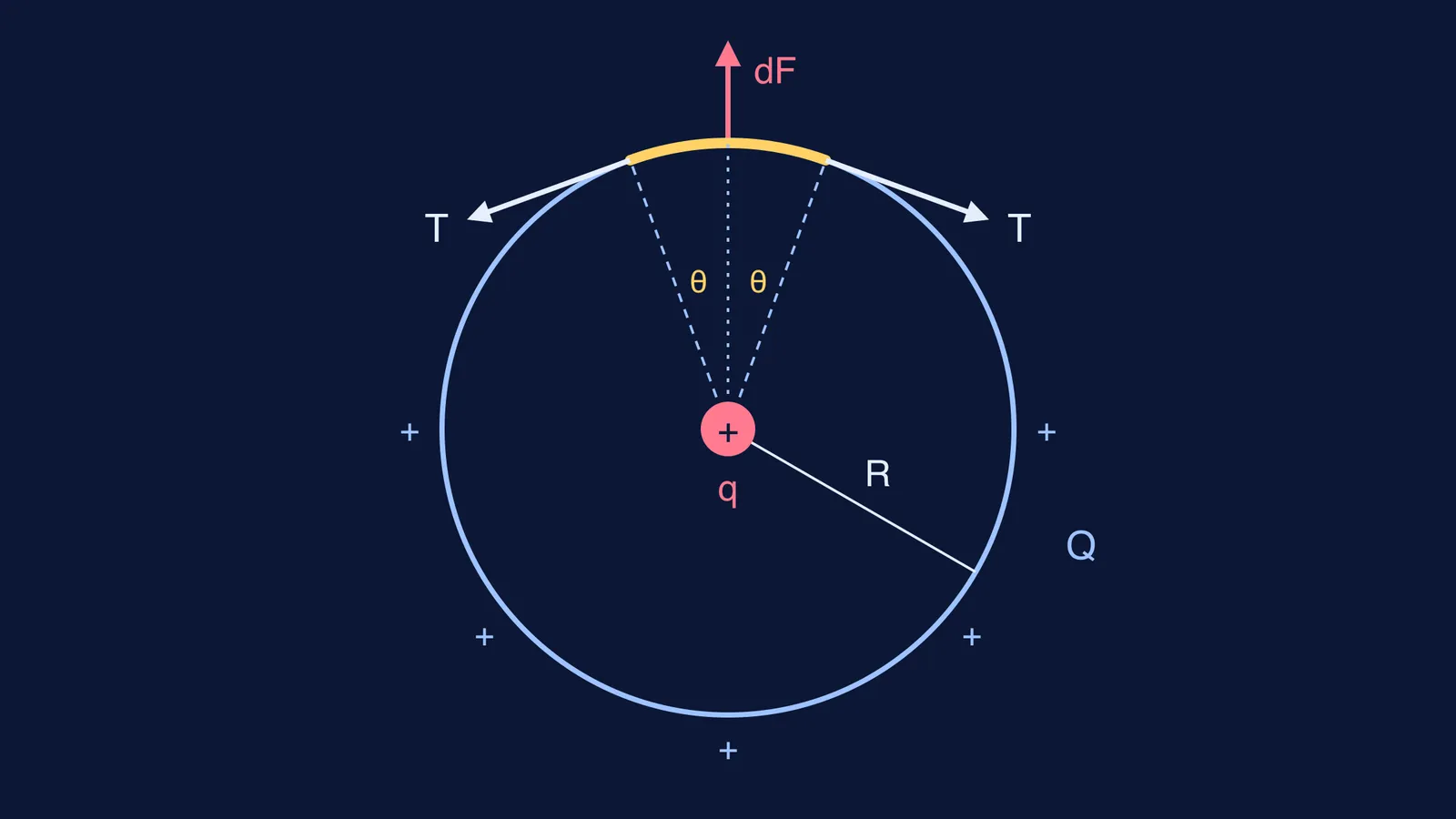
The hero diagram above shows this sketch. Build it in five steps:
Cut out a small arc that subtends an angle 2θ at the centre, placed symmetrically about the vertical.
Draw the electric force dF on the arc pointing radially outward, away from q.
At each end of the arc, draw a tension T along the tangent, pulling away from the arc (the rest of the ring is pulling on it).
Split each T into components. The horizontal parts, T cos θ, point in opposite directions and cancel.
The vertical parts, T sin θ each, both point toward the centre. Together they give 2T sin θ inward, and this must balance dF.
How do you derive T = qQ/8π²ε₀R²?
Work through it in order.
Charge per unit length: λ = Q/(2πR).
Length of the arc: R·2θ, so its charge is dQ = λ·2Rθ = Qθ/π.
Force on the arc from q, all at distance R: dF = q·dQ/(4πε₀R²) = qQθ/(4π²ε₀R²).
Balance: 2T sin θ = dF. For a small arc, sin θ ≈ θ, so 2Tθ = qQθ/(4π²ε₀R²).
The θ cancels: T = qQ/(8π²ε₀R²).
The same result written with k = 1/(4πε₀) is T = kqQ/(2πR²), or T = qλ/(4πε₀R) in terms of the line charge density. Learn to recognise all three.
How can you check the answer with a half ring?
Cut the ring in half instead. Each element of the half ring feels an outward push kqλ dφ/R at angle φ from the symmetry axis. Adding the components along that axis from φ = −π/2 to π/2 gives 2kqλ/R. The two cut ends each supply a tension T, so 2T = 2kqλ/R and T = kqλ/R, which is the same answer. If your two methods disagree, look for a dropped 2 or π.
This free-body habit is the same one used to find the electric field of a charged arc: symmetric components cancel and only one direction survives.
What is the tension for real numbers?
Take Q = 10 μC on the ring, q = 2 μC at the centre and R = 10 cm = 0.10 m. Use ε₀ = 8.8541878188 × 10⁻¹² F/m, the 2022 CODATA value from NIST.
qQ = (2 × 10⁻⁶)(10 × 10⁻⁶) = 2 × 10⁻¹¹ C².
8π²ε₀R² = 8 × 9.870 × 8.854 × 10⁻¹² × 0.01 ≈ 6.99 × 10⁻¹² C²/N.
T = (2 × 10⁻¹¹)/(6.99 × 10⁻¹²) ≈ 2.86 N.
Check it the other way with k = 8.99 × 10⁹ N·m²/C² from OpenStax: kqQ = 0.180 N·m², and dividing by 2πR² = 0.0628 m² gives about 2.86 N again.
Which mistakes cost marks on this problem?
Using the full ring charge Q in dF instead of the small arc's charge dQ.
Drawing only one tension force. The arc has two ends, so there are two.
Writing T sin θ on one side but taking the arc as θ, which loses a factor of 2.
Reporting the total tension. The question asks for the increase caused by q; the ring's own self-repulsion is a separate contribution.
Forgetting the sign: opposite charges reduce the tension.
If your answer comes out off by 2 or π, the Fermi Problem Library has worked problems with a step-by-step solver that explains the reasoning, so you can see exactly which step went wrong. To revisit line charge density or Coulomb's law first, the Fermi Concept Library gives each concept its own lesson.
For more ring practice, try how a charge oscillates along a ring's axis, and brush up on Coulomb's law in vector form before you do.
Next time you see a ring, a loop or a bubble under a central force, cut out a small arc and balance 2T sin θ against the push.