

On this page
In introductory physics, you first meet Coulomb's law as a way to find the magnitude of the electrostatic force: F = k |q₁ q₂| / r². You calculate the raw number and then decide the direction yourself by remembering the fundamental rule that "like charges repel, and opposites attract."
This manual approach works perfectly when two charges sit on a single straight line, such as an x-axis. But when you are dealing with three charges forming a triangle, or a continuous charge distribution stretching across three dimensions, guessing the direction by drawing arrows becomes highly prone to error. You might easily point an arrow in the wrong quadrant. This is where the vector form takes over and simplifies the work.
What is the formula for Coulomb's law in vector form?
To let the maths handle the direction for you, Coulomb's law is written using vectors. If we want to find the force exerted on charge 1 due to charge 2 (F₁₂), we write:
F₁₂ = k q₁ q₂ r₂₁ / r³
Let us break down what these terms mean:
F₁₂: The force vector acting on charge 1.
k: Coulomb's constant (9 × 10⁹ N m² C⁻²).
q₁, q₂: The two charges, keeping their positive or negative signs.
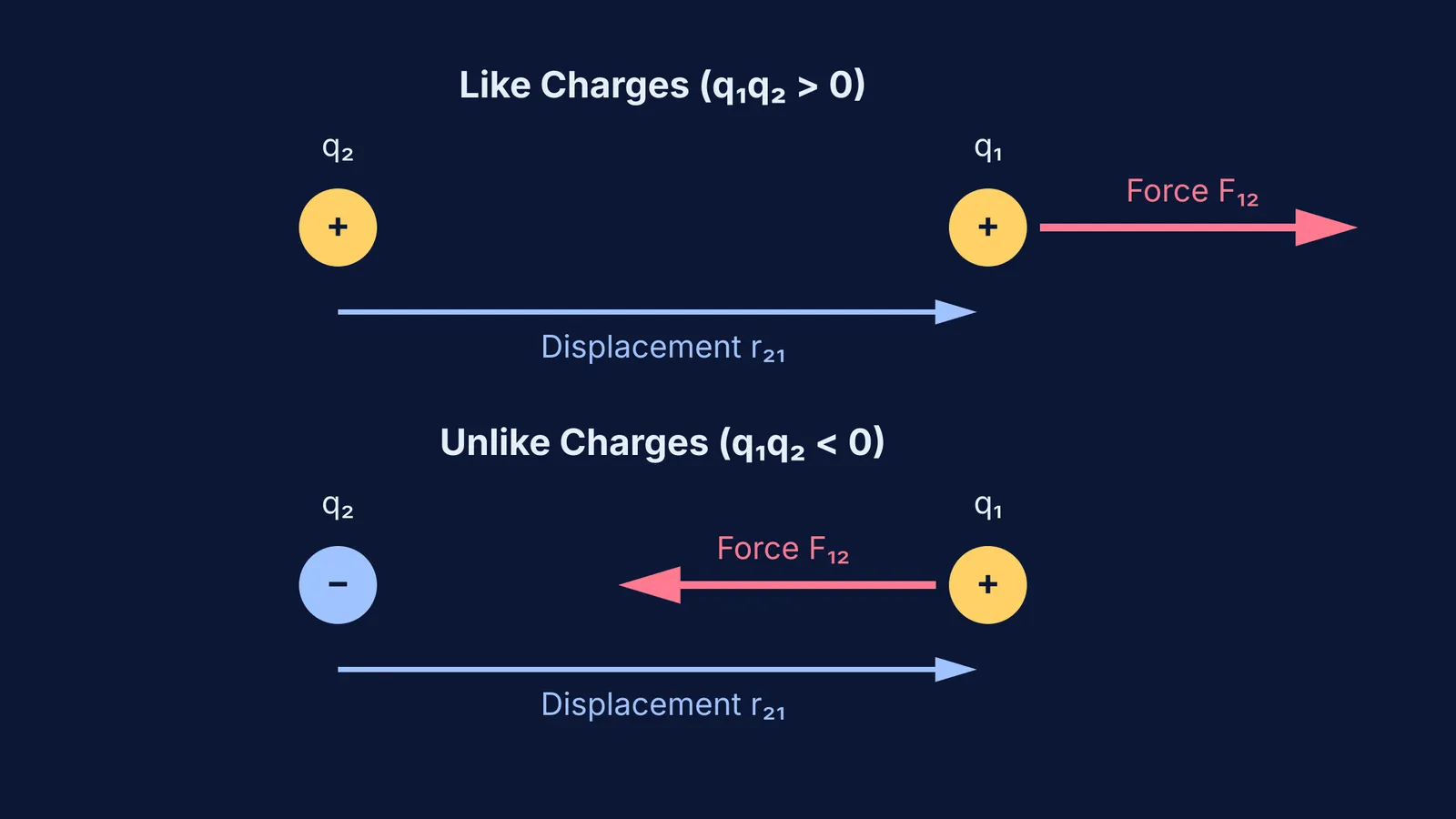
r₂₁: The displacement vector pointing *from* charge 2 *to* charge 1.
r: The straight-line distance between the charges (the magnitude of r₂₁).
As *OpenStax University Physics* explains, the signs of the charges determine the direction of the force. If both charges have the same sign, their product q₁ q₂ is positive. The force F₁₂ will therefore point in the exact same direction as r₂₁ — away from charge 2.
If the charges have opposite signs, q₁ q₂ becomes a negative number. This negative sign flips the direction of the vector, meaning the force on charge 1 points opposite to r₂₁ (pulling it back toward charge 2). The formula decides whether to push or pull without you having to sketch it first.
Why is there an r³ in the denominator?
A frequent question students ask is: if electrostatic force follows an inverse-square law, why is there an r³ (r cubed) in the vector formula?
The answer lies in how unit vectors work. The standard vector formula often uses a unit vector (r̂₂₁), which has a length of 1 and only shows direction:
F₁₂ = k q₁ q₂ r̂₂₁ / r²
To make calculations easier, especially when substituting coordinate points, we replace the unit vector with the full displacement vector divided by its own length: r̂₂₁ = r₂₁ / r. Substituting this back in gives r² × r in the denominator, resulting in the r³ term. The physical law is still an inverse-square relationship; the extra r in the denominator simply cancels out the extra length introduced by using the full vector r₂₁ instead of a unit vector. This keeps the equation tidy and prevents side calculations for angles.
What are the most common student mistakes?
Because the vector form bundles magnitude and direction together, it is easy to make sign errors if you mix the scalar and vector methods.
A 2012 study published in *AIP Conference Proceedings* by Wilcox and Pollock tracked how university physics students solved complex Coulomb's law problems. The researchers found that only 8% of students in the study's interview group made any unprompted attempt to check if their final mathematical result was physically plausible.
When working with vectors, the most common pitfall is the "double correction." A student will notice that a charge is negative and plug the minus sign into the formula. Then, looking at their diagram, they see the force should be attractive, so they manually add *another* negative sign to flip the vector. These two negatives cancel out, accidentally turning an attractive force into a repulsive one.
When you use the vector form, you must trust the equation: plug in the raw coordinates to find r₂₁, include the exact signs of q₁ and q₂, and let the multiplication dictate the final direction.
A framework for vector problems
To safely navigate exam problems involving multiple charges in three dimensions, follow a strict, four-step routine:
Define the target: Clearly identify which charge is feeling the force. If a problem asks for the net force on charge 1 due to several other charges, charge 1 is your permanent target.
Find the displacement vector: Draw the vector from the source charge to the target charge. If calculating the force from charge 2, you need r₂₁. In coordinates, this is always calculated as target minus source: r₂₁ = (x₁ - x₂)î + (y₁ - y₂)ĵ + (z₁ - z₂)k̂.
Include the signs: Multiply the charge values (q₁ and q₂). You must keep their plus or minus signs exactly as given in the problem. Do not take the absolute value.
Distribute the scalar: Calculate the magnitude component k q₁ q₂ / r³. This will give you a single number (a scalar), which could be positive or negative. Multiply this scalar across the î, ĵ, and k̂ components of your displacement vector.
If you struggle to apply these 3D vectors to exam questions, the Fermi Problem Library has worked problems with a step-by-step solver that explains the reasoning rather than printing an answer.
Mastering this formula early on does more than just solve electrostatics problems. It helps you avoid electrostatics mistakes like confusing fields and potentials. Furthermore, it builds a solid mathematical foundation that protects you from common errors in vector physics when you eventually move on to calculating magnetic fields using the Biot-Savart law or analysing three-dimensional gravitational forces.


