

On this page
A thin ring of radius R carries charge Q spread evenly around it. A small charge on its axis, a little way from the centre, is let go. Does it oscillate, and with what period? The answer needs one approximation, and justifying it is the step to show clearly.
What force does a charge feel on the axis of a charged ring?
The field at distance x along the axis of a uniformly charged ring is E = (1/4πε₀)·Qx/(x² + R²)^(3/2), pointing along the axis, as derived in OpenStax University Physics Volume 2, Example 5.7. The same section shows that far from the ring (x much larger than R) this reduces to the field of a point charge. Our post on the electric field on the axis of a ring and a disc walks through that derivation and its limits.
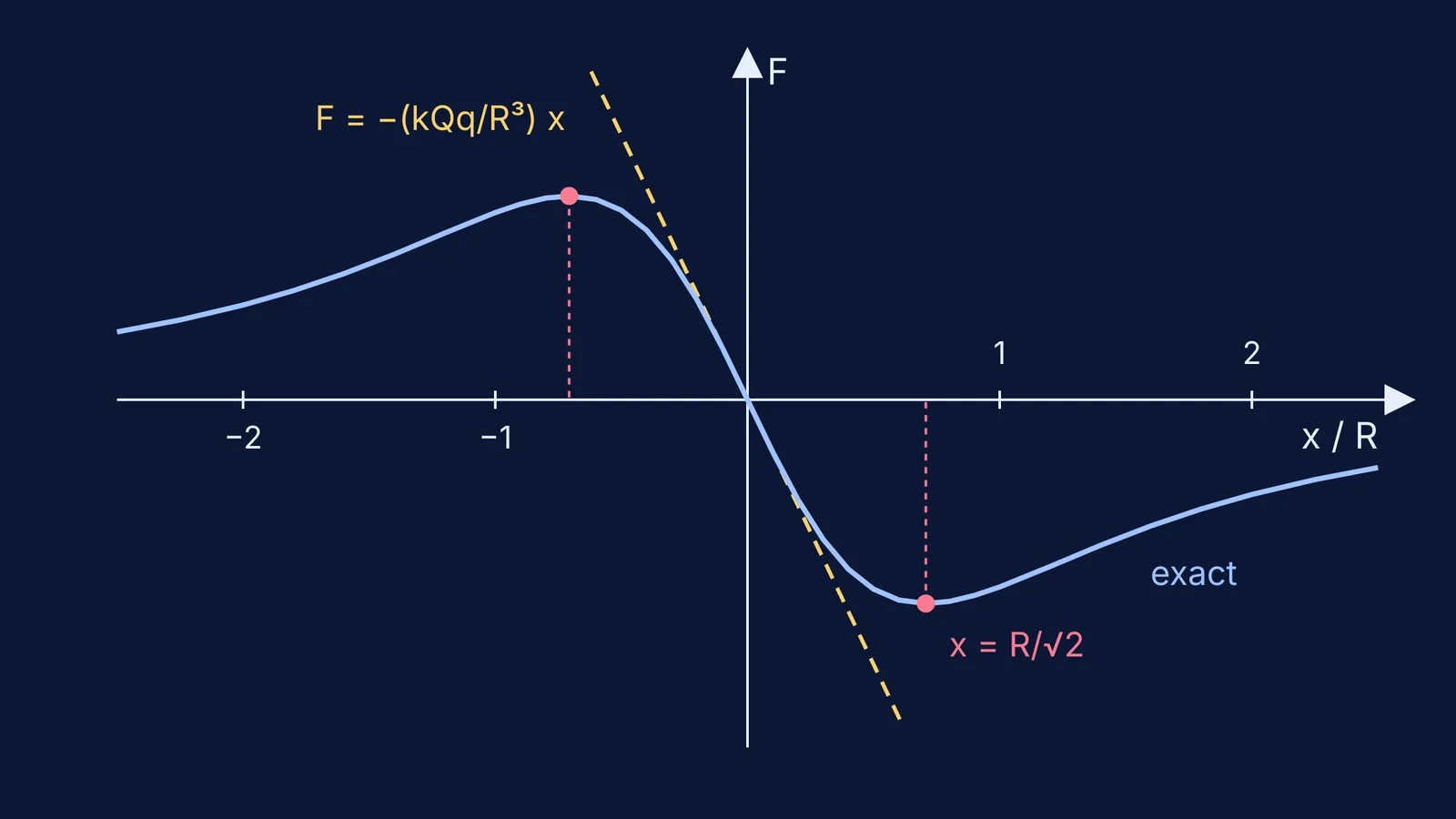
At the centre the field is zero, so the centre is an equilibrium point. On either side, the field of a positive ring points away from its plane, so a negative charge −q is pulled back towards the centre. With k = 1/4πε₀, the force is F = −kQqx/(x² + R²)^(3/2).
Why is the motion SHM for small displacements?
In simple harmonic motion, the net force is proportional to the displacement and acts in the opposite direction, as defined in OpenStax University Physics Volume 1, section 15.1. It also gives a spring's period as T = 2π√(m/k).
Our force is not exactly proportional to x, because x also sits inside the bracket. But if x is much smaller than R, the bracket is close to R³, and:
F ≈ −(kQq/R³)·x
That is SHM, with an effective force constant kQq/R³ in place of the spring constant. So:
Angular frequency: ω = √(kQq/mR³)
Period: T = 2π√(4πε₀mR³/Qq)
To check with energy: for small x, the potential energy of −q is a constant plus (kQq/2R³)x², a parabola with the same force constant. Our post on how KE and PE vary with displacement in SHM shows what that parabola means during each swing.
Worked example: how long is one oscillation?
Take a fixed ring with R = 10 cm and Q = +2 μC on a horizontal axis, so gravity does not act along the motion. A bead with q = −1 μC and m = 10 g is released 1 cm from the centre. With ε₀ = 8.854 × 10⁻¹² F/m from NIST's CODATA value, k = 1/4πε₀ ≈ 8.99 × 10⁹ N m²/C².
Check the approximation: A/R = 1/10, so x is small compared with R.
kQq = 8.99 × 10⁹ × 2 × 10⁻⁶ × 1 × 10⁻⁶ ≈ 1.80 × 10⁻² N m².
mR³ = 0.010 × (0.10)³ = 1.0 × 10⁻⁵ kg m³.
ω² = 1.80 × 10⁻² / 1.0 × 10⁻⁵ ≈ 1.80 × 10³ s⁻², so ω ≈ 42.4 rad/s.
T = 2π/ω ≈ 0.148 s.
Top speed, at the centre: v = ωA ≈ 42.4 × 0.01 ≈ 0.42 m/s.
The same set-up (find the force, show it is proportional to −x, read off ω) solves the SHM of a body dropped through a tunnel across the Earth. If you get stuck choosing the approximation, the Fermi Problem Library has worked problems with a step-by-step solver that explains the reasoning rather than printing an answer.
When is the motion not SHM?
Large amplitude. The exact force is the linear one multiplied by (1 + x²/R²)^(−3/2). At x = 0.1R that factor is about 0.985, so the force is 1.5% below the linear value. At x = 0.3R it is about 0.88, or 12% below. The force is largest at x = R/√2 (set dF/dx = 0) and gets weaker beyond that. The bead still oscillates, but its period depends on amplitude and is longer than the small-oscillation T.
Same-sign charge on the axis. If q has the same sign as Q, the force pushes it away from the centre. The centre is then an unstable equilibrium along the axis, so there is no oscillation.
Same-sign charge moved sideways, in the ring's plane. Now it is pushed back to the centre, but it oscillates only if held in the plane, since it is unstable along the axis. With no charge at the centre, the potential's curvatures in the three directions add to zero; the axial one is −kQ/R³, so each in-plane one is +kQ/2R³. That gives ω = √(kQq/2mR³), a period √2 times longer: about 0.21 s with the same magnitudes as above.
How to practise this problem
Redo the derivation from memory, then change one thing: the charge's sign, the amplitude or the radius. Each time, decide whether the motion is SHM before computing. If restoring forces still feel shaky, the Fermi Concept Library gives every physics concept its own lesson and its place in the map.


