On this page
If you have done the onion peel practical, you have made a temporary mount: a specimen in a drop of liquid under a coverslip, fine today and useless next week. The slides in your school's slide box have usually been dehydrated, cleared and sealed so they last for years.
What makes a mount temporary?
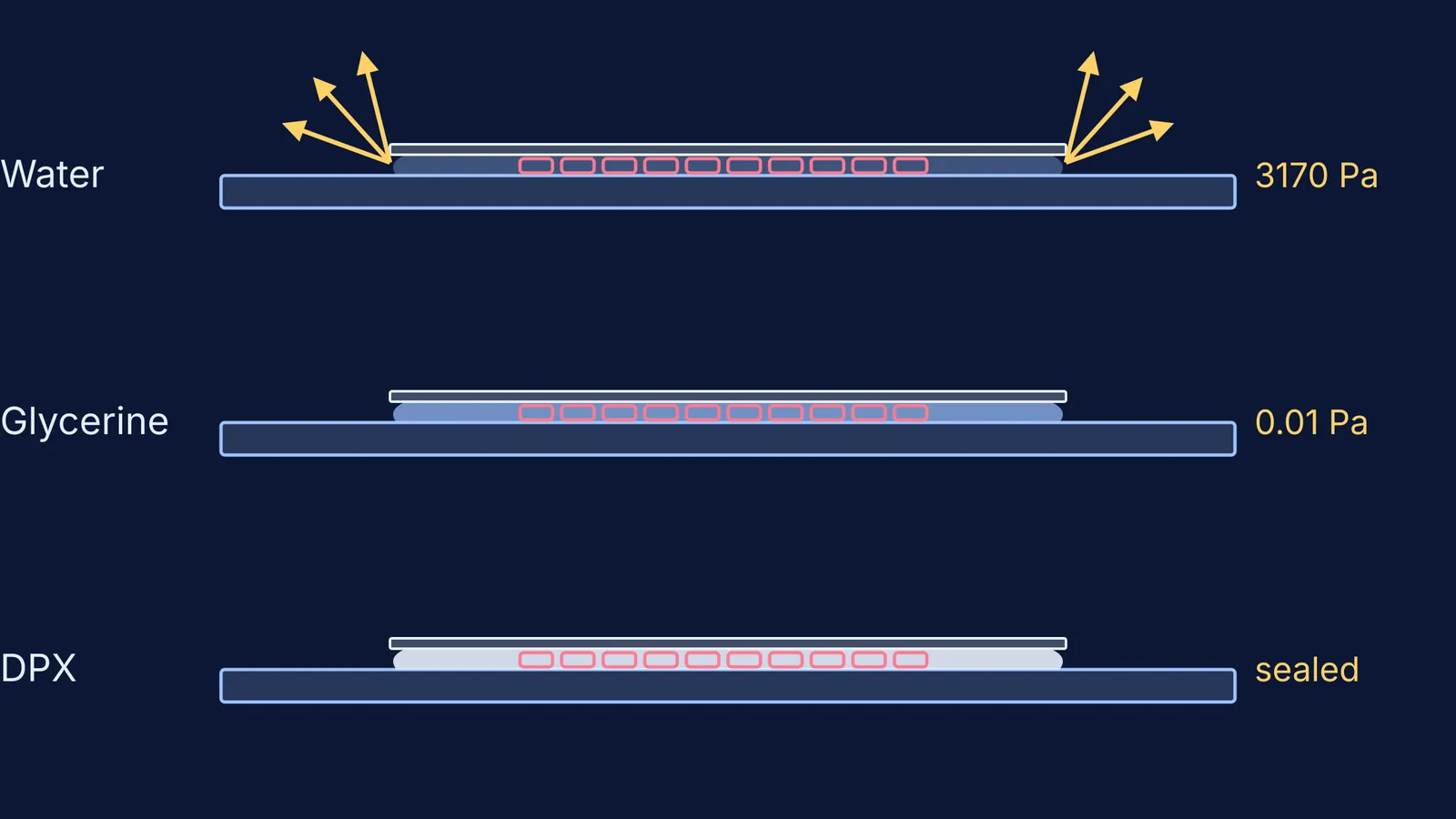
A mount is temporary when the liquid around the specimen, usually water or glycerine, can still evaporate from the coverslip edges. A 2014 review of mounting media in the Journal of Dr. NTR University of Health Sciences describes water as a convenient temporary mountant for examining some live specimens and for checking sections during staining (Ravikumar, Surekha and Thavarajah, 2014). The same review says liquid and glycerin mounts need the coverslip edge "ringed" with a sealant to prevent loss through evaporation.
Water has a second weakness. Its refractive index is 1.333, while the review gives about 1.5 for glass and about 1.53 for fixed tissue (Ravikumar et al., 2014). Light bends at each boundary, so a mismatched mountant gives poorer clarity and contrast.
Its strength is speed: you can peel, stain, mount and look within one period. For the steps, see our guides to preparing onion peel and cheek cell slides and a temporary mount of a leaf peel for stomata. If you are unsure which dye goes with which specimen, read safranin, methylene blue, iodine: which stain for which slide.
Why does glycerine stop a slide from drying?
Glycerine (glycerol) barely evaporates at room temperature. The International Chemical Safety Card for glycerol gives its vapour pressure as 0.01 Pa at 25 °C and describes it as hygroscopic, which means it takes up water from the air (ICSC 0624, ILO and WHO). Water's vapour pressure at 25 °C is about 3.17 kPa, or 3,170 Pa, in the standard IAPWS-95 data (vapour pressure of water table).
That is a gap of roughly 300,000 times. Vapour pressure measures how readily molecules escape a liquid's surface, so a glycerine film at the coverslip edge loses almost nothing while water keeps evaporating.
The 2014 review gives aqueous glycerol a refractive index of 1.46, closer to glass than water, and notes it is added to other mountants to slow drying and cracking (Ravikumar et al., 2014). Still, glycerine does not make a slide permanent: the review says a liquid preparation sealed well with nail polish could last some months.
How is a permanent slide prepared?
The review lists the sequence before mounting: fixing, paraffin embedding, sectioning, staining, dehydrating and clearing (Ravikumar et al., 2014). The last steps make a wet section last.
Dehydrate. Ethanol of increasing strength replaces the water in the tissue. One university lab protocol for H&E slides uses 95% ethanol twice for 30 seconds each, then fresh 100% ethanol twice (Bridges Lab, University of Michigan).
Clear. The slide goes into xylene. The review explains that xylene's refractive index is very close to that of fixed tissue, which makes the tissue more transparent; this is where the term "clearing" comes from.
Mount. A drop of resinous mountant goes under the coverslip. The review gives DPX (polystyrene with a plasticiser, dissolved in xylene) a refractive index of 1.52, and Canada balsam, a resin from fir bark, 1.52 to 1.54.
Harden. As the solvent evaporates, the resin hardens and fixes the coverslip to the slide, so resin mounts usually need no ringing. The Michigan protocol still seals the edge with nail polish.
The order matters because the resin is dissolved in xylene, which does not mix with water; the review lists miscibility with the dehydrant or clearing agent as a property of an ideal mountant. Alcohol removes the water, xylene replaces the alcohol, and only then can the resin soak in. The trade-off: alcohol and xylene strip some stains, so the review notes that fat stains such as the Sudan dyes go in aqueous mountants.
Temporary or permanent: which does your practical need?
Live specimen, like pond-water organisms? A water mount, looked at quickly.
Observing and drawing over a whole period? Glycerine.
Same slide needed next month, or by the next batch? A permanent mount.
Fat stain? An aqueous mountant, even for longer storage.
A short viva script built on the facts above:
Examiner: Is this slide temporary or permanent? You: Permanent. The coverslip is fixed in hardened resin and there is no liquid at the edge.
Examiner: Why not keep it in water? You: Water evaporates, and its refractive index of 1.333 is far from glass at about 1.5. DPX is about 1.52 (Ravikumar et al., 2014).
Examiner: Why the alcohol before the xylene? You: The resin is dissolved in xylene, which does not mix with water. Alcohol removes the water first, then xylene replaces the alcohol.
If refractive index is the part that feels shaky, the Fermi Concept Library covers every concept in physics, chemistry, biology, mathematics and computing, each with its own lesson, so you can link the optics to the slide box.
Next time you add that drop of glycerine, you will know why it is there.