On this page
A question that says "find the tangent where the curve cuts the y-axis" hides its point in the wording. You must work out the crossing point yourself before you can find a slope. A common slip is to differentiate before you know where.
How do you find the tangent where a curve cuts the y-axis?
The tangent to f at a is the line through (a, f(a)) whose slope is the limit of [f(x) − f(a)]/(x − a) as x approaches a, which is the derivative at a (OpenStax Calculus Volume 1, section 3.1). That definition needs two things, a point and a slope, in that order.
Find the point. Every point on the y-axis has x = 0, so put x = 0 in the equation. If you get y = c, the point is (0, c).
Find the slope. Differentiate, then substitute x = 0. Call the result m.
Write the line. Point-slope form gives y − c = m(x − 0), which is just y = mx + c.
For a refresher, see writing a line from a point and a slope or zooming in on a curve until it looks straight.
Worked example: an exponential curve at the y-axis
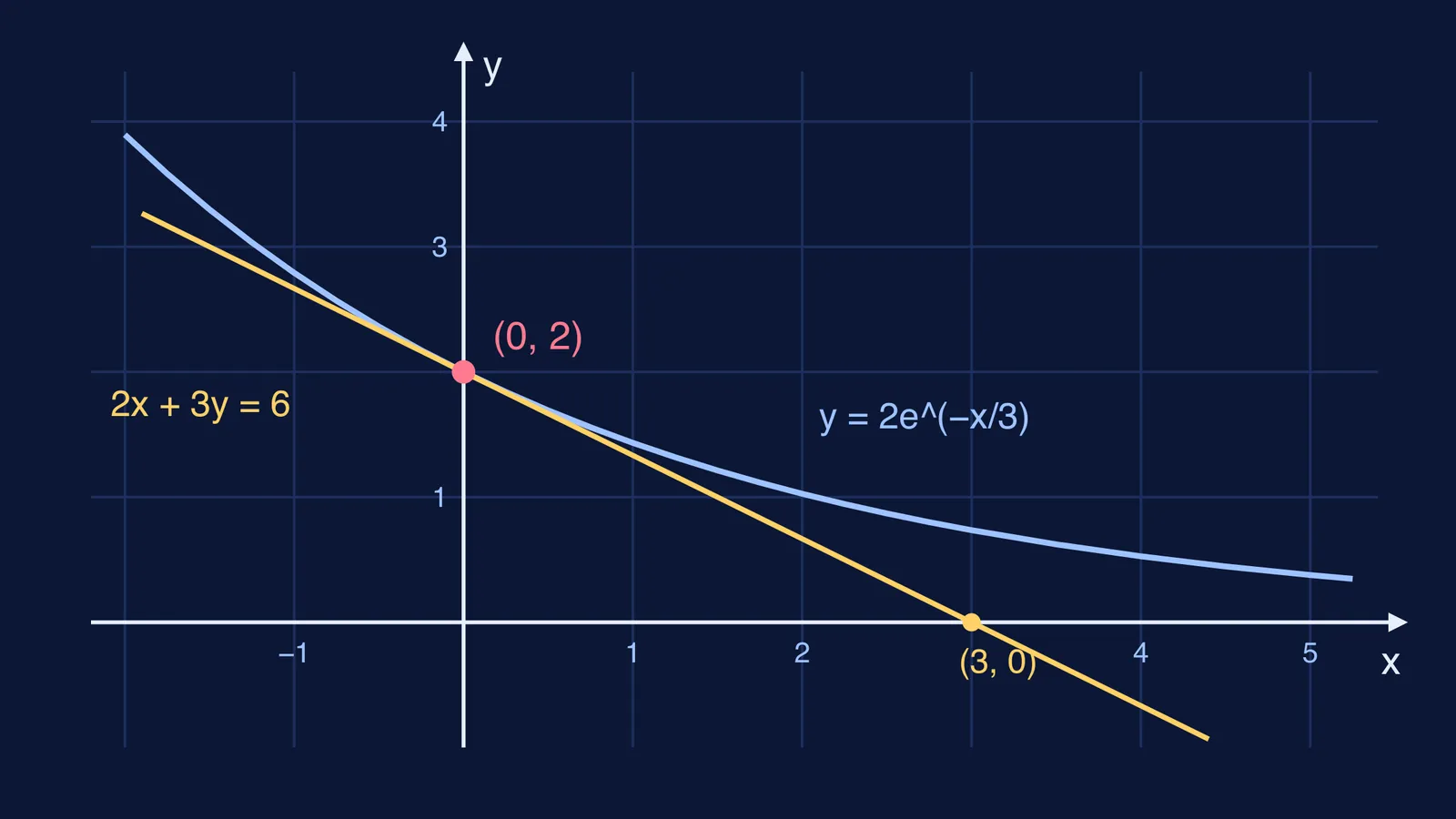
Find the tangent to y = 2e^(−x/3) where it cuts the y-axis.
Point: x = 0 gives y = 2e^0 = 2, so the point is (0, 2).
Slope: dy/dx = −(2/3)e^(−x/3). At x = 0 this is −2/3.
Line: y − 2 = −(2/3)x. Multiply by 3 and tidy up to get 2x + 3y = 6.
The diagram at the top shows this line, which meets the x-axis at (3, 0).
For any curve y = be^(−x/a), the same steps give the point (0, b), slope −b/a, and the tangent x/a + y/b = 1: a line with intercepts a and b. Derive it once rather than memorising it. The slope comes out cleanly because eˣ is its own derivative.
What changes when the curve cuts the x-axis?
Only step 1 changes: on the x-axis y = 0, so solve f(x) = 0.
Take y = eˣ − 2. Setting y = 0 gives eˣ = 2, so x = ln 2 and the point is (ln 2, 0). The slope is dy/dx = eˣ, which equals 2 at x = ln 2. The tangent is y = 2(x − ln 2), or y = 2x − 2 ln 2.
But y = eˣ on its own never reaches the x-axis, because eˣ is always positive. If the crossing equation has no solution, say so: there is no tangent.
Worked example: a rational curve at both axes
Find the tangents to y = (x − 7)/((x − 2)(x − 3)) where it cuts each axis.
x-axis. A fraction is zero only when its numerator is zero and its denominator is not. So x = 7, and the denominator there is 5 × 4 = 20, which is not zero. The point is (7, 0).
Shortcut: if y = N/D and N = 0 at your point, the quotient rule (N′D − ND′)/D² reduces to N′/D. Here N′ = 1, so the slope is 1/20. The tangent is y = (x − 7)/20, or x − 20y = 7.
y-axis. Put x = 0: y = −7/6, so the point is (0, −7/6). This time N is not zero, so you need the full quotient rule. With D = x² − 5x + 6, at x = 0 you have N = −7, N′ = 1, D = 6 and D′ = −5. The slope is (1 × 6 − (−7)(−5))/36 = −29/36. The tangent is y = −7/6 − (29/36)x, or 29x + 36y + 42 = 0.
Check it: put x = 0 back in and you get y = −42/36 = −7/6. Good.
Which mistakes cost marks on these questions?
Did you put x = 0 for the y-axis and y = 0 for the x-axis, not the other way round?
Does the curve actually cross that axis? y = eˣ never meets the x-axis, and y = 1/x never meets the y-axis.
For a rational curve, is the denominator non-zero at your crossing point?
Did the curve cross more than once? Each crossing gets its own tangent.
Did you write an equation, not just the slope?
If the question also asks for the normal, its slope is −1/m (for m not zero).
A syllabus note: the 2026-27 reprint of the NCERT Class 12 chapter Application of Derivatives mentions tangents and normals in its introduction, but has no section on them (NCERT, Chapter 6 PDF). Check your board's or exam's current syllabus before deciding how much to practise.
The Fermi Problem Library has worked problems with a step-by-step solver that explains the reasoning, so you can see which of the three steps went wrong. If the gap is the derivative rules, the Fermi Concept Library gives each concept its own lesson.