On this page
An equation that mixes sin 2x, cos 2x and tan x speaks three languages at once. Writing everything in terms of t = tan x turns it into algebra you already know. Here are the formulas, when they help, a worked example, and the trap that costs marks.
What are sin 2x and cos 2x in terms of tan x?
The NIST Digital Library of Mathematical Functions lists these double-angle forms as equations 4.21.27 to 4.21.29 in its table of trigonometric identities:
sin 2x = 2 tan x / (1 + tan²x)
cos 2x = (1 − tan²x) / (1 + tan²x)
tan 2x = 2 tan x / (1 − tan²x)
To derive them, write sin 2x = 2 sin x cos x over 1 = sin²x + cos²x, then divide top and bottom by cos²x. The same move on cos 2x = cos²x − sin²x gives the second formula. That division is the whole story, including the trap: it is only allowed when cos x is not zero.
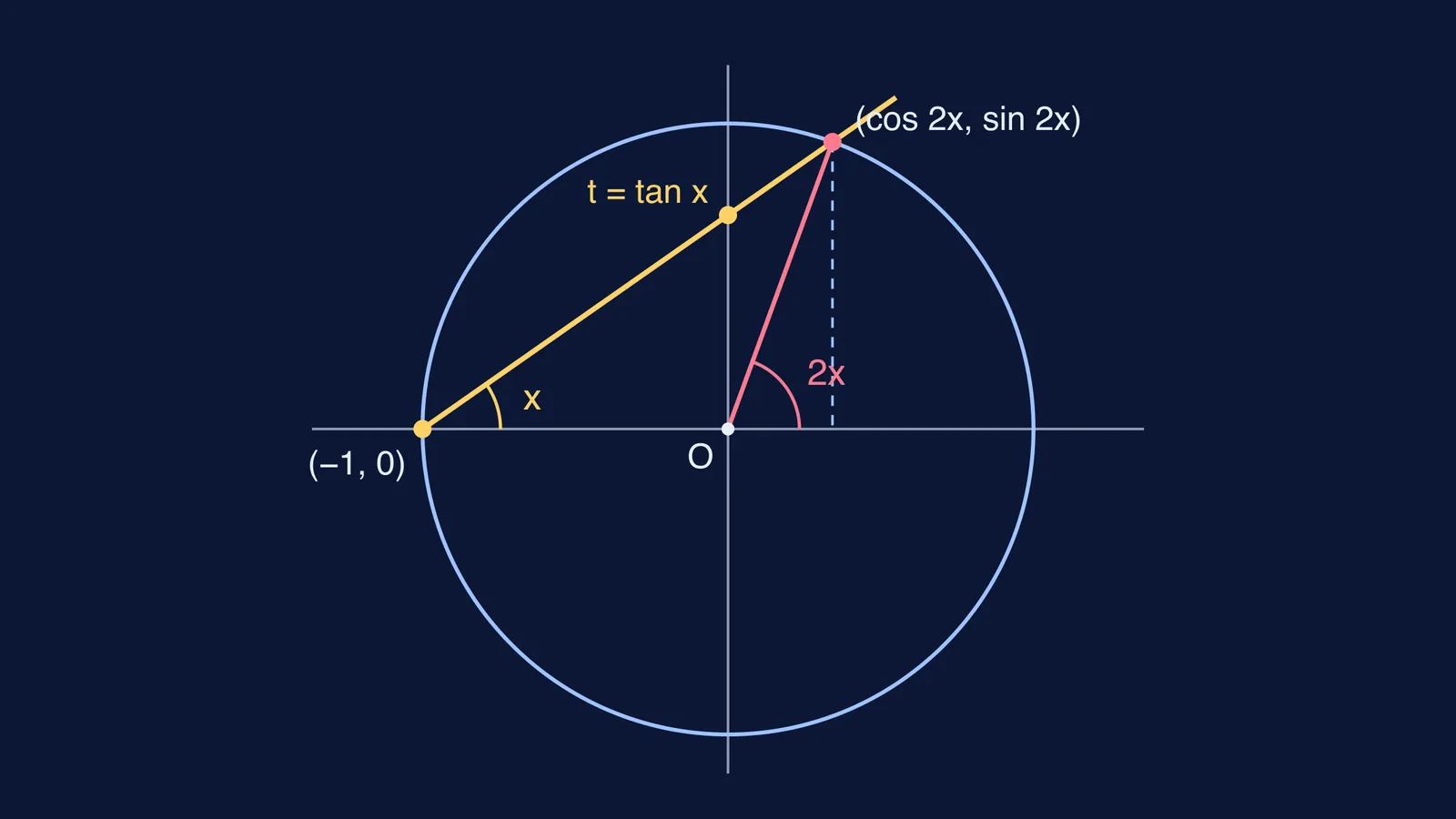
The picture at the top of this post shows why. A line from (−1, 0) with slope t = tan x meets the unit circle at (cos 2x, sin 2x), because the angle at the centre is twice the angle at the circumference. As x approaches 90°, the line turns vertical and t runs off to infinity: the one case the formulas cannot handle.
Replace x by x/2 and you get sin x and cos x in terms of tan(x/2), the version used in integration, covered in tan half-angle substitution: sin and cos in terms of t.
When does the tan x substitution simplify an equation?
Use it when:
the equation contains sin 2x, cos 2x and tan x (or cot x) together;
the equation has the form a sin 2x + b cos 2x = c and you would rather solve a quadratic in tan x than find an auxiliary angle;
you are given tan x and asked for sin 2x or cos 2x. For tan x = 3/4, the formulas give sin 2x = 24/25 and cos 2x = 7/25 without ever finding x.
Skip it when:
a lone sin x or cos x appears, as in sin x + cos 2x = 1; cos 2x = 1 − 2 sin²x gives a quadratic in sin x directly;
the equation already factorises, as sin 2x = cos x does once you write sin 2x = 2 sin x cos x. For a close cousin, see how to solve cos 2x = cos x completely.
Worked example: how do you solve 2 sin 2x − cos 2x = 2?
Put t = tan x: 4t/(1 + t²) − (1 − t²)/(1 + t²) = 2.
Multiply through by 1 + t², which is never zero: 4t − 1 + t² = 2 + 2t².
Tidy up: t² − 4t + 3 = 0, so (t − 1)(t − 3) = 0, giving t = 1 or t = 3.
Write the general solution: tan x = 1 gives x = nπ + π/4, and tan x = 3 gives x = nπ + tan⁻¹3, where n is any integer.
Test the case the substitution cannot see, cos x = 0. At x = π/2, sin 2x = 0 and cos 2x = −1, so the left side is 1, not 2. No extra roots.
Check t = 3 by putting it back: sin 2x = 6/10 and cos 2x = −8/10, so 2(0.6) + 0.8 = 2. If the jump from tan x = 3 to x = nπ + tan⁻¹3 feels shaky, revise how to find the general solution of trigonometric equations.
Which solutions does the tan x substitution lose?
Try sin 2x + cos 2x = −1. Substituting gives 2t + 1 − t² = −1 − t². The t² terms cancel, leaving 2t = −2, so t = −1 and x = nπ − π/4.
But put x = π/2 into the original: sin π + cos π = 0 − 1 = −1. It is a solution, and t never found it because tan(π/2) does not exist. The full answer is x = nπ − π/4 or x = nπ + π/2.
The warning sign was the cancellation. When a quadratic in t drops to a linear equation, a root has gone to infinity, and infinite t means cos x = 0.
A three-question checklist for your next paper
After substituting, does every term share the denominator 1 + t²? If not, pick another identity.
After clearing denominators, did the degree drop? Expect a lost root.
Does x = π/2 + nπ satisfy the original equation? Test it every time.
If you keep losing roots here, the Fermi Problem Library has worked problems with a step-by-step solver that explains the reasoning rather than printing an answer. To rebuild the identities, the Fermi Concept Library gives each concept its own lesson and its place in the map.