On this page
The equation cos 2x = cos x fits on one line, but correct methods give answers that look different, and it is easy to drop solutions. Here is the 2nπ ± α method, two cross-checks and a unit-circle test.
What is the general solution of cos θ = cos α?
For any angles θ and α, cos θ = cos α holds exactly when θ = ±α + 2nπ for some integer n, as listed in the table of equal trigonometric functions on Wikipedia's inverse trigonometric functions page. Many textbooks write this as θ = 2nπ ± α.
The unit circle shows why. Cosine is the x-coordinate, and α and −α are mirror images in the horizontal axis, so they share it. Full turns (2nπ) bring you back to the same two points. Our post on finding the general solution of trigonometric equations covers the sine and tangent versions.
How do you solve cos 2x = cos x step by step?
Match the form. Here θ = 2x and α = x, so 2x = 2nπ ± x.
Take the plus sign: 2x = 2nπ + x, which gives x = 2nπ.
Take the minus sign: 2x = 2nπ − x, so 3x = 2nπ, which gives x = 2nπ/3.
Merge the two families. Any 2nπ can be written as 2(3n)π/3, so the first family is already inside the second.
Write the answer: x = 2nπ/3, where n is any integer.
In the interval [0, 2π) this gives exactly three answers: 0, 2π/3 and 4π/3 (0°, 120° and 240°). If the question says [0, 2π] with a closed bracket, add 2π as well.
Does the double-angle method give the same answer?
Yes. OpenStax Precalculus works this exact equation in its worked example on solving trigonometric equations. It replaces cos 2θ with 2cos²θ − 1, so the equation becomes 2cos²θ − cos θ − 1 = 0, which factorises as (2cos θ + 1)(cos θ − 1) = 0. Its answers are θ = 2π/3 ± 2πk, θ = 4π/3 ± 2πk and θ = 0 ± 2πk.
Interleaved, those three families form one family spaced a third of a turn apart: 0, 2π/3, 4π/3, 2π and so on. That is x = 2nπ/3 again. The key is picking the form of cos 2x that contains only cos x; see the three forms of cos 2x and when to use each one.
A third method uses cos α − cos β = −2 sin((α + β)/2) sin((α − β)/2), from OpenStax's sum-to-product formulas. Here, cos 2x − cos x = −2 sin(3x/2) sin(x/2) = 0. So sin(3x/2) = 0, giving x = 2nπ/3, or sin(x/2) = 0, giving x = 2nπ, which is already included. All three methods agree.
How do you check the answers on the unit circle?
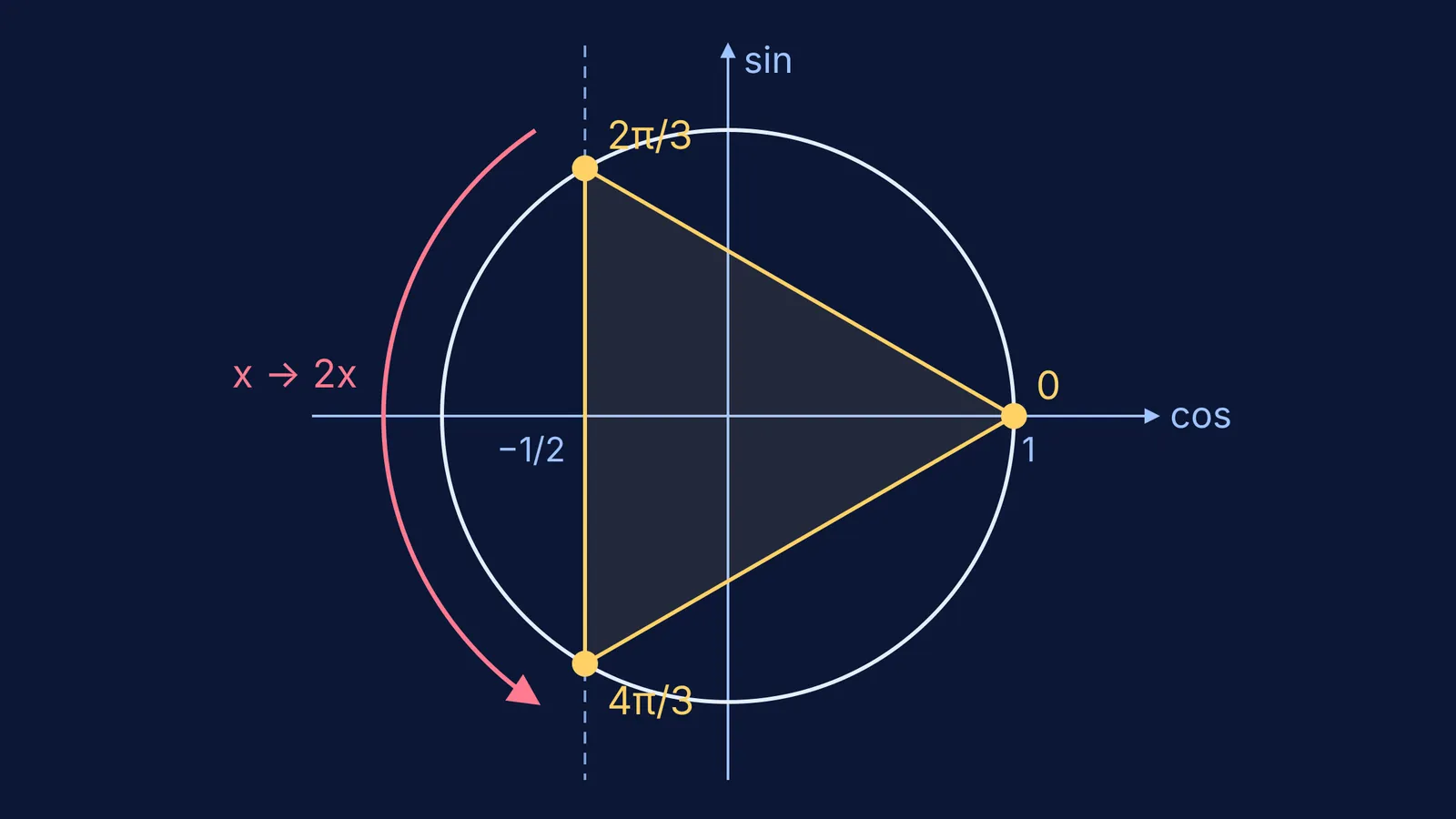
Mark 0, 2π/3 and 4π/3 on a unit circle; they form an equilateral triangle, as in the diagram above. Then test each one:
x = 0: cos 0 = 1 and cos 0 = 1. It works.
x = 2π/3: then 2x = 4π/3. Both angles sit on the vertical line through −1/2, so both cosines are −1/2. It works.
x = 4π/3: then 2x = 8π/3, which is 2π + 2π/3. That is the 2π/3 point again, so the cosine is −1/2. It works.
A non-answer, x = π: cos 2π = 1 but cos π = −1. It fails, which is what you want.
Now count the answers. The factorised form says cos x = 1 (one point on the circle) or cos x = −1/2 (two points). So there are exactly three answers per full turn. If your general solution gives two or four, something has gone wrong.
What mistakes cost marks on this question?
Using only the plus sign. You get x = 2nπ and lose two of the three answers in every turn.
Dividing both sides by an expression such as cos x or sin(x/2). Any step that divides by something that can be zero can throw away answers.
Leaving two families unmerged and then not recognising the merged form among the options.
Mixing degrees and radians, such as 2nπ ± 60°.
Missing an endpoint such as 2π in a closed interval.
If you reach an answer that looks different from the book's and can't tell whether they match, the Fermi Problem Library has worked problems with a step-by-step solver that explains the reasoning rather than just printing an answer. To revisit general solutions from the ground up, the Fermi Concept Library gives each mathematics concept its own lesson.
For practice, try cos 3x = cos x. You should get x = nπ or x = nπ/2, which merge into x = nπ/2.