On this page
You are stuck on ∫ x/(1 + x⁴) dx. The denominator has an x⁴, and nothing in your formula list looks like it. The fix is one substitution: let t = x². The x⁴ becomes t², the lone x in the numerator disappears into dt, and the integral turns into the arctan form you already know.
How do you integrate x/(1 + x⁴)?
The standard result you are aiming for is ∫ du/(a² + u²) = (1/a) tan⁻¹(u/a) + C, given as Formula 5.24 in OpenStax Calculus Volume 1, section 5.7. With a = 1 it is simply ∫ du/(1 + u²) = tan⁻¹u + C.
Now the steps:
Notice that x⁴ = (x²)². The denominator is 1 + (x²)², which is 1 plus something squared.
Put t = x². Then dt = 2x dx, so x dx = dt/2.
Substitute: ∫ x dx/(1 + x⁴) = ∫ (dt/2)/(1 + t²) = ½ ∫ dt/(1 + t²).
Integrate: ½ tan⁻¹t + C.
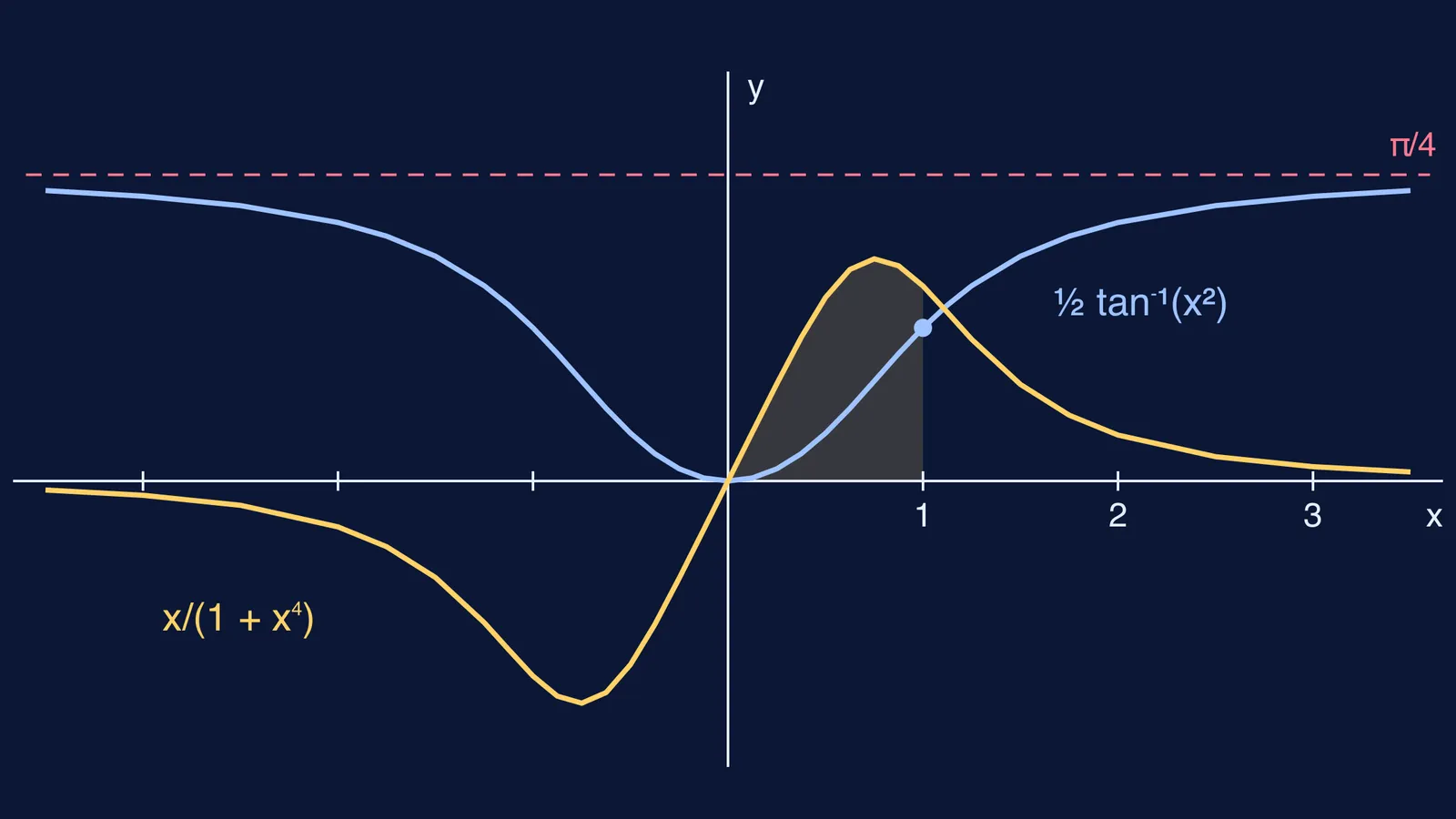
Put x back: ½ tan⁻¹(x²) + C.
Check by differentiating. The derivative of ½ tan⁻¹(x²) is ½ × 2x/(1 + x⁴) = x/(1 + x⁴). The chain rule hands back the integrand.
Why does t = x² work here and not everywhere?
The substitution works because two things line up. The numerator x is half the derivative of x², so it is absorbed into dt with nothing left over. And the denominator 1 + (x²)² is a sum of squares in t.
Change either one and the trick breaks:
∫ x²/(1 + x⁴) dx: the numerator x² is not the derivative of x², so t = x² leaves a √t behind. This family needs a different route: split the numerator into (x² + 1) and (x² − 1) halves and divide by x², as in our post on integrating (x² + 1)/(x⁴ + 1).
∫ x³/(1 + x⁴) dx: the numerator is a multiple of the derivative of the whole denominator, so t = 1 + x⁴ gives ¼ ln(1 + x⁴) + C. That is a log, not an arctan.
∫ x/(1 + x⁸) dx: t = x² gives ½ ∫ dt/(1 + t⁴), which still has a fourth power. No arctan in one step.
How do you integrate x³/(1 + x⁸)?
Same pattern, higher powers. Here x⁸ = (x⁴)², and the derivative of x⁴ is 4x³, which matches the numerator.
Put t = x⁴, so dt = 4x³ dx and x³ dx = dt/4.
Substitute: ∫ x³ dx/(1 + x⁸) = ¼ ∫ dt/(1 + t²) = ¼ tan⁻¹t + C.
Put x back: ¼ tan⁻¹(x⁴) + C.
The general rule is ∫ xⁿ⁻¹/(1 + x²ⁿ) dx = (1/n) tan⁻¹(xⁿ) + C for any n ≠ 0. So x²/(1 + x⁶) gives ⅓ tan⁻¹(x³) + C, and x⁵/(1 + x¹²) gives ⅙ tan⁻¹(x⁶) + C. The same xⁿ⁻¹ idea drives the integral of 1/(x(xⁿ + 1)), where it leads to a log instead.
When the constant is not 1, use the full formula with a. For ∫ x/(9 + x⁴) dx, t = x² gives ½ ∫ dt/(9 + t²) = ½ × (1/3) tan⁻¹(t/3) + C = (1/6) tan⁻¹(x²/3) + C.
What is the integral of x/(1 + x⁴) from 0 to 1?
The limits move with the substitution. With t = x², x = 0 becomes t = 0 and x = 1 becomes t = 1. So ∫₀¹ x/(1 + x⁴) dx = ½ (tan⁻¹1 − tan⁻¹0) = ½ × π/4 = π/8.
From 0 to infinity, t also runs from 0 to infinity, and the value is ½ × π/2 = π/4. You can see this in the diagram at the top: the arctan curve climbs towards π/4 but never reaches it.
In the same way, ∫₀¹ x³/(1 + x⁸) dx = ¼ × π/4 = π/16.
Practice set: five to try now
Apply the one-line test first, then solve.
∫ x/(4 + x⁴) dx
∫ x²/(1 + x⁶) dx
∫ x⁴/(1 + x¹⁰) dx
∫ eˣ/(1 + e²ˣ) dx
∫ x³/(1 + x⁴) dx
Answers: (1) ¼ tan⁻¹(x²/2) + C; (2) ⅓ tan⁻¹(x³) + C; (3) ⅕ tan⁻¹(x⁵) + C; (4) tan⁻¹(eˣ) + C, with t = eˣ; (5) ¼ ln(1 + x⁴) + C, the trap, because the numerator matches the derivative of the whole denominator.
Check every answer by differentiating it, the habit we describe in how to check an integral by differentiating.
If your substitution keeps leaving a stray x or √t behind and you cannot see why, the Fermi Problem Library has worked problems with a step-by-step solver that explains the reasoning rather than printing an answer. If the arctan standard form itself feels shaky, the Fermi Concept Library gives each mathematics concept its own lesson.