

On this page
You see ∫dx/(x(xⁿ + 1)) and the obvious move, t = xⁿ, seems to fail. dt is n·xⁿ⁻¹ dx, and there is no xⁿ⁻¹ anywhere in the question. The fix takes one line, and it is the hint NCERT gives with the question in the Class 12 textbook: Exercise 7.5, Question 16 tells you to multiply the numerator and denominator by xⁿ⁻¹ and put xⁿ = t.
How do you integrate 1/(x(xⁿ + 1))?
Follow the NCERT hint, one step at a time.
Multiply top and bottom by xⁿ⁻¹. The x in the denominator becomes x·xⁿ⁻¹ = xⁿ, so the integrand is xⁿ⁻¹/(xⁿ(xⁿ + 1)).
Put t = xⁿ. Then dt = n·xⁿ⁻¹ dx, so xⁿ⁻¹ dx = dt/n.
The integral is now (1/n)∫dt/(t(t + 1)).
Split into partial fractions: 1/(t(t + 1)) = 1/t − 1/(t + 1). Check it by recombining: (t + 1 − t)/(t(t + 1)) = 1/(t(t + 1)).
Integrate: (1/n)[ln|t| − ln|t + 1|] + C.
Put t = xⁿ back: (1/n) ln|xⁿ/(xⁿ + 1)| + C.
NCERT writes log where we write ln; they mean the same natural logarithm. This answer matches the Careers360 solution linked above, and the worked solution on Teachoo uses the same hint and steps. The working holds for any n ≠ 0, though the textbook has a positive whole number in mind.
Is there a faster way than partial fractions?
Two other routes reach the same answer, which gives you a built-in check.
The first splits the 1 in the numerator. Write 1 as (xⁿ + 1) − xⁿ. Then 1/(x(xⁿ + 1)) = 1/x − xⁿ⁻¹/(xⁿ + 1). The first term integrates to ln|x|. The second has the derivative of its denominator on top, up to a factor of n, so it gives (1/n) ln|xⁿ + 1|. The answer is ln|x| − (1/n) ln|xⁿ + 1| + C, and since ln|x| = (1/n) ln|xⁿ|, it is the same as the substitution answer. This is the same idea as the add and subtract trick for x² over x² + 1.
The second divides top and bottom by xⁿ⁺¹. The integrand becomes x⁻ⁿ⁻¹/(1 + x⁻ⁿ). Put u = 1 + x⁻ⁿ, so du = −n·x⁻ⁿ⁻¹ dx, and the integral is −(1/n) ln|1 + x⁻ⁿ| + C. Because 1 + x⁻ⁿ = (xⁿ + 1)/xⁿ, flipping the fraction inside the log cancels the minus sign, and you are back at (1/n) ln|xⁿ/(xⁿ + 1)| + C.
What about 1/(x(xⁿ − 1))?
The same multiply-and-substitute move works. You get (1/n)∫dt/(t(t − 1)), and this time 1/(t(t − 1)) = 1/(t − 1) − 1/t. So the integral is (1/n) ln|(xⁿ − 1)/xⁿ| + C. Notice the fraction inside the log has flipped compared with the plus case: that is where most sign mistakes happen.
NCERT's Exercise 7.5, Question 20 is the n = 4 case, 1/(x(x⁴ − 1)), with the answer (1/4) log|(x⁴ − 1)/x⁴| + C.
The trick fits any integrand that is a lone x times a function of xⁿ. Some cousins:
1/(x(xⁿ + a)) with a ≠ 0: the same steps give (1/(na)) ln|xⁿ/(xⁿ + a)| + C, because 1/(t(t + a)) = (1/a)(1/t − 1/(t + a)).
1/(x(xⁿ + 1)²): the substitution gives (1/n)∫dt/(t(t + 1)²), which needs a partial fraction with a repeated factor.
1/(xⁿ + 1) on its own: no lone x, so there is nothing for xⁿ⁻¹ to fix. This one needs a different method.
For more practice, read how to solve integrals using substitution and partial fractions.
How do you check your answer quickly?
Differentiate it. Using the split-the-1 form, d/dx[ln|x| − (1/n) ln|xⁿ + 1|] = 1/x − xⁿ⁻¹/(xⁿ + 1) = (xⁿ + 1 − xⁿ)/(x(xⁿ + 1)) = 1/(x(xⁿ + 1)). That is the integrand, so the answer is right. Our guide on checking an integral by differentiating shows this habit in more detail.
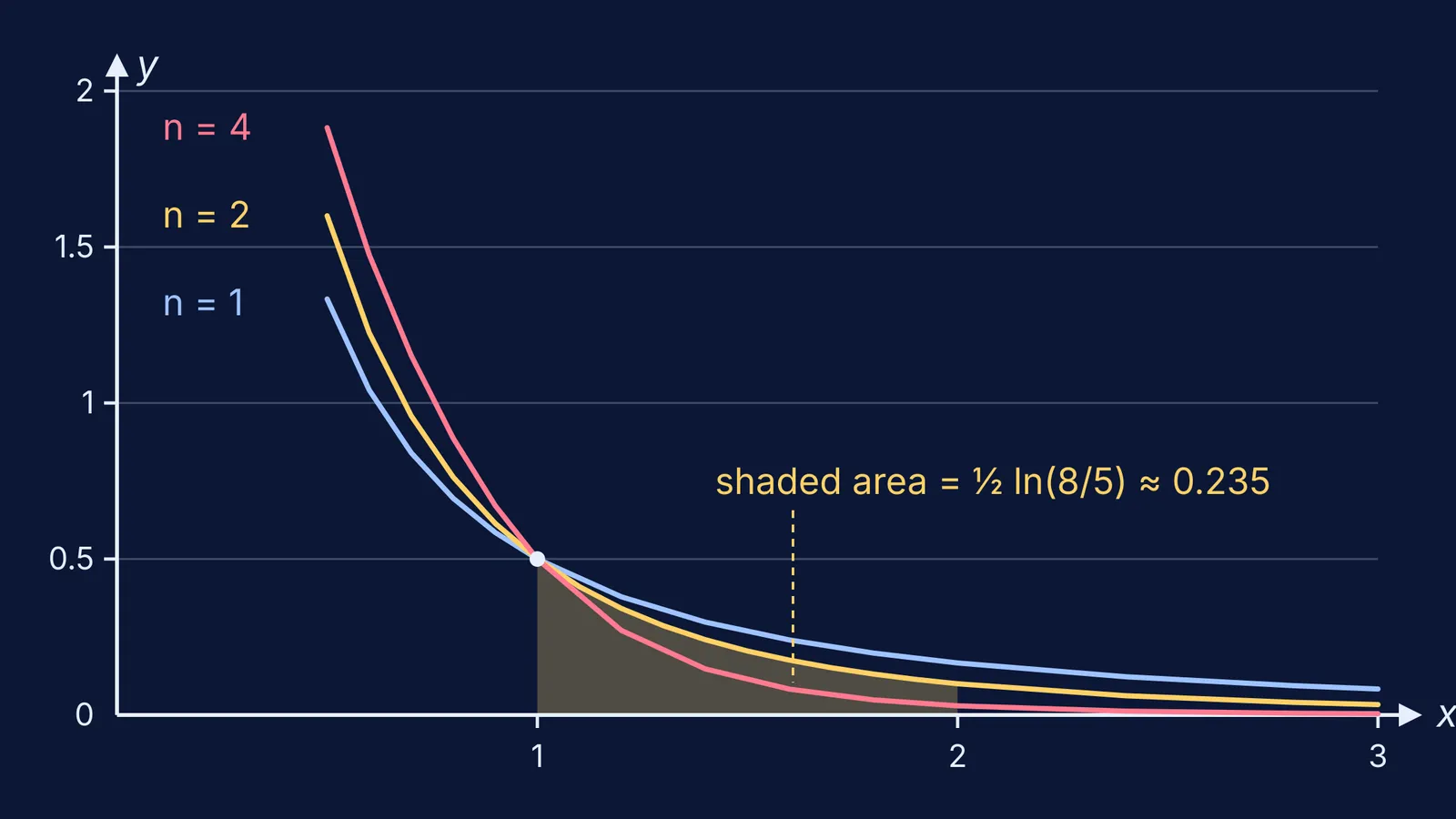
For a second check, put in numbers. Take n = 2 and integrate from 1 to 2: (1/2) ln(4/5) − (1/2) ln(1/2) = (1/2) ln(8/5), about 0.235. A rough Simpson's rule estimate with x = 1, 1.5 and 2 gives about 0.237. The two agree closely, a good sign that no step went wrong.
If step 1 is the part that never occurs to you in a test, practise it on similar questions. The Fermi Problem Library has worked problems with a step-by-step solver that explains the reasoning rather than printing an answer. For a refresher on partial fractions themselves, the Fermi Concept Library gives each mathematics concept its own lesson.
Try the minus case with n = 3 on paper now, then differentiate your answer to check it.


