On this page
Pick a leaf from the sunny top of a tree and another from deep inside the same tree. They share the same DNA, yet the top leaf usually feels stiffer and thicker. That contrast is a clean example of a plant matching its body to its environment, and a classic structure-and-function comparison in school biology.
What is the difference between sun leaves and shade leaves?
Studies of many species keep finding the same differences:
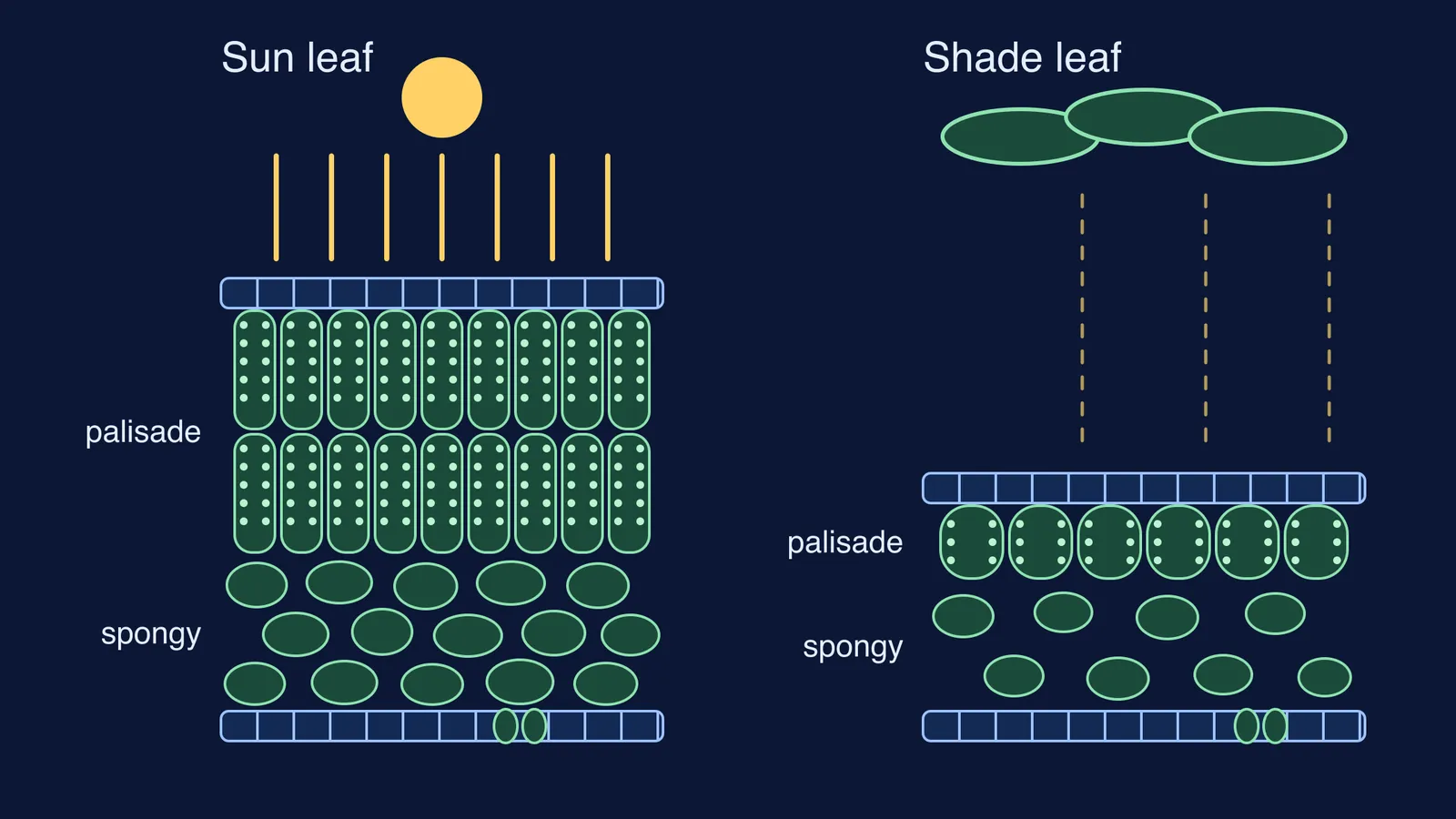
Thickness: sun leaves are thicker and have a thicker mesophyll, the green tissue between the upper and lower skin of the leaf (Wyka et al., Oecologia, 2012).
Palisade cells: sun leaves contain more columnar palisade cells, while palisade cells in shade leaves tend to be rounder (Gotoh et al., Scientific Reports, 2018).
Air space: grapevine leaves grown in high light were thicker and less porous than leaves grown in low light (Théroux-Rancourt et al., AoB PLANTS, 2023).
Mass per area: in 385 tropical trees in Peru, leaf mass per area was 19% higher in sun leaves than in shade leaves from the same trees (Martin et al., Frontiers in Plant Science, 2020).
Pigment: in that same study, chlorophyll per gram of leaf was 19% higher in shade leaves, though per square centimetre the two were similar (Martin et al., 2020).
The palisade is the layer of tall, packed cells just under the upper surface. For how it sits above the spongy layer, see our guide to dorsiventral vs isobilateral leaves.
Why are sun leaves thicker than shade leaves?
Photosynthesis needs carbon dioxide to reach the chloroplasts, and it gets there from the air spaces inside the leaf. Ichiro Terashima and colleagues modelled this and argued that a thicker mesophyll gives more chloroplast surface facing those air spaces per unit of leaf area, at the price of higher building and upkeep costs (Terashima et al., Journal of Plant Research, 2001).
In bright light, there is enough energy to keep all that extra machinery busy, so the cost pays off. In the grapevine study, sun leaves had more mesophyll surface exposed to air per unit leaf area, and their greater thickness and lower porosity, plus less surface per cell volume, almost completely explained that gap (Théroux-Rancourt et al., 2023). Column-shaped palisade cells may also help light travel deeper into the leaf instead of being absorbed in the top layer (Gotoh et al., 2018).
Why are shade leaves thinner?
In dim light, the limit is light, not carbon dioxide or enzymes. Extra layers of palisade would sit idle, so a plant gets more from spreading the same material over more leaf area. A meta-analysis of 500 experiments on 760 plant species found that leaf area ratio, the leaf area a plant carries per unit of its mass, fell by up to three-fold as daily light rose (Poorter et al., New Phytologist, 2019).
In shade, light is the limiting factor in Blackman's law, so the leaf is built to catch light, not to process lots of it.
Is the sun-shade difference adaptation or acclimation?
Leaves on one tree differ because the same genes respond to different light as each leaf develops; biologists call this phenotypic plasticity, or acclimation. Adaptation, strictly, is a heritable trait shaped by natural selection, such as a species' ability to switch between the two designs at all.
Some plants can even remodel a leaf that is already fully grown. When shaded sycamore maple seedlings were moved into full sun, their existing leaves became thicker within 30 days, mostly because palisade cells grew longer, although the most heavily shaded plants suffered lasting light damage instead (Wyka et al., Photosynthesis Research, 2022).
How do you write this as an exam answer?
Here is a model 3-mark answer to "Explain how sun and shade leaves are adapted to their light conditions."
State the contrast: sun leaves are thicker, with longer, column-shaped palisade cells, sometimes in more than one layer; shade leaves are thinner, with shorter palisade cells and more air space.
Give the reason for sun leaves: high light can drive a lot of photosynthesis, so extra palisade tissue and chloroplast surface increase the rate per unit leaf area.
Give the reason for shade leaves: light is limiting, so a thin leaf spreads its material over more area and catches more light per gram.
Before you submit, check that you named a tissue (palisade or mesophyll), linked structure to function, and stated which factor limits photosynthesis in each case.
If the terms mesophyll, palisade or limiting factor still feel shaky, the Fermi Concept Library has a lesson for each concept in biology, so you can fill the gap before practising answers.
Next time you pass a tree, pick one leaf from the sunny edge and one from inside, and feel the difference for yourself.