

On this page
When studying plant anatomy for exams like NEET-UG or Class 11 Biology, one of the most common comparisons is between dorsiventral and isobilateral leaves. The difference comes down to how a plant adapts its cellular structure—its stomata, mesophyll, and vascular bundles—to capture sunlight and prevent water loss.
What is a dorsiventral leaf?
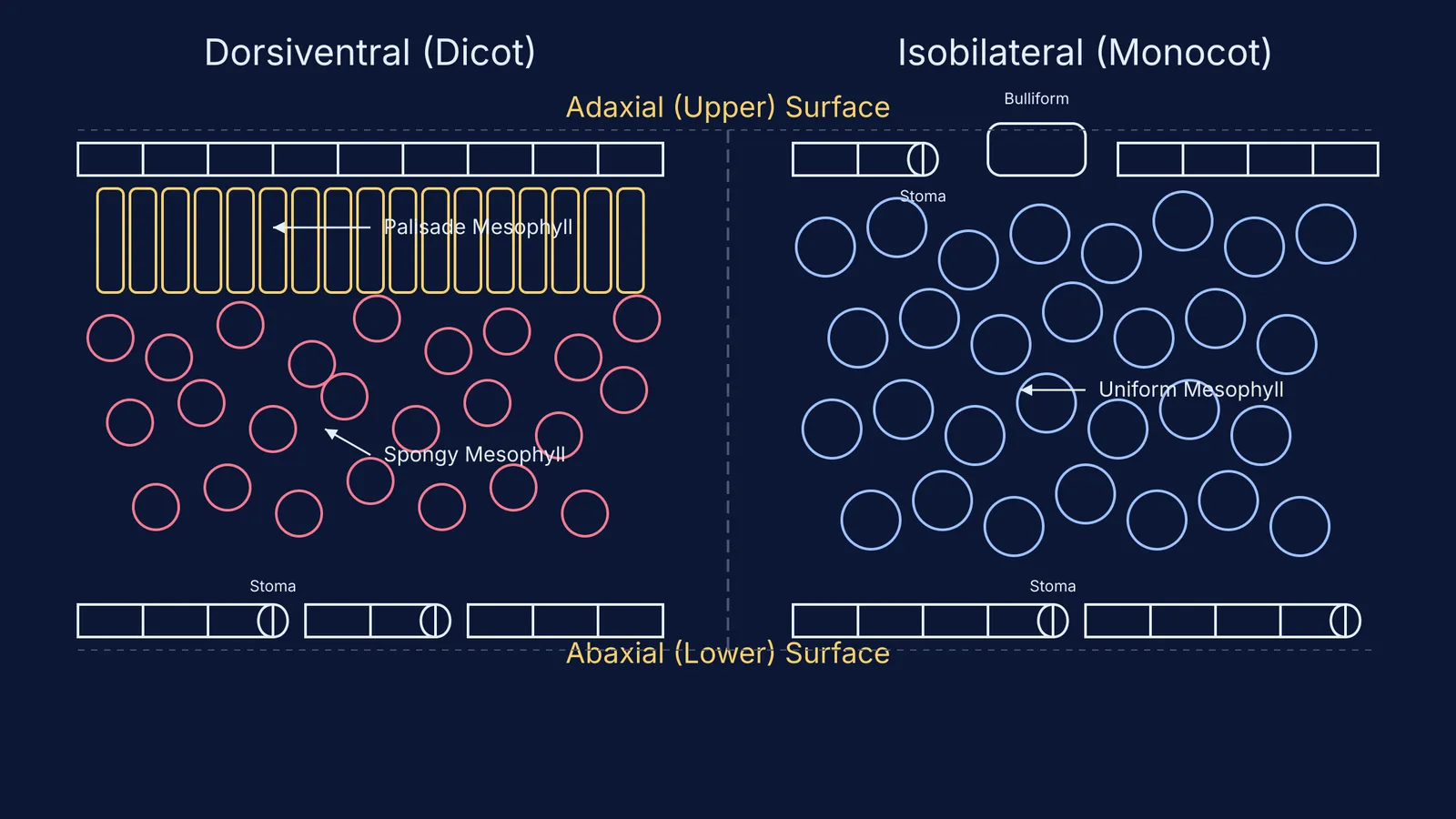
A dorsiventral leaf has two surfaces that look and function differently: an upper (adaxial) surface and a lower (abaxial) surface. This anatomy is typical of dicotyledonous plants, such as mango, banyan and sunflower.
Because these leaves usually grow horizontally, the upper surface takes the brunt of the direct sunlight. To adapt, the leaf is highly asymmetric inside. The mesophyll (the tissue where photosynthesis happens) is differentiated into two distinct layers:
Palisade parenchyma: Located just below the upper epidermis, this layer consists of vertically elongated, tightly packed cells that are rich in chloroplasts. They absorb the intense light striking the top of the leaf, acting as the primary site for carbon fixation.
Spongy parenchyma: Found below the palisade layer, these cells are rounder and loosely arranged with large air spaces between them. This open network of cells helps gases diffuse rapidly during photosynthesis and respiration, ensuring that carbon dioxide reaches the chloroplasts efficiently.
To minimise water loss through transpiration, dorsiventral leaves are usually hypostomatic. This means their stomata are mostly (or entirely) located on the lower, shaded surface. The greater sensitivity of abaxial stomata to light helps the plant control gas exchange efficiently without losing too much moisture to evaporation.
Another key feature is the vascular system. Dorsiventral leaves exhibit reticulate venation, meaning their vascular bundles form a net-like pattern. Because the veins vary in thickness, the vascular bundles seen in a cross-section also vary in size. These bundles are typically surrounded by a single layer of colourless bundle sheath cells.
What is an isobilateral leaf?
An isobilateral leaf has upper and lower surfaces that are structurally similar. This type of anatomy is characteristic of monocotyledonous plants, particularly grasses, maize, wheat and lilies.
Isobilateral leaves often grow vertically or at steep angles, meaning both surfaces receive roughly equal amounts of sunlight throughout the day. Because of this even light distribution, the internal structure does not need to be asymmetric:
The mesophyll is not differentiated into palisade and spongy layers. Instead, the mesophyll characteristics are uniform throughout the leaf, consisting of roughly spherical cells that all contain chloroplasts.
The leaves are amphistomatic, meaning stomata are distributed evenly on both the upper and lower epidermis. This allows for gas exchange on both sides of the vertical leaf.
In grasses, the upper epidermis also contains specialised, large, empty cells called bulliform cells. These motor cells play a crucial role in managing the plant's water balance. When the plant has plenty of water, these cells absorb moisture, become turgid, and keep the leaf surface flat and fully exposed to the sun. When the plant is under water stress, the bulliform cells lose turgor and collapse. This makes the leaf curl inwards, hiding the stomata and significantly reducing the exposed surface area to minimise further water loss.
Isobilateral leaves feature parallel venation. As a result, the vascular bundles are generally of a similar size across the leaf, with the exception of the prominent midrib. In many C4 monocots like maize, the vascular bundles are surrounded by a prominent layer of large bundle sheath cells that contain chloroplasts, a specialised structure known as Kranz anatomy.
Dorsiventral vs isobilateral leaf anatomy: the key differences
If you need a quick checklist of anatomical differences for an exam, look at these specific features:
Mesophyll: Differentiated into distinct palisade and spongy layers in dorsiventral leaves; undifferentiated and uniform in isobilateral leaves.
Stomata: Found mainly on the lower epidermis in dorsiventral leaves; present on both surfaces in isobilateral leaves.
Venation: Reticulate (net-like) with varying bundle sizes in dorsiventral leaves; parallel with uniform bundle sizes in isobilateral leaves.
Orientation: Dorsiventral leaves are typically horizontal; isobilateral leaves are typically vertical.
Plant type: Dorsiventral anatomy is found in dicots; isobilateral anatomy is found in monocots.
Bulliform cells: Absent in dorsiventral leaves; present in the upper epidermis of isobilateral grass leaves.
If you want to review the cellular differences without memorising a textbook, the Concept Library covers every concept in physics, chemistry, biology, mathematics and computing, each with its own lesson and its place in the map.


