On this page
Look at a sunset and then at a full Moon a few nights later, and the two discs seem almost exactly the same size. They are nowhere near the same size. The explanation is one ratio.
How much bigger is the Sun than the Moon?
NASA's Sun fact sheet gives the Sun's mean radius as 695,700 km, so its diameter is about 1,391,400 km. NASA's Moon fact sheet gives the Moon's mean radius as 1,737.4 km, a diameter of about 3,475 km. Divide one by the other and the Sun comes out about 400 times wider than the Moon.
The same two fact sheets give the distances. The Sun is on average 149.6 million km from Earth, and the Moon's average distance is 384,400 km. So the Sun is also about 390 times farther away. Bigger by 400, farther by 390: the two effects almost cancel.
Why do the sun and moon look the same size?
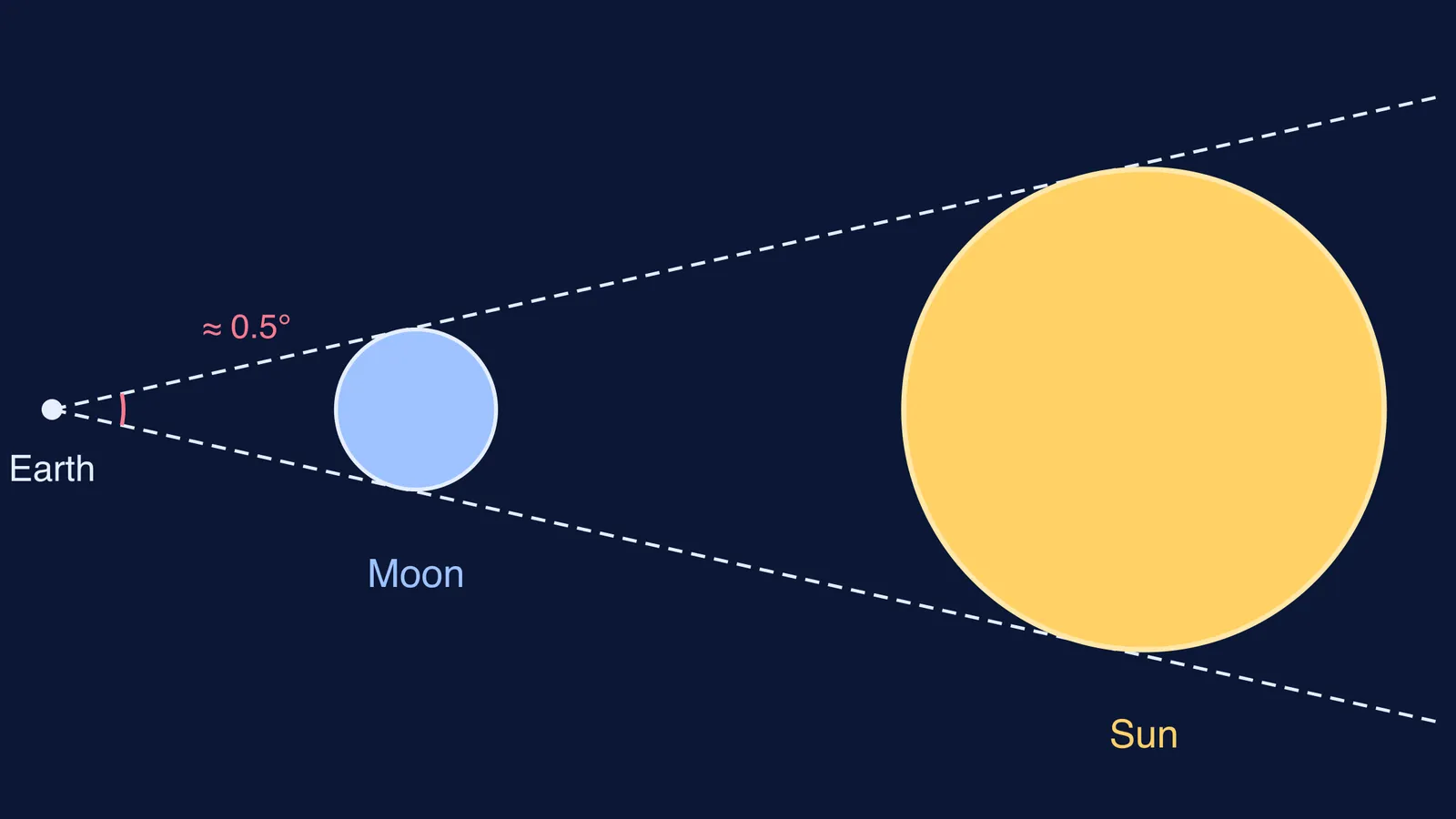
How big something looks depends on the angle it covers at your eye, not on its width alone. That angle is called its angular size.
Here is the worked example, using NASA's figures from the Sun and Moon fact sheets:
Sun: 1,391,400 km ÷ 149,600,000 km = 0.0093 radians, which is about 0.53 degrees.
Moon: 3,475 km ÷ 384,400 km = 0.0090 radians, which is about 0.52 degrees.
Check: the two angles differ by only about 3%, because 400 and 390 are so close.
NASA also lists the apparent diameters directly: 1,919 arcseconds for the Sun at its mean distance, according to the Sun fact sheet, and 1,896 arcseconds for the Moon at full Moon, according to the Moon fact sheet. A degree has 3,600 arcseconds, so both are just over half a degree, and they agree to about 1%.
This is similar triangles. Draw two lines from your eye that just touch the edges of the Moon, extend them, and the Sun fits snugly between the same two lines. Ideas like this are easier to see than to read, which is why the Fermi Simulation Lab has interactive simulations for them.
Why are some solar eclipses total and others a ring of fire?
The match is close but not fixed, because both distances change. NASA's Moon fact sheet puts the Moon's mean closest distance (perigee) at 363,300 km and its farthest (apogee) at 405,500 km. Run the same formula:
At perigee, 3,475 ÷ 363,300 gives about 0.55 degrees.
At apogee, 3,475 ÷ 405,500 gives about 0.49 degrees.
The Sun's apparent size changes a little too, between 1,887 and 1,952 arcseconds (about 0.52 to 0.54 degrees) through the year, according to the Sun fact sheet.
So when the Moon is near perigee, it looks slightly bigger than the Sun and can hide it completely: a total solar eclipse. Near apogee it looks slightly smaller. NASA's guide to eclipse types explains that the Moon then "does not completely cover the Sun", leaving a bright ring around it: an annular eclipse. The same perigee effect is what makes a supermoon look bigger than an ordinary full Moon.
Looking at even a thin ring of Sun without proper protection can harm your eyes. Before any eclipse, read how to watch a solar eclipse safely at home.
Is it just a coincidence, and will it last?
Nothing in physics requires the two angles to match; it simply happens that they do right now. NASA's page on lunar laser ranging says the Moon is receding from Earth at about 3.8 centimetres per year. Against the 384,400 km distance in the Moon fact sheet that is tiny: over 10,000 years it adds up to less than half a kilometre. Over far longer spans, though, the Moon's disc keeps shrinking in our sky, so annular eclipses will slowly become more common than total ones. See what drives the drift in why the Moon is slowly drifting away from Earth.
How can you check it yourself?
The Moon's distance is about 110 times its diameter (384,400 ÷ 3,475 is about 111, from the Moon fact sheet). That means anything held at 110 times its own width from your eye covers the Moon exactly. Call it the 1-in-110 test.
Measure the distance from your eye to your outstretched fingertips, say 60 cm.
Divide by 110. For 60 cm you get about 5.5 mm.
Punch a hole about that wide in a card, hold it at arm's length and line it up with the full Moon. The Moon should just fill it.
Never look at the Sun to compare. Instead, make a small pinhole in a card and let sunlight fall on paper 1 metre behind it. The Sun's image will be close to 1 cm across, because the Sun's distance is about 108 times its diameter, from the Sun fact sheet.
If radians or the small-angle approximation are the shaky part, the Fermi Concept Library has a lesson for every concept in physics and mathematics, each with its place in the map. Then take your card outside on the next full Moon.