

On this page
We notice the moon when it looks unusually huge, hanging low on the horizon and glowing brightly against the night sky. The news often calls this event a supermoon. But what physically changes in space to make the moon look bigger? It comes down to the shape of its orbit and the simple maths of angular size.
What is a supermoon?
The moon does not orbit Earth in a perfect circle. Its path is an ellipse, meaning the distance between Earth and the moon changes continuously throughout the month. If you are solving focal distances on an ellipse, you know that the distance from the focus—where Earth sits—to the boundary of the ellipse varies.
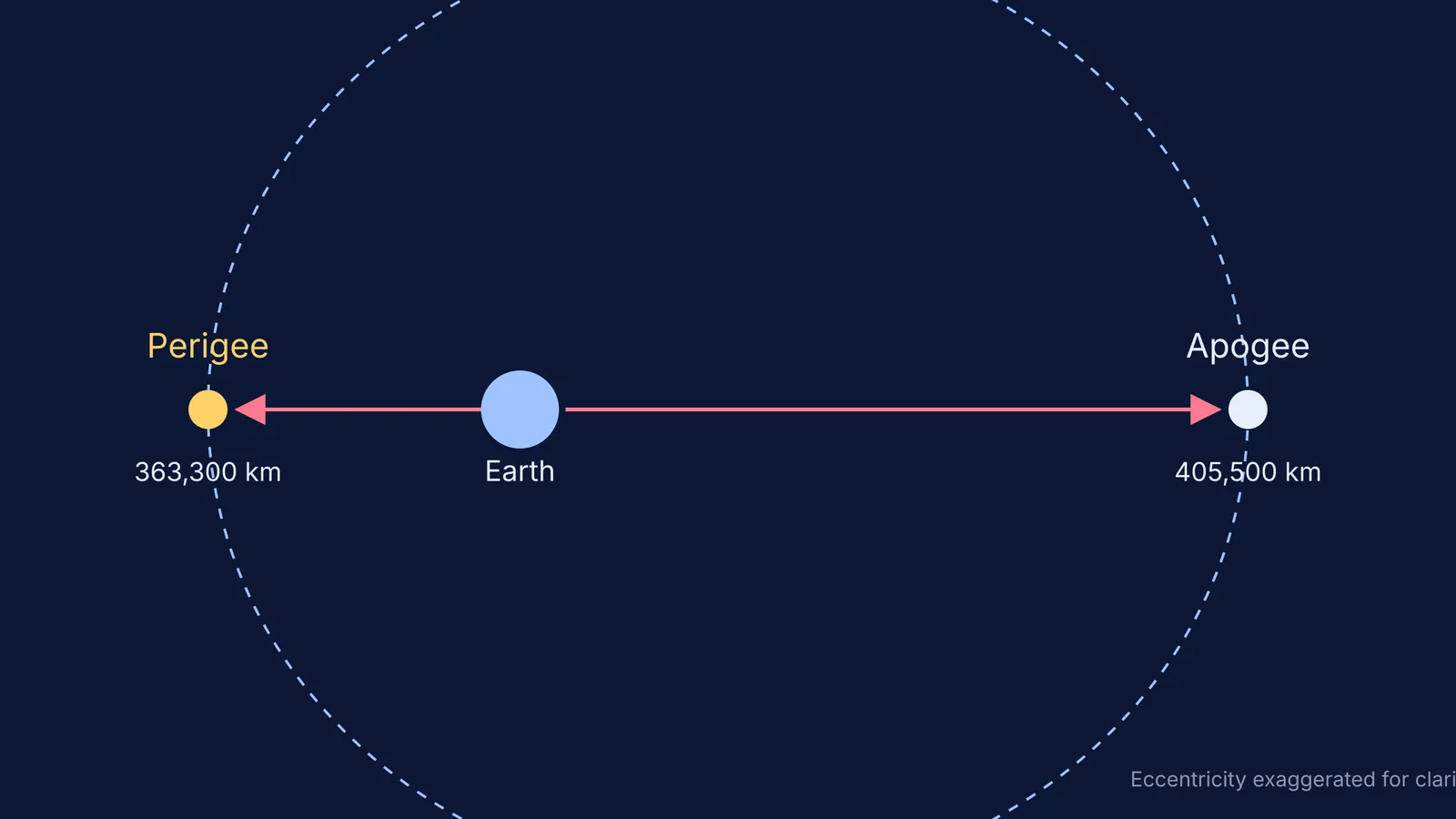
The point in this orbit where the moon is closest to Earth is called perigee. On average, the perigee distance is about 363,300 kilometres (NASA). The point where it is farthest away is called apogee, sitting at an average distance of roughly 405,500 kilometres.
A supermoon happens when the full moon phase coincides exactly, or almost exactly, with perigee. The technical astronomical term for this alignment is a "perigee-syzygy". Syzygy refers to the straight-line configuration of three celestial bodies (the Sun, Earth, and Moon), which creates the full moon phase. When this alignment happens while the moon is at perigee, the moon is both fully illuminated and unusually close to us.
Why does it look 14 percent bigger?
The change in apparent size is a direct result of angular size. In physics and astronomy, the angular size (θ) of an object depends on its actual physical diameter (D) and its distance from the observer (d). For small angles, this relationship is approximated as θ ≈ D / d.
Because the actual diameter of the moon remains constant, its angular size is inversely proportional to its distance. When the moon is at perigee, the distance d is at its minimum. Because the distance from Earth drops from about 405,500 kilometres at apogee down to 363,300 kilometres at perigee, the angular size increases. This brings the moon closer by over 40,000 kilometres, making its diameter appear up to 14 percent larger than a "micromoon"—a full moon at apogee (NASA).
This increase in width also affects brightness. Because the area of a circle scales with the square of its diameter, a 14 percent increase in width means a substantial increase in surface area. This larger visible area reflects more sunlight, making a supermoon up to 30 percent brighter than a full moon at apogee. If you are studying gravitation and satellites or Kepler's laws, this is a clear real-world example of how elliptical orbits affect what we see from Earth.
Seeing orbits change in static diagrams can be hard. The Fermi Simulation Lab has interactive simulations where you can adjust the eccentricity of an orbit and see how perigee and apogee distances shift. It provides interactive simulations for the ideas that are easier to see than to read.
How does the orbit affect the moon's speed?
The elliptical orbit does not just change how big the moon looks; it also changes how fast it travels. According to Kepler's second law, an orbiting body sweeps out equal areas in equal times. To do this, the moon must move faster when it is closer to Earth and slower when it is farther away.
During a supermoon, when the moon is at perigee, it is travelling at its maximum orbital speed. Conversely, during a micromoon at apogee, it is moving at its slowest. This changing speed is why the time between full moons can vary slightly from month to month, and why the moon's position in the sky at the exact same time each night traces out a complex figure-eight pattern known as an analemma.
Is the moon illusion tricking your eyes?
While the 14 percent difference in size (NASA) is a measurable physical fact, it can be quite difficult to notice with the naked eye when the moon is high up in the empty sky. Because we do not have a regular, average-sized moon sitting next to it for comparison, our brains struggle to judge the difference in scale.
The spectacular, giant moon you often see at moonrise is partly due to the "moon illusion". This is a well-documented psychological effect where the human visual system perceives the moon as much larger when it is near the horizon. When the moon is low, your brain subconsciously compares it to familiar foreground objects like trees, hills, and buildings, making it feel massive.
However, a supermoon amplifies this psychological trick. You are seeing the moon illusion combined with a genuine, physical increase in the moon's angular size. The moon is actually casting a larger image on your retina, making the horizon illusion even more striking than usual.


