On this page
"Find the sum of all two-digit numbers divisible by 3" looks like a lot of adding. It is really three short steps: find the first and last multiple, count the terms, then use the sum formula for an arithmetic progression (AP). The same steps work for any divisor and any range.
What is the sum of all two-digit numbers divisible by 3?
An arithmetic progression is a sequence in which the difference between each term and the one before it stays the same, as Wikipedia's article on arithmetic progressions defines it. Multiples of 3 go up by 3 every time, so they form an AP with common difference d = 3.
First and last term. The smallest two-digit multiple of 3 is 12 and the largest is 99. So a = 12 and l = 99.
Count the terms. The same article gives the nth term of an AP as aₙ = a + (n − 1)d. Put in 99 = 12 + (n − 1) × 3, so 87 = (n − 1) × 3, n − 1 = 29 and n = 30.
Add them. The sum of a finite AP is n(a + l)/2, the number of terms times the average of the first and last term. Here that is 30 × (12 + 99) ÷ 2 = 30 × 111 ÷ 2 = 1665.
The counting step is NCERT Class 10 Chapter 5, Example 7, which asks how many two-digit numbers are divisible by 3; the worked solution on Teachoo's page for Example 7 uses the same AP, 12, 15, 18, …, 99, and gets 30 terms.
How do you find the first and last multiple quickly?
Most wrong answers start here. Use division instead of guessing:
First multiple: divide the smallest number in the range by the divisor and round up. 10 ÷ 3 = 3.33, round up to 4, and 4 × 3 = 12.
Last multiple: divide the largest number in the range by the divisor and round down. 99 ÷ 3 = 33 exactly, and 33 × 3 = 99.
Count check: the number of terms is (rounded-down value) − (rounded-up value) + 1. Here 33 − 4 + 1 = 30, which matches the nth-term answer.
The "+ 1" counts both ends. We cover more of this counting in how to count the multiples between two numbers using an AP.
Why does n/2 × (first + last) work?
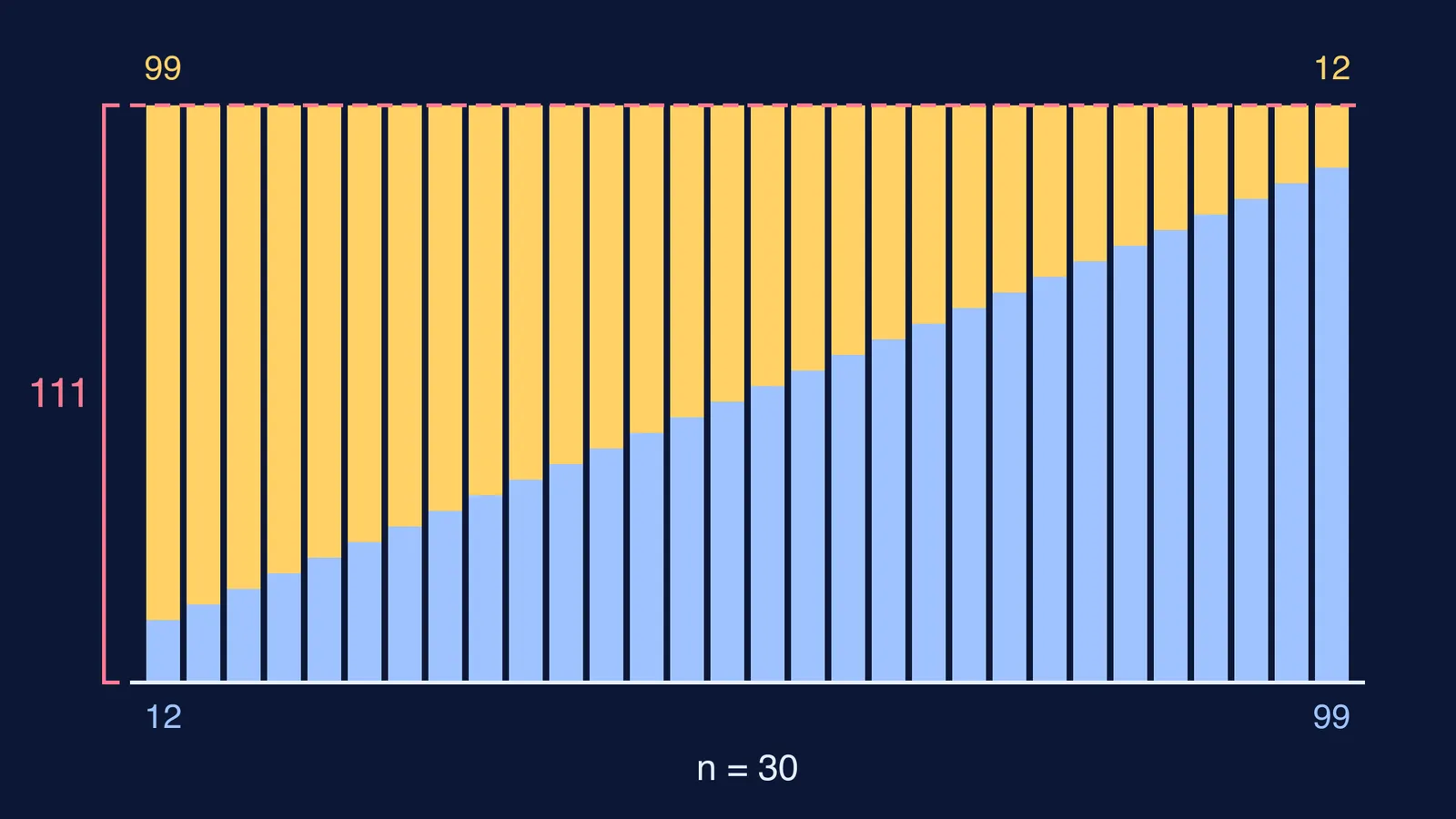
Write the sum forwards, then write it backwards underneath: 12 + 15 + … + 99 and 99 + 96 + … + 12. Each column adds to 111. With 30 columns, the two rows make 30 × 111 = 3330, and one row is half of that, 1665. The same Wikipedia article repeats an anecdote, of uncertain reliability, that a young Carl Friedrich Gauss reinvented the formula for 1 + 2 + … + n, and notes he was not the first; the idea is much older.
For the same idea drawn out for 1 to n, see our visual proof of the arithmetic series sum.
Can you check the answer another way?
Yes. Every multiple of 3 from 3 to 99 is 3 × (1 + 2 + … + 33). The sum 1 + 2 + … + 33 is 33 × 34 ÷ 2 = 561, so that whole list adds to 1683. The one-digit multiples 3, 6 and 9 add to 18. Take them away: 1683 − 18 = 1665. Two methods, one answer.
Practice: try the three steps on two more questions
Sum of two-digit numbers divisible by 7. First: 10 ÷ 7 rounds up to 2, so 14. Last: 99 ÷ 7 rounds down to 14, so 98. Count: 14 − 2 + 1 = 13. Sum: 13 × (14 + 98) ÷ 2 = 13 × 56 = 728.
Sum of three-digit numbers divisible by 7. First: 100 ÷ 7 rounds up to 15, so 105. Last: 999 ÷ 7 rounds down to 142, so 994. Count: 142 − 15 + 1 = 128. Sum: 128 × (105 + 994) ÷ 2 = 64 × 1099 = 70336.
Before you write the final answer, check:
Is the first term inside the range (two-digit means 10 to 99)?
Did you use the last multiple, not the last number in the range?
Did you divide by 2?
Does a rough estimate agree? 30 numbers averaging about 55 give roughly 1650.
If you keep landing on the wrong count or the wrong last term, work a few similar questions in the Fermi Problem Library, where a step-by-step solver explains the reasoning rather than printing an answer. For a refresher on the chapter as a whole, read our guide to arithmetic progressions for Class 10, or look up the AP lesson in the Fermi Concept Library.