

On this page
Finding the number of multiples of a given digit within a range is a classic arithmetic problem. Rather than listing every single number, you can solve it in a few quick steps using an arithmetic progression (AP).
Whether you are preparing for your board exams or tackling competitive tests like the JEE, knowing how to find the first and last terms efficiently will save you valuable time in the exam hall.
How many multiples of 7 between 100 and 300?
There are exactly 28 multiples of 7 between 100 and 300.
To find this without counting manually, we use the mathematical properties of sequences. According to the official Class 10 mathematics syllabus, an arithmetic progression (AP) is a sequence where the difference between consecutive terms is constant. In our case, the multiples of 7 naturally form an AP where the common difference is 7.
When faced with ranges like "between 100 and 300", it is important to remember that "between" usually means strictly greater than the lower bound and strictly less than the upper bound. Here is the three-step framework to find the exact count.
Step 1: Find the first multiple after 100
To find the first number greater than 100 that is divisible by 7, divide the lower limit (100) by 7.
100 ÷ 7 = 14 with a remainder of 2.
This means 14 × 7 = 98, which is just outside our range. To get the first multiple inside the range, we simply take the next multiple:
15 × 7 = 105.
So, our first term (a) is 105.
Step 2: Find the last multiple before 300
Next, you need to find the largest number less than 300 that is perfectly divisible by 7. Divide the upper limit (300) by 7.
300 ÷ 7 = 42 with a remainder of 6.
Subtract this remainder from 300, or simply multiply your integer quotient by 7:
42 × 7 = 294.
So, our last term (l) is 294.
If you struggle to identify these starting and ending bounds in tricky sequence problems, the Fermi Problem Library has a step-by-step solver that explains the reasoning rather than printing an answer.
Step 3: Use the AP formula to count the terms
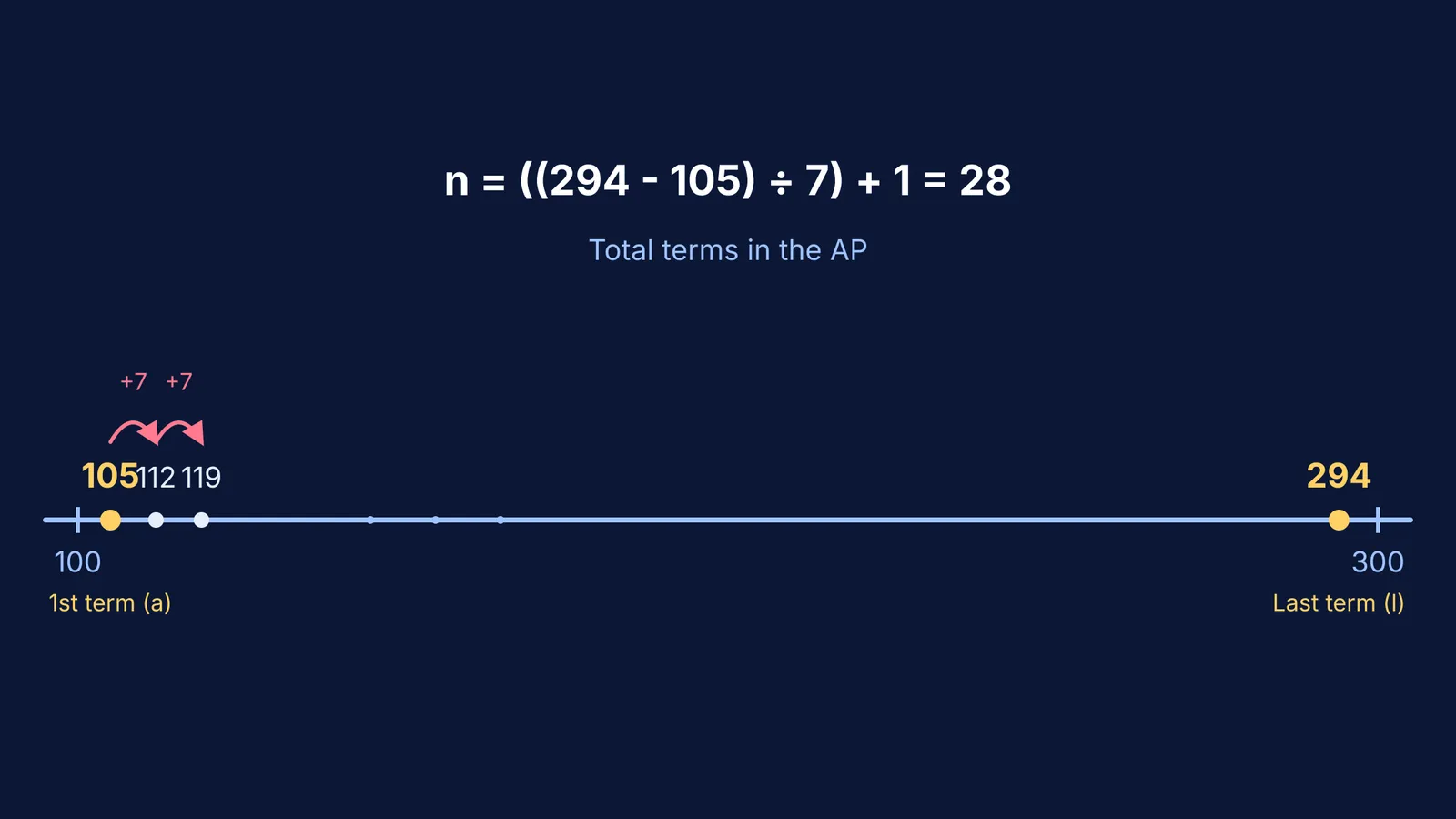
We now have an arithmetic progression starting at 105 and ending at 294: 105, 112, 119, ..., 294.
First term (a) = 105
Common difference (d) = 7
Last term (l) = 294
The standard formula for the nth term of an AP is:
l = a + (n - 1)d
Substitute our known values into the equation:
294 = 105 + (n - 1)7
First, subtract 105 from both sides:
294 - 105 = (n - 1)7
189 = (n - 1)7
Next, divide by the common difference:
189 ÷ 7 = n - 1
27 = n - 1
Finally, add 1:
n = 28.
So, there are 28 multiples of 7 in this range.
How do you find the sum of these multiples?
Once you know that there are 28 terms in the sequence, finding their sum is straightforward. You do not need to add all 28 numbers individually.
The formula for the sum of an AP when both the first and last terms are known is:
Sum = (n ÷ 2) × (a + l)
Substitute the values we calculated earlier:
Sum = (28 ÷ 2) × (105 + 294)
Simplify the terms inside the brackets and the fraction:
Sum = 14 × 399
To calculate this quickly without a calculator, you can treat 399 as (400 - 1):
14 × (400 - 1) = 5600 - 14 = 5586.
The sum of all multiples of 7 between 100 and 300 is 5586.
Mastering these basic properties of progressions makes sequence problems much faster to solve. For your next step, explore the ratio of nth terms of two APs from the ratio of their sums or learn how to find the numerically greatest term in a binomial expansion.


