

On this page
In sequence and series problems for competitive exams like JEE Main and Class 11 board exams, you will often encounter a specific type of question: you are given the ratio of the sums of n terms of two arithmetic progressions (APs), and you have to find the ratio of their nth terms. Solving this by setting up long simultaneous equations can consume a lot of time. Instead, you can solve this in a single step by replacing n with 2n − 1.
What is the 2n − 1 trick?
If the ratio of the sums of n terms of two arithmetic progressions is given as an algebraic expression in n, you can find the ratio of their nth terms by simply substituting n with 2n − 1 everywhere in the expression.
For example, if you need the ratio of the 11th terms of the two sequences, you calculate the substitution value by evaluating 2(11) − 1, which gives 21. You then replace n with 21 in the original sum ratio expression. This immediately gives you the ratio of the 11th terms without ever needing to find the individual first terms or common differences of either sequence.
Why does replacing n with 2n − 1 work?
The trick works because of the algebraic structure of the arithmetic progression formulas. The sum of the first n terms of an arithmetic progression is Sn = (n/2)[2a + (n − 1)d] (Wikipedia).
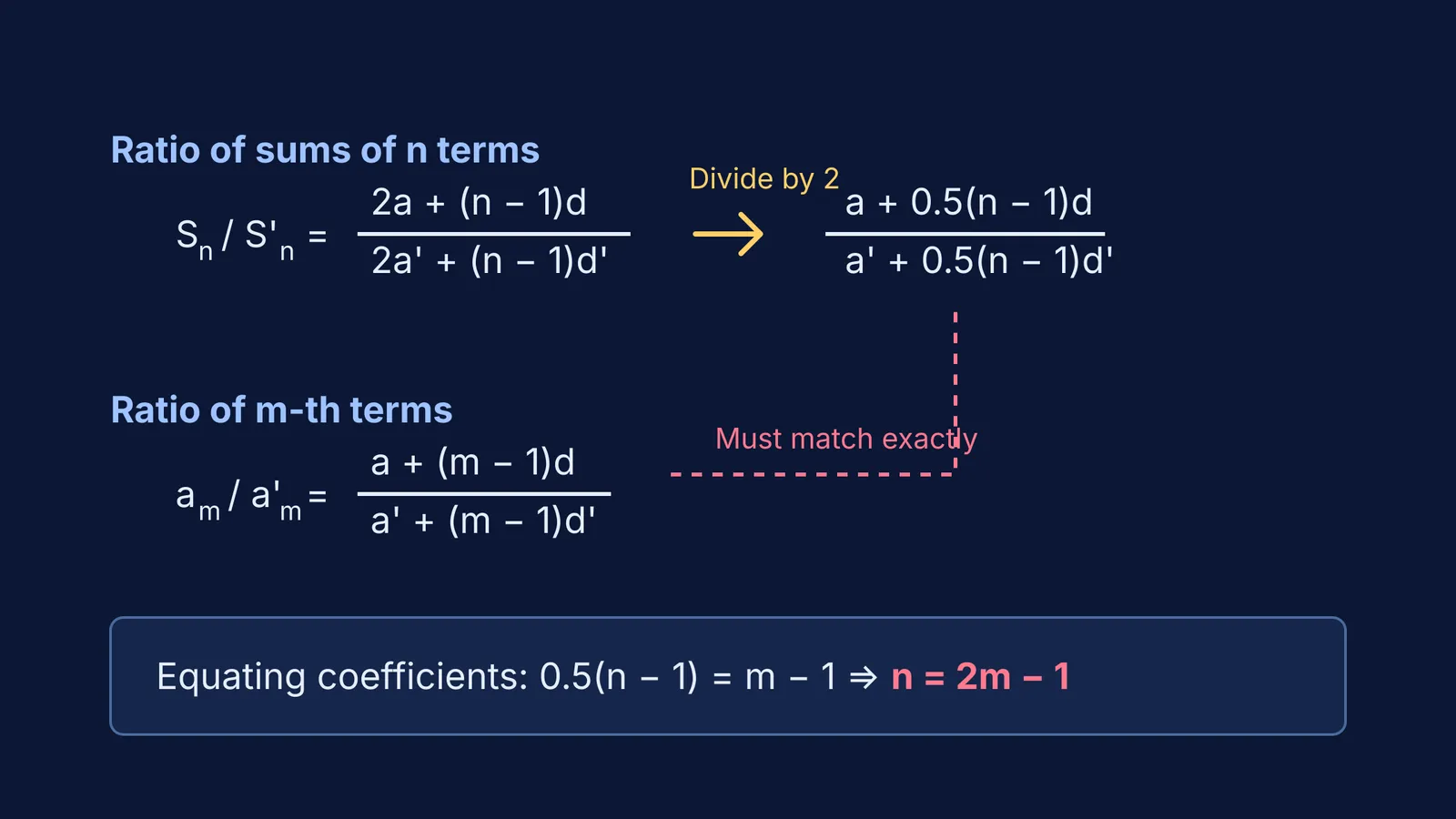
When you write the ratio of the sums of two arithmetic progressions with first terms a and a', and common differences d and d', the n/2 factor present in both the numerator and the denominator cancels out entirely: Ratio of sums = [2a + (n − 1)d] / [2a' + (n − 1)d']
To make this look like the formula for a single term, we can divide both the numerator and the denominator by 2. This manipulation yields: Ratio of sums = [a + 0.5(n − 1)d] / [a' + 0.5(n − 1)d']
Now, consider the standard formula for the mth term of an arithmetic progression, which is am = a + (m − 1)d. To make the manipulated sum ratio match the ratio of the mth terms exactly, the coefficient of the common difference d in both expressions must be algebraically identical.
We set the coefficients equal to each other: 0.5(n − 1) = m − 1
Multiply both sides by 2: n − 1 = 2m − 2
Add 1 to both sides: n = 2m − 1
So, to find the ratio of the mth terms directly from the ratio of sums, you must substitute n with 2m − 1. If you often get stuck on algebraic substitutions or have trouble deriving these sequence formulas from scratch, the Fermi Problem Library has worked problems with a step-by-step solver that explains the reasoning rather than printing an answer.
How do you find the ratio of the 11th terms?
Suppose the ratio of the sums of n terms of two arithmetic progressions is given as (7n + 1) : (4n + 27). Find the ratio of their 11th terms.
Using the substitution method, we can bypass the simultaneous equations completely:
Identify the specific term you need. Here, m = 11.
Find the substitution value using the rule: n = 2(11) − 1 = 21.
Replace n with 21 in the given ratio of sums expression.
Calculating the new numerator: Numerator = 7(21) + 1 = 147 + 1 = 148
Calculating the new denominator: Denominator = 4(21) + 27 = 84 + 27 = 111
The ratio of their 11th terms is 148 / 111. By observing that both numbers are divisible by 37, this fraction simplifies down to exactly 4 / 3.
What is the ratio of the 18th terms?
To reinforce the concept, consider another scenario where the ratio of the sums of n terms of two APs is (3n + 8) : (7n + 15). What is the ratio of their 18th terms?
The target term is m = 18.
The substitution value is n = 2(18) − 1 = 35.
Substitute n = 35 into the sum ratio.
Numerator = 3(35) + 8 = 105 + 8 = 113
Denominator = 7(35) + 15 = 245 + 15 = 260
The ratio of their 18th terms is simply 113 / 260.
If you are revising arithmetic progressions, you might also find these shortcuts useful for your exam preparation:
Whether you are dealing with mathematical sequences or analysing physical motion—such as calculating Distance in the nth second: the sₙ formula and where it helps—knowing exactly how the sum of terms and the nth term connect will save you crucial minutes on test day.


