

On this page
Most students memorise the AP sum formula. That works until a question gives you the sum and asks for n, or two values of n both fit. Seeing where the formula comes from makes those questions easier. Here is the picture, then three board-style problems.
What is the visual proof of the arithmetic progression sum?
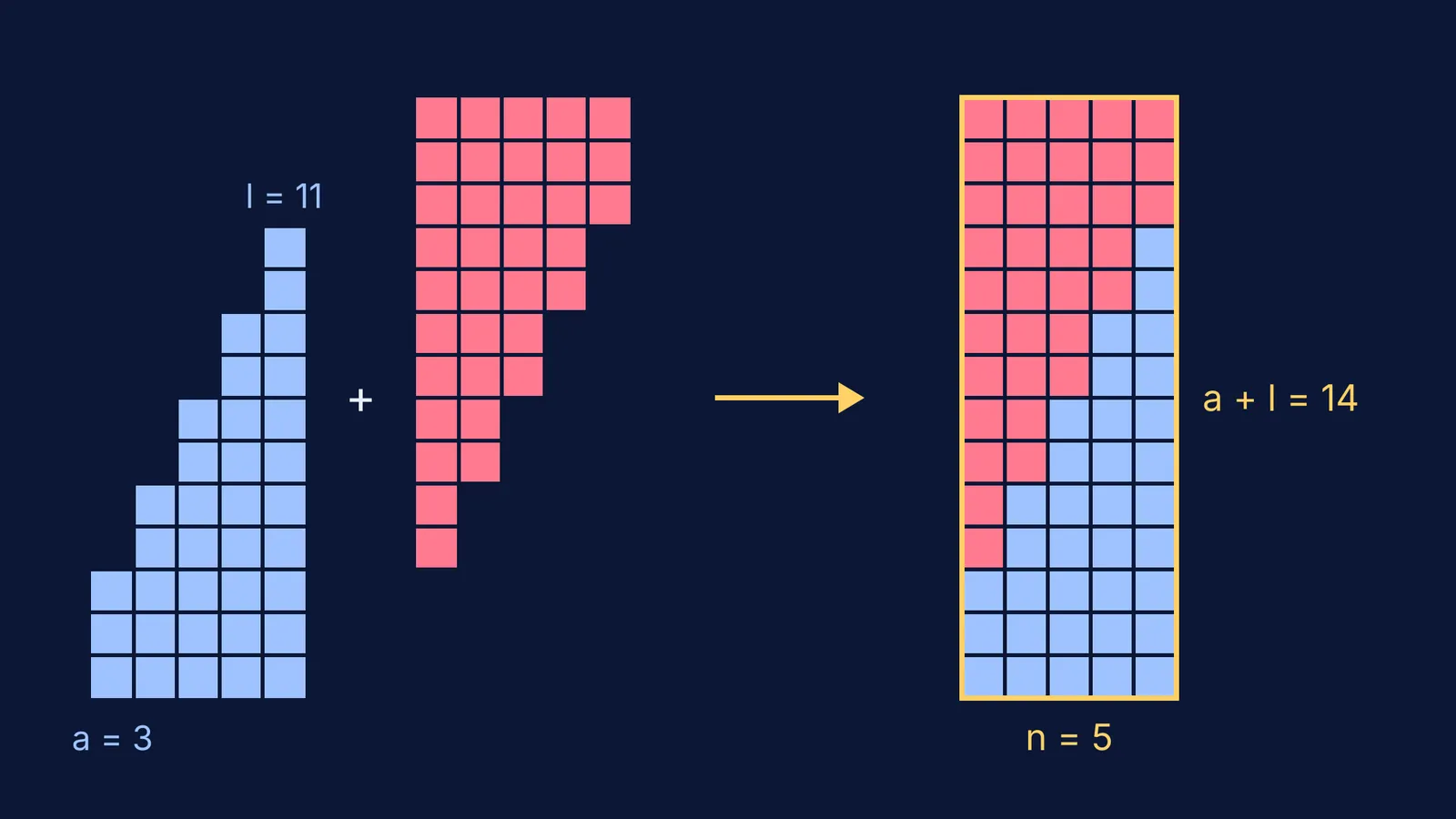
Take the AP 3, 5, 7, 9, 11. Draw each term as a column of square blocks: 3 blocks, then 5, then 7, then 9, then 11. You get a staircase that climbs by the common difference, d = 2, at every step.
Now copy the staircase, turn the copy upside down and lower it onto the first. Its tallest column (11) lands on the shortest (3), then 9 on 5, then 7 on 7. Every column now holds 3 + 11 = 14 blocks.
The two staircases fill a rectangle 5 columns wide and 14 blocks tall, which is 70 blocks. One staircase is exactly half of it, so 3 + 5 + 7 + 9 + 11 = 35. In symbols, with n terms, first term a and last term l:
The rectangle is n columns wide.
Each column is a + l tall.
So the sum of one staircase is S = n(a + l)/2.
Wolfram MathWorld states the sum of an arithmetic series as S = n(a1 + an)/2, n times the average of the first and last terms (MathWorld, Arithmetic Series).
Why does every column have the same height?
Moving one column right adds d to the original staircase and takes d away from the flipped copy, so every pair has the same total. In algebra, the kth term from the start is a + (k - 1)d and the kth term from the end is l - (k - 1)d, and they add to a + l.
The algebraic proof does the same on paper: write the sum forwards, then backwards underneath, add term by term and halve (Wikipedia, Arithmetic progression). The same article notes that similar rules were known in India to Aryabhata, Brahmagupta and Bhaskara II. MathWorld calls this the trick Gauss used as a schoolboy to add 1 to 100: 100 x 101 / 2 = 5050 (MathWorld). Wikipedia calls that story an anecdote of uncertain reliability.
Since l = a + (n - 1)d, substituting gives the other Class 10 form, S = n/2[2a + (n - 1)d]: the same rectangle, its height written differently.
How do you use the staircase on exam questions?
For each problem, find n first, then picture the rectangle.
Example 1: sum of all odd numbers from 1 to 99.
Predict: 50 odd numbers, average about 50, so about 2500.
Here a = 1, l = 99, d = 2. From 99 = 1 + (n - 1) x 2, n = 50.
S = 50 x (1 + 99)/2 = 50 x 50 = 2500.
Example 2: 7 + 10.5 + 14 + ... + 84.
Here a = 7, d = 3.5, l = 84.
Find n: 84 = 7 + (n - 1) x 3.5, so n - 1 = 22 and n = 23.
Predict: 23 columns with an average height of (7 + 84)/2 = 45.5, so just over 1000.
S = 23 x 91/2 = 1046.5.
The usual slip is n = 22: counting gaps, not terms, drops a column.
Example 3: how many terms of 24, 21, 18, ... add up to 78?
Set up: S = n/2[48 + (n - 1)(-3)] = n(51 - 3n)/2 = 78.
This gives 3n² - 51n + 156 = 0, or n² - 17n + 52 = 0, so n = 4 or n = 13.
Check n = 4: 24 + 21 + 18 + 15 = 78.
Check n = 13: the last term is 24 - 36 = -12, and S = 13 x (24 - 12)/2 = 78.
Both are correct. The staircase keeps falling: 12, 9, 6, 3, 0, -3, -6, -9, -12. Blocks above zero cancel those below, so terms 5 to 13 add to 0. Write both values with that reason.
Where to go from here
For more practice, read our guide to arithmetic progressions in Class 10, with nth term and sum problems. For a harder set, see how to derive sums in sequences and series for JEE and inserting arithmetic and geometric means between two numbers.
If you find the staircase easier to watch than to imagine, the Fermi Simulation Lab has interactive simulations for the ideas that are easier to see than to read. If you keep getting n wrong, the Fermi Problem Library has worked problems with a step-by-step solver that explains the reasoning rather than printing an answer.
Tonight, draw the 3, 5, 7, 9, 11 rectangle by hand, then redo Example 3 without looking.


