On this page
A coin lands heads or tails; a die shows one of six faces. These single results are the building blocks of every probability question in Class 10 and 11, and the fact that their probabilities add up to exactly 1 gives you a quick error check in a board exam.
What is an elementary event?
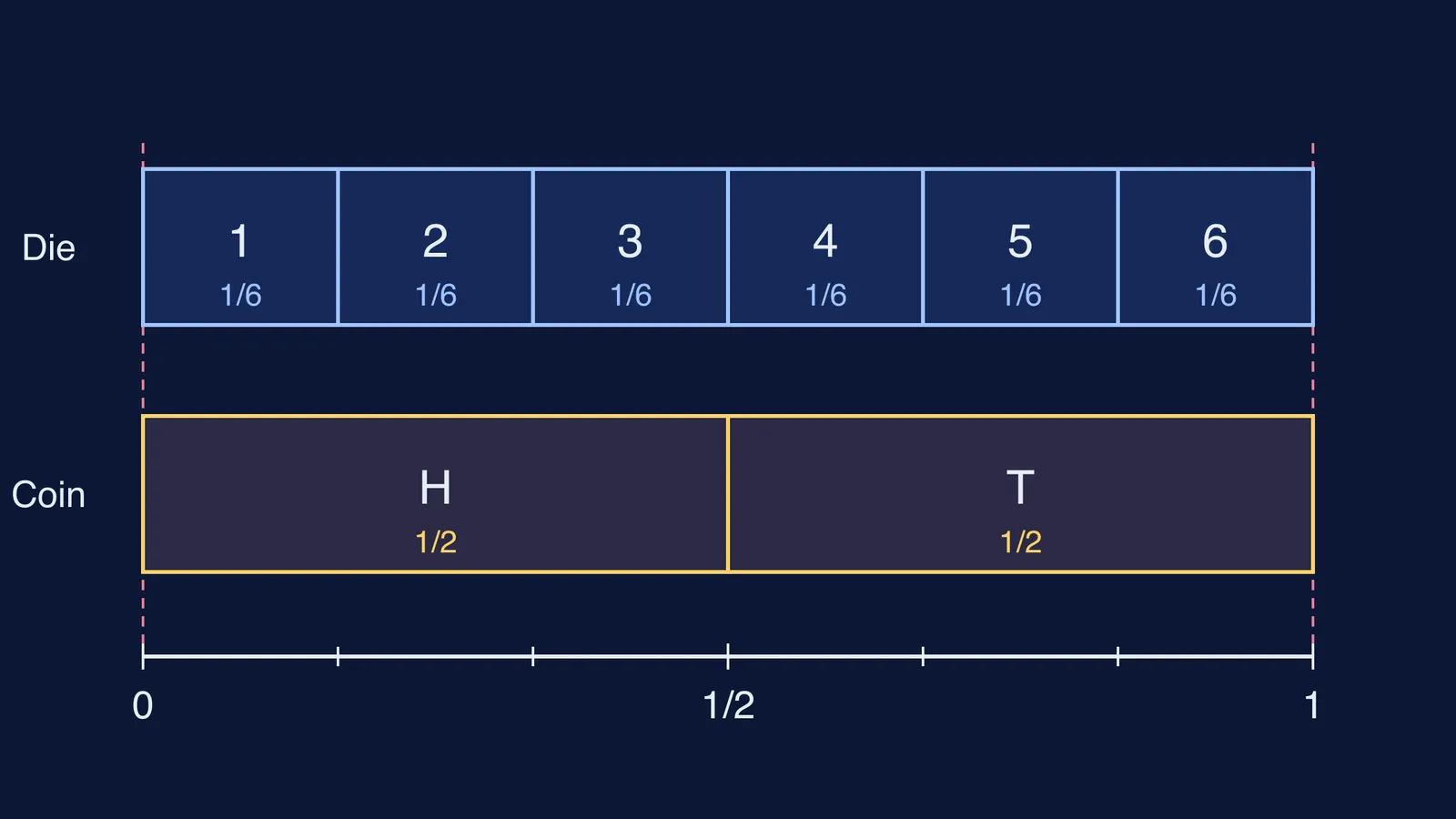
An elementary event is an event that has only one outcome of the experiment, as the NCERT Class 10 Mathematics chapter on probability defines it. Tossing a coin once has two elementary events, head and tail. Rolling a die once has six: getting 1, 2, 3, 4, 5 or 6.
"Getting a number greater than 4" is not elementary: it contains two outcomes, 5 and 6. Your Class 11 book calls elementary events "simple events" and notes that a sample space with n distinct elements has exactly n simple events (NCERT Class 11 Mathematics, Probability).
Why do the probabilities of all elementary events add up to 1?
Two facts do all the work.
They cannot happen together. A die cannot show 2 and 5 on the same throw. The Class 11 NCERT chapter states that simple events of a sample space are always mutually exclusive.
Together they cover everything. Whatever happens, one of them happens, so together they make up the whole sample space S.
Now use the rules probability is built on. In the axiomatic approach set out in the Class 11 NCERT chapter, P(S) = 1, and for mutually exclusive events P(E ∪ F) = P(E) + P(F). Split S into its elementary events, add their probabilities, and the total must equal P(S), which is 1. The chapter writes this as P(ω₁) + P(ω₂) + ... + P(ωₙ) = 1.
For a fair die you can see it in the arithmetic: six faces at 1/6 each give 6/6 = 1. For a fair coin, 1/2 + 1/2 = 1.
Does the rule still work if outcomes are not equally likely?
Yes. The Class 11 NCERT chapter shows that P(H) = 1/4 and P(T) = 3/4 is a valid assignment for a coin, because each number lies between 0 and 1 and the two add to 1. In the same chapter, the assignment 0.1, 0.2, 0.3, 0.4, 0.5 and 0.6 for six outcomes is rejected, because the total is 2.1, not 1.
So any list of probabilities must pass two tests: every value lies between 0 and 1, and the values for all elementary events sum to 1. For a coin that favours heads, see our post on biased coin probabilities over two tosses.
How do you use it to check a board answer?
Take Question 8 from CBSE's Class 10 Mathematics Standard sample paper for 2025-26: "A pair of dice is tossed. The probability of not getting the sum eight is", with options (A) 5/36, (B) 31/36, (C) 5/18 and (D) 5/9.
List the elementary events. Each outcome is an ordered pair such as (2, 6), so there are 6 × 6 = 36 of them, each with probability 1/36. The Class 10 NCERT chapter draws this 36-cell grid.
Count the event. A sum of 8 comes from (2, 6), (3, 5), (4, 4), (5, 3) and (6, 2): five outcomes, so P(sum 8) = 5/36.
Take the complement. "Not sum 8" covers the other 31 elementary events, so its probability is 31/36.
Check with the rule. 5/36 + 31/36 = 36/36 = 1. All 36 outcomes are counted exactly once.
The official marking scheme gives (B) 31/36, reached through the same two numbers.
Notice the trap: option (A), 5/36, is the probability of the event itself, which is what you pick if you stop at step 2. Writing both numbers side by side for the sum-to-1 check helps you see which one the question asks for. More in our explainer on why P(not E) is 1 minus P(E).
What should you check before moving on?
Run this list on any probability answer:
Is the answer between 0 and 1? A value like -1.5 is wrong on sight; Exercise 14.1 in the Class 10 NCERT chapter asks you to spot exactly that.
Did you list elementary events, not compound ones? For two dice, (1, 4) and (4, 1) are different outcomes.
Are the outcomes really equally likely? The sums of two dice are not, as our post on why the sum of two dice is not equally likely shows.
Do the event and its complement, or a whole distribution, add to 1?
If your counts keep failing that last check, the method is the problem, not the arithmetic. The Fermi Problem Library has worked problems with a step-by-step solver that explains the reasoning rather than printing an answer, so you can see where a count went wrong. If the idea of a sample space itself feels shaky, the Fermi Concept Library gives each mathematics concept its own lesson.