

On this page
A coin is biased so that heads comes up more often than tails, and the question tells you the ratio between them. Then the coin is tossed twice. Questions like this are common in school probability exercises and JEE practice. They take two lines of algebra and one multiplication rule. Here is the setup, all four two-toss outcomes and the traps.
How do you find P(H) when heads is twice as likely as tails?
You need one rule. In the axioms of probability set out by Andrey Kolmogorov in 1933, the probability of the whole sample space is 1. For one toss the sample space is {H, T}, so P(H) + P(T) = 1.
Let P(T) = p.
"Heads is twice as likely as tails" means P(H) = 2p.
Add them: p + 2p = 1, so 3p = 1 and p = 1/3.
So P(T) = 1/3 and P(H) = 2/3.
Check your answer the way an examiner would: each value lies between 0 and 1, and they add up to 1. Our guide on checking whether a probability assignment is valid walks through that test in more detail.
The same setup works for any ratio. If heads is k times as likely as tails, then P(T) = 1/(k + 1) and P(H) = k/(k + 1). For k = 3 that gives 1/4 and 3/4.
What are the two-toss probabilities for a coin like this?
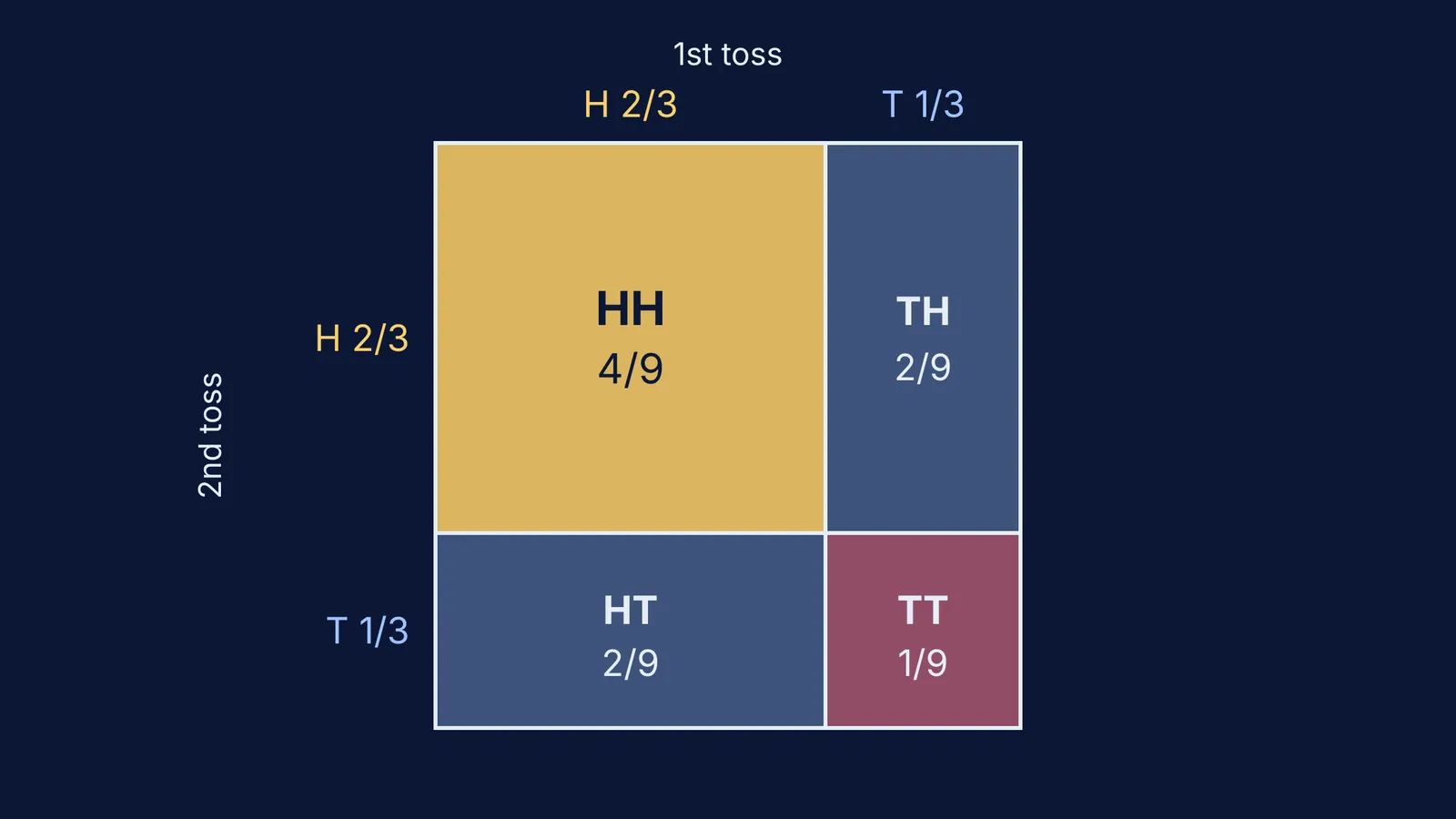
A coin has no memory, so the first toss does not change the second. Two events A and B are independent when P(A and B) = P(A) × P(B), as OpenStax Introductory Statistics defines it. So you multiply along each path:
HH: 2/3 × 2/3 = 4/9
HT: 2/3 × 1/3 = 2/9
TH: 1/3 × 2/3 = 2/9
TT: 1/3 × 1/3 = 1/9
They add up to 9/9 = 1, which tells you nothing is missing. If you like to see the branches, draw it as a probability tree diagram, step by step.
Examiners then ask about combinations of these four outcomes:
Exactly one head: HT + TH = 2/9 + 2/9 = 4/9.
At least one head: 1 − P(TT) = 1 − 1/9 = 8/9. This complement trick is the same one used to work out how many tosses you need to be almost sure of at least one head.
Both tosses the same: HH + TT = 4/9 + 1/9 = 5/9.
Two heads, given at least one head: (4/9) ÷ (8/9) = 1/2.
With a fair coin, exactly one head and two heads would be 1/2 and 1/4. The bias changes every answer, so counting "1 outcome out of 4" fails.
Where do students lose marks on biased coin questions?
Watch for these four slips:
Treating HH, HT, TH and TT as equally likely and answering 1/4 for two heads. That is only true for a fair coin.
Writing 2/9 for exactly one head. There are two orders, HT and TH, so it is 4/9.
Turning "twice as likely" into P(H) = 2 and P(T) = 1 and not dividing by the total.
Using 1 − P(HH) for "at least one head". The complement of at least one head is no heads, which is TT.
If you keep getting a different number from the answer key and cannot see which step went wrong, the Fermi Problem Library has worked problems with a step-by-step solver that explains the reasoning rather than printing an answer.
Are real coins actually biased?
Only slightly, and not in the way textbooks describe. Persi Diaconis, Susan Holmes and Richard Montgomery reported in SIAM Review in 2007 that vigorously flipped coins tend to come up the same way they started, with a chance of about 0.51 for natural flips. A team led by František Bartoš tested this with 350,757 flips and found Pr(same side) = 0.508, while heads and tails stayed equally likely overall.
Andrew Gelman and Deborah Nolan titled their 2002 paper in The American Statistician "You Can Load a Die, But You Can't Bias a Coin". So the coin with P(H) = 2/3 is a model for practising the rules, not a coin you will find in your pocket.
A five-minute practice set
Try these before checking the answers below.
A coin lands heads with probability 3/4. Find P(T), then P(two heads in two tosses).
The coin with P(H) = 2/3 is tossed three times. Find P(exactly two heads).
The same coin is tossed twice. Find P(at least one tail).
Answers: (1) P(T) = 1/4 and P(HH) = 3/4 × 3/4 = 9/16. (2) There are three orders (HHT, HTH, THH), each 2/3 × 2/3 × 1/3 = 4/27, so the total is 12/27 = 4/9. (3) 1 − P(HH) = 1 − 4/9 = 5/9.
If independence or complements still feel shaky, the Fermi Concept Library covers every concept in mathematics, each with its own lesson and its place in the map.


