On this page
Sulphite and sulphate differ by one oxygen atom: SO₃²⁻ against SO₄²⁻. In a Class 12 practical both give a white precipitate with barium chloride, so the precipitate alone tells you nothing. The difference shows up when acid touches them, and that is what the practical and the viva test.
How do you tell sulphite and sulphate ions apart?
The NCERT Class 12 chemistry lab manual, Unit 7 separates them with two observations.
Gas with dilute acid. With warm dilute sulphuric acid, a sulphite gives sulphur dioxide, which NCERT describes as "suffocating with the smell of burning sulphur". The gas turns potassium dichromate paper, acidified with dilute H₂SO₄, green. A sulphate gives no gas here; NCERT tests for it only in Step III, after the dilute and concentrated acid tests come up empty.
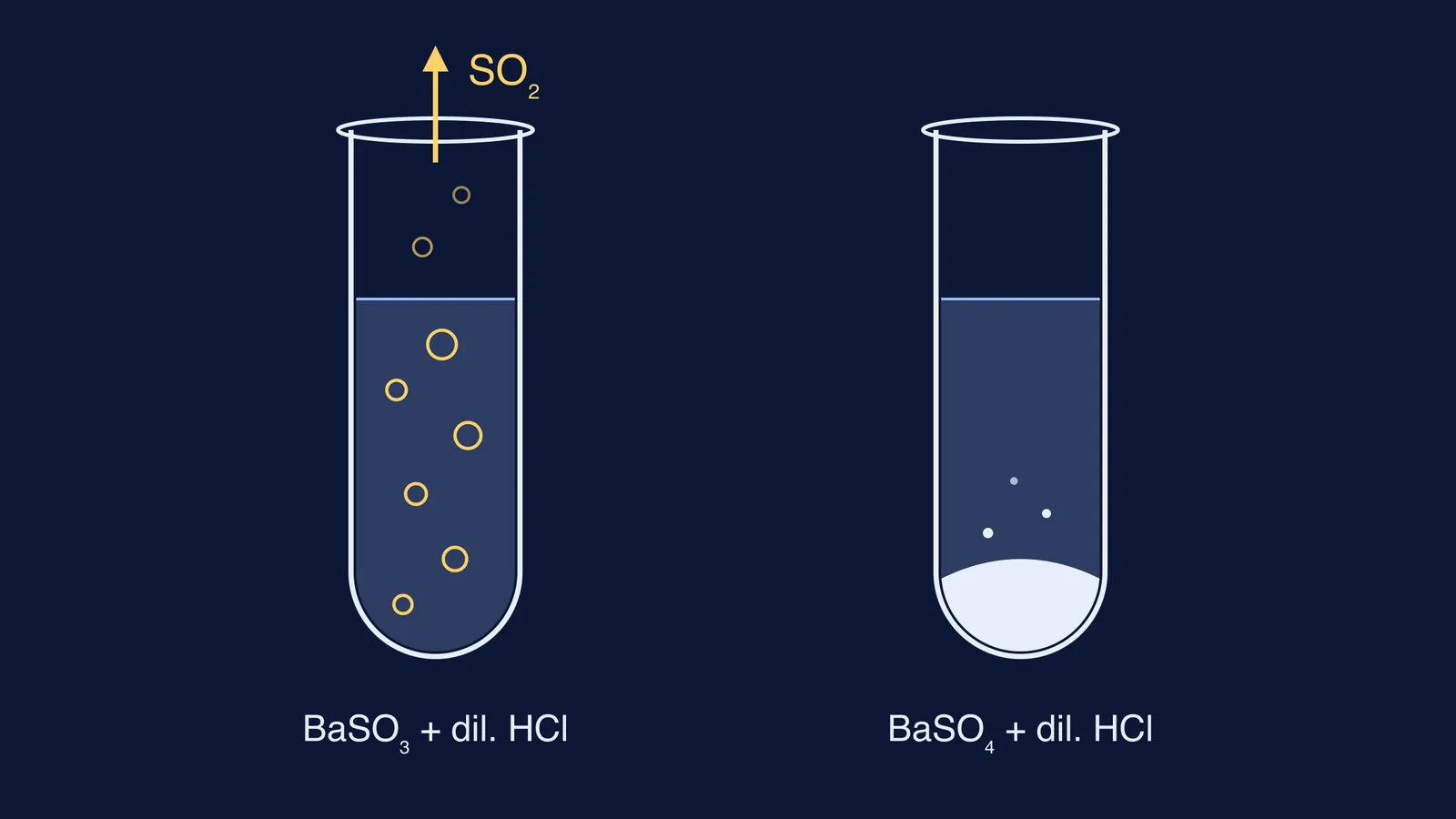
The barium precipitate in HCl. Barium sulphite dissolves in dilute hydrochloric acid and gives off SO₂. Barium sulphate is "insoluble in conc. HCl or conc. HNO₃", in the manual's words.
In one line: sulphite gives SO₂ with acid and its barium salt dissolves in HCl; sulphate gives no gas, and its barium salt stays put. Our post on preliminary dilute acid tests for carbonate, sulphide and sulphite compares the gases side by side.
Why does barium sulphite dissolve in HCl but barium sulphate does not?
Sulphite behaves as a base. The LibreTexts notes on the sulphite ion/Qualitative_Analysis/Properties_of_Select_Nonmetal_Ions/Sulfite_Ion_(SO)) state that "due to the basic nature of SO₃²⁻, all sulfites dissolve in acidic solution". Acid turns sulphite into sulphurous acid, which breaks down and releases SO₂ gas. As sulphite ions are used up, more barium sulphite dissolves to replace them. NCERT writes it as BaSO₃ + 2HCl → BaCl₂ + H₂O + SO₂.
Sulphate is the anion of sulphuric acid, a strong acid, so dilute HCl has no gas to drive off. Barium sulphate barely dissolves even in water: the CRC Handbook value quoted on PubChem's barium sulfate page is 0.00031 g per 100 g of water at 20 °C, and the Merck Index entry on the same page calls it "practically insoluble in dilute acids".
What does the test look like at the bench?
A worked run for a white, water-soluble salt, using the quantities in the NCERT lab manual:
Add 1-2 mL of dilute H₂SO₄ to 0.1 g of the salt, and warm it if no gas comes off. Hold acidified potassium dichromate paper at the mouth of the tube.
If the paper turns green and you smell burning sulphur, suspect sulphite. Add barium chloride to 1 mL of the water extract. A white precipitate forms.
Add dilute HCl to that precipitate. It dissolves and SO₂ is given off: sulphite confirmed. NCERT's second check is that the precipitate decolourises acidified potassium permanganate.
If step 1 and the concentrated acid test gave nothing, acidify 1 mL of the water extract with dilute HCl first, then add barium chloride. A white precipitate that does not dissolve in concentrated HCl or HNO₃ means sulphate. NCERT's second check: a white lead sulphate precipitate with lead acetate, after acidifying with acetic acid.
Notice the order in step 4. Acid goes in before barium chloride, so any sulphite is destroyed first and a precipitate that forms in acid points to barium sulphate. Our post on the barium chloride test for sulphate covers that test on its own.
One complication: sulphite slowly turns into sulphate in air, and LibreTexts/Qualitative_Analysis/Properties_of_Select_Nonmetal_Ions/Sulfite_Ion_(SO)) gives the reaction as 2SO₃²⁻ + O₂ → 2SO₄²⁻.
How should you answer this in the practical viva?
A complete answer has three parts: the observation, the reason and an equation. A script you can adapt:
Question: How will you distinguish a sulphite from a sulphate?
Answer: With warm dilute sulphuric acid, a sulphite gives SO₂, which turns acidified dichromate paper green; a sulphate gives no gas. Both give a white precipitate with barium chloride, but barium sulphite dissolves in dilute HCl with SO₂ given off, while barium sulphate is insoluble even in concentrated HCl.
Follow-up: Why? Sulphite is basic, so acid converts it to sulphurous acid, which loses SO₂. Sulphate comes from a strong acid, so nothing escapes.
Mistakes that cost marks:
Adding barium chloride in the sulphate test before acidifying.
Naming SO₂ from limewater alone. NCERT's own footnote notes that SO₂ also turns limewater milky; CO₂ is odourless, SO₂ is not.
Writing BaSO₄ as dissolving in acid in an equation.
For the chemistry behind the green dichromate paper and the decolourised permanganate, see our explainer on sulphur dioxide reducing tests with KMnO4 and dichromate.
If you keep mixing up which anion gives which gas, the Fermi Concept Library gives each chemistry concept its own lesson and its place in the map. When an equation is where you go wrong, the Fermi Problem Library has worked problems with a step-by-step solver that explains the reasoning rather than printing an answer.
At the bench, run the acid test first and let the barium precipitate confirm what the gas already told you.