On this page
Many students mix up these two terms and only find out when an assertion-reason question tests them. This post follows one glucose molecule and labels every ATP it makes by the method that made it. All counts use the values in NCERT's Class 11 chapter Respiration in Plants.
What is the difference between substrate-level and oxidative phosphorylation?
Substrate-level phosphorylation is ATP made when a high-energy phosphate group is handed directly from a substrate molecule to ADP (OpenStax Biology 2e, glycolysis). One enzyme does it in one reaction, and the reaction itself needs no membrane and uses no oxygen.
Oxidative phosphorylation is ATP made by ATP synthase (complex V), using the proton gradient that the electron transport system (ETS) builds on the inner mitochondrial membrane. NCERT explains the name: in respiration "it is the energy of oxidation-reduction utilised" to make the proton gradient, "for this reason" the process is called oxidative phosphorylation (NCERT, section 12.4.2).
Three quick tests tell them apart:
Machinery: substrate-level uses a single enzyme acting on a substrate. Oxidative uses complexes I to IV plus ATP synthase.
Oxygen: the substrate-level reactions themselves do not use it. Oxidative phosphorylation needs oxygen as the final hydrogen acceptor.
Carrier first? If ATP appears in the same reaction that breaks down the substrate, it is substrate-level. If NADH or FADH2 is made first and paid out later, the ATP is oxidative.
Where is each ATP made in glycolysis, the Krebs cycle and the ETS?
Here is the step list for one glucose molecule. Every number comes from the NCERT chapter. From step 3 onwards, each step runs twice per glucose: glycolysis splits glucose into two 3-carbon halves, and the Krebs cycle turns once for each of the two pyruvates. For a closer look at each stage, see our posts on why glycolysis nets only two ATP and what one turn of the Krebs cycle produces.
Glucose to glucose-6-phosphate (cytoplasm): 1 ATP used.
Fructose-6-phosphate to fructose 1,6-bisphosphate: 1 ATP used.
PGAL to BPGA, twice: 2 NADH formed, no ATP yet. These NADH are paid out at the ETS.
BPGA to 3-phosphoglyceric acid, twice: 2 ATP, substrate-level.
PEP to pyruvic acid, twice: 2 ATP, substrate-level.
Pyruvate to acetyl CoA in the mitochondrial matrix, twice: 2 NADH, no ATP.
The rest of the Krebs cycle, two turns: 6 NADH and 2 FADH2, no ATP.
Succinyl-CoA to succinic acid, two turns: 2 GTP, which pass their phosphate on to make 2 ATP, substrate-level.
ETS on the inner membrane: 10 NADH at 3 ATP each gives 30 ATP, oxidative.
ETS: 2 FADH2 at 2 ATP each gives 4 ATP, oxidative.
NCERT gives the rates in steps 9 and 10: 3 ATP per NADH and 2 per FADH2. Our post on the electron transport chain complexes explains why FADH2 gives fewer.
How do you get 38 ATP from those steps?
Here is the sum, worked out by method:
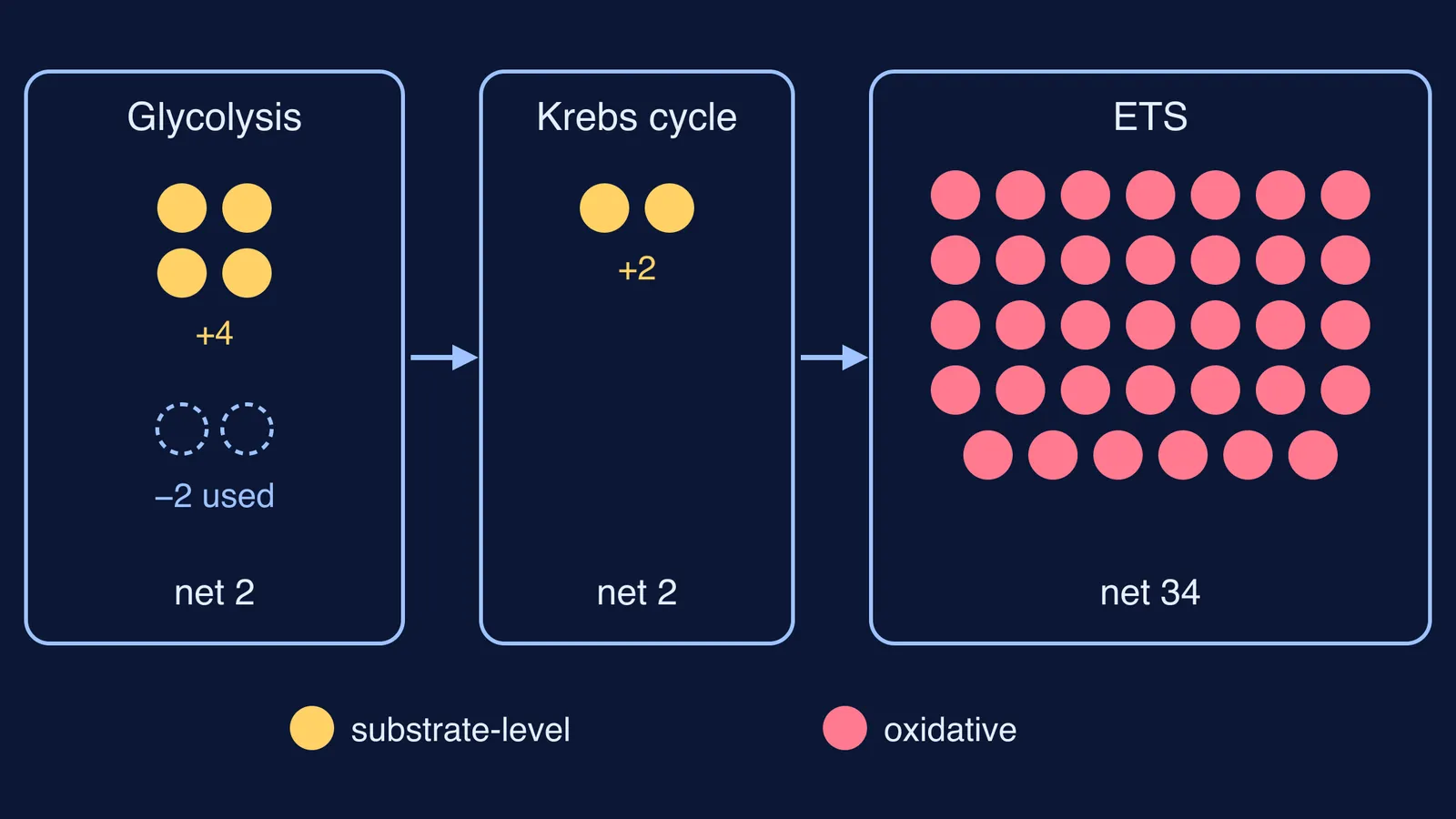
Substrate-level: 2 (step 4) + 2 (step 5) + 2 (step 8) = 6 made, minus 2 used in steps 1 and 2 = 4 net.
Oxidative: 30 (step 9) + 4 (step 10) = 34.
Total: 4 + 34 = 38, the net gain the NCERT balance sheet gives for one glucose.
That makes 34 of the 38 ATP, about 89%, oxidative. This fits OpenStax Biology 2e, which says chemiosmosis is used to generate 90 percent of the ATP made during aerobic glucose catabolism.
Which mistakes cost marks on this topic?
Writing 4 ATP for glycolysis. It makes 4 but uses 2, so the net is 2.
Calling the Krebs-cycle ATP oxidative because it is made in the mitochondria. The mechanism decides the method, not the location. The succinyl-CoA step is substrate-level.
Counting NADH as ATP inside the Krebs cycle. NADH only becomes ATP at the ETS.
Forgetting fermentation. NCERT gives fermentation a net gain of 2 ATP per glucose. All of it is substrate-level, because the ETS never runs.
Mixing this up with photophosphorylation. That process uses light energy to build the proton gradient. Respiration uses redox energy.
If the jump from "NADH formed" to "ATP made" still feels abstract, the Fermi Concept Library gives each biology concept its own lesson and shows where it sits in the map.
A two-minute self-check before your test
On a blank page, write the ten steps above from memory.
Mark each ATP S (substrate-level) or O (oxidative), and circle the two ATP that are used.
Add the S column and the O column separately. You should get 4 and 34.
If your total is not 38, find the step where it went wrong instead of starting again.
For more practice, the Fermi Problem Library has worked problems with a step-by-step solver that explains the reasoning rather than just printing an answer. That helps with ATP-counting questions, where one wrong label spoils the total.