On this page
You write 2 ⊂ {1, 2, 3}, it looks right, and it is marked wrong. The mistake is about which symbol fits the kind of thing on the left. Once you see that, nested sets like {1, {1}} stop being traps.
What is the difference between ∈ and ⊂?
The NCERT Class 11 Mathematics chapter on sets uses ∈ for "belongs to": if a is an element of A, you write a ∈ A. The same chapter defines a subset this way: a set A is a subset of a set B if every element of A is also an element of B, written A ⊂ B.
So the quick test is to look at the left side first.
∈ (element of): the left side is one object, and you ask whether it appears in the list.
⊂ (subset of): the left side is a set, and you ask whether each of its members appears in the list.
The symbol ∈ is a stylised Greek epsilon, first used by Giuseppe Peano in 1889 and taken from ἐστί, meaning "is" (Element of a set, Wikipedia). Reading it aloud as "is in" keeps you honest.
Why does ⊂ need a set on the left?
Because the definition walks through the members of the left side. NCERT writes it as "A ⊂ B if a ∈ A ⇒ a ∈ B" (NCERT, Chapter 1). To check 2 ⊂ {1, 2, 3}, you would need the members of 2, but in school maths the number 2 is an object, not a collection. The statement does not make sense.
There are two correct ways to say what you meant: 2 ∈ {1, 2, 3}, or {2} ⊂ {1, 2, 3}.
How do you handle tricky sets like {1, {1}}?
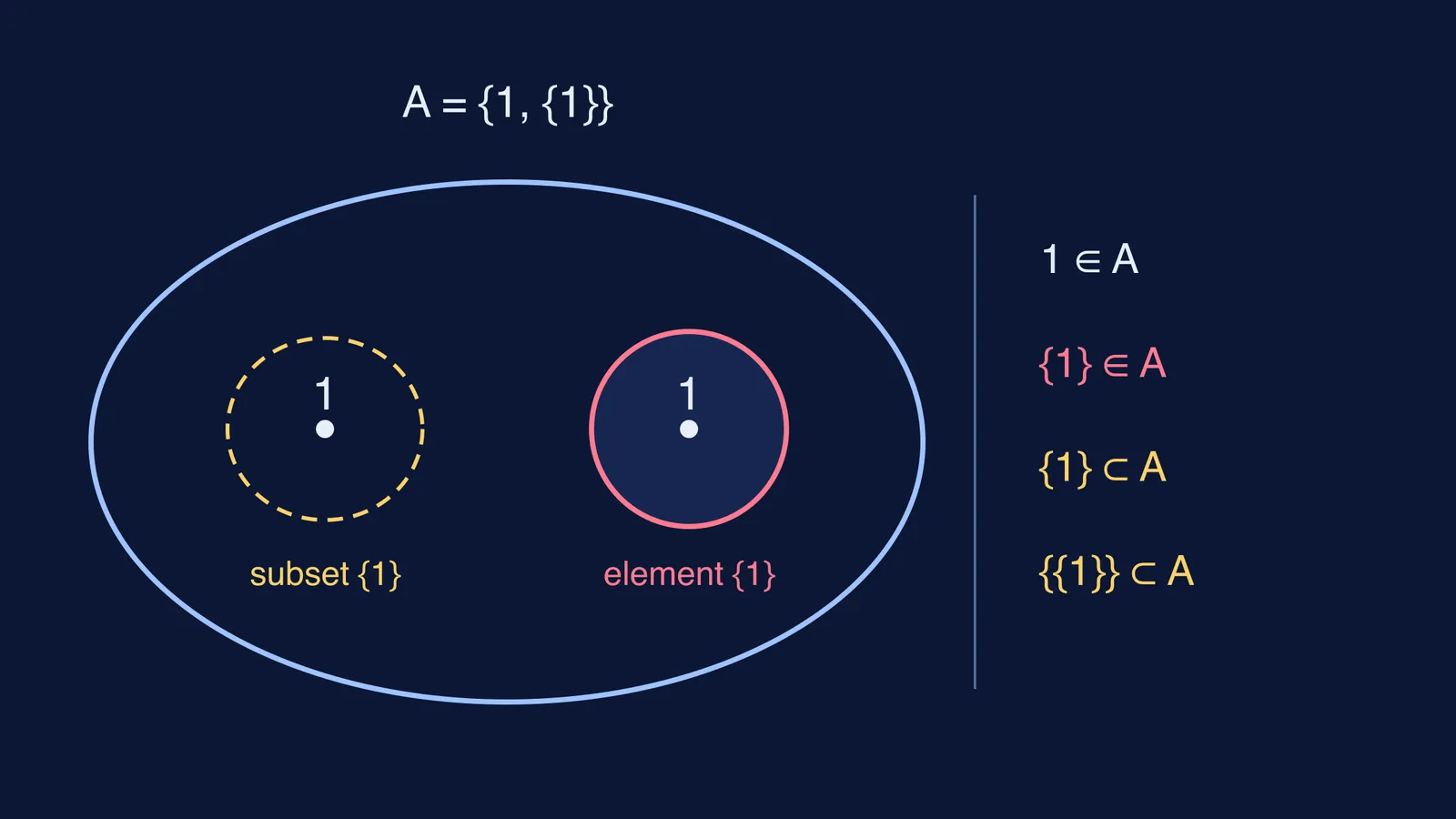
Start by counting the elements, not the 1s. In A = {1, {1}} there are exactly two elements: the number 1 and the set {1}. Wikipedia's article on elements makes the same point with B = {1, 2, {3, 4}}: its elements are 1, 2 and the set {3, 4}, while 3 and 4 on their own are not elements of B (Element of a set, Wikipedia).
Now test eight statements about A = {1, {1}}:
1 ∈ A is true, because 1 is in the list.
{1} ∈ A is true, because {1} is in the list, braces and all.
{1} ⊂ A is true, because the only member of {1} is 1, and 1 ∈ A.
1 ⊂ A is wrong, because the left side is not a set.
{{1}} ⊂ A is true, because its only member is {1}, and {1} ∈ A.
{{1}} ∈ A is false, because the list holds 1 and {1}, not {{1}}.
∅ ⊂ A is true, because NCERT notes the empty set is a subset of every set.
∅ ∈ A is false, because ∅ is not in the list.
So {1} is both an element of A and a subset of A, which is exactly why this set makes a good test question. If ∅ and {∅} feel slippery, our explainer on the empty set versus the set containing the empty set works through the same idea.
A three-question check before you write the symbol
What is on the left: one object, or a set in braces?
If you want ∈: is the left side exactly one of the listed items, written the same way, braces included?
If you want ⊂: remove the outer braces of the left side. Is each thing that remains listed on the right?
Parents checking homework can ask one question: "Is this thing in the list, or a bag of things that are all in the list?" The first means ∈; the second means ⊂.
In a power set every subset becomes an element, so our guide to writing a power set systematically is the natural next step.
Does ⊂ mean subset or proper subset?
It depends on the book. NCERT uses ⊂ for "is a subset of" and states that every set is a subset of itself, so A ⊂ A is true in NCERT notation (NCERT, Chapter 1). Other authors use ⊂ only for a proper subset and write ⊆ when equality is allowed, much like < and ≤ (Subset, Wikipedia).
Where can you practise ∈ and ⊂?
NCERT's Exercise 1.3, Question 3 is a good drill: it takes A = {1, 2, {3, 4}, 5} and asks which ∈ and ⊂ statements are incorrect, and why.
If the definitions themselves feel shaky, the Fermi Concept Library has a lesson for each concept in mathematics. When you want to see the reasoning behind a full answer, the Fermi Problem Library has worked problems with a step-by-step solver that explains the reasoning rather than printing an answer.
Pick one nested set today, write eight statements about it, and mark each true, false or meaningless.