

On this page
When you are first introduced to set theory, the idea of a 'set of sets' can feel abstract. But finding a power set is just a matter of listing combinations. The power set of a set is simply the collection of all its possible subsets.
Whether you are studying for a school exam, preparing for your engineering entrance tests, or working out sample spaces in probability, you need to know how to find these subsets without missing any. The most reliable way is to list them systematically by size.
What goes into a power set?
Before you start writing, there are two special cases to remember. Every power set must include:
The empty set (∅): The empty set contains nothing, and it is considered a subset of every possible set.
The set itself: Every set is a subset of itself.
If your original set is called A, its power set is written as P(A). Every single element inside P(A) will be a set, wrapped in its own curly braces.
How do you list the elements of a power set?
The most common mistake when writing a power set is guessing combinations randomly and losing track. To avoid this, group the subsets by their size, starting from zero elements up to the full size of the set.
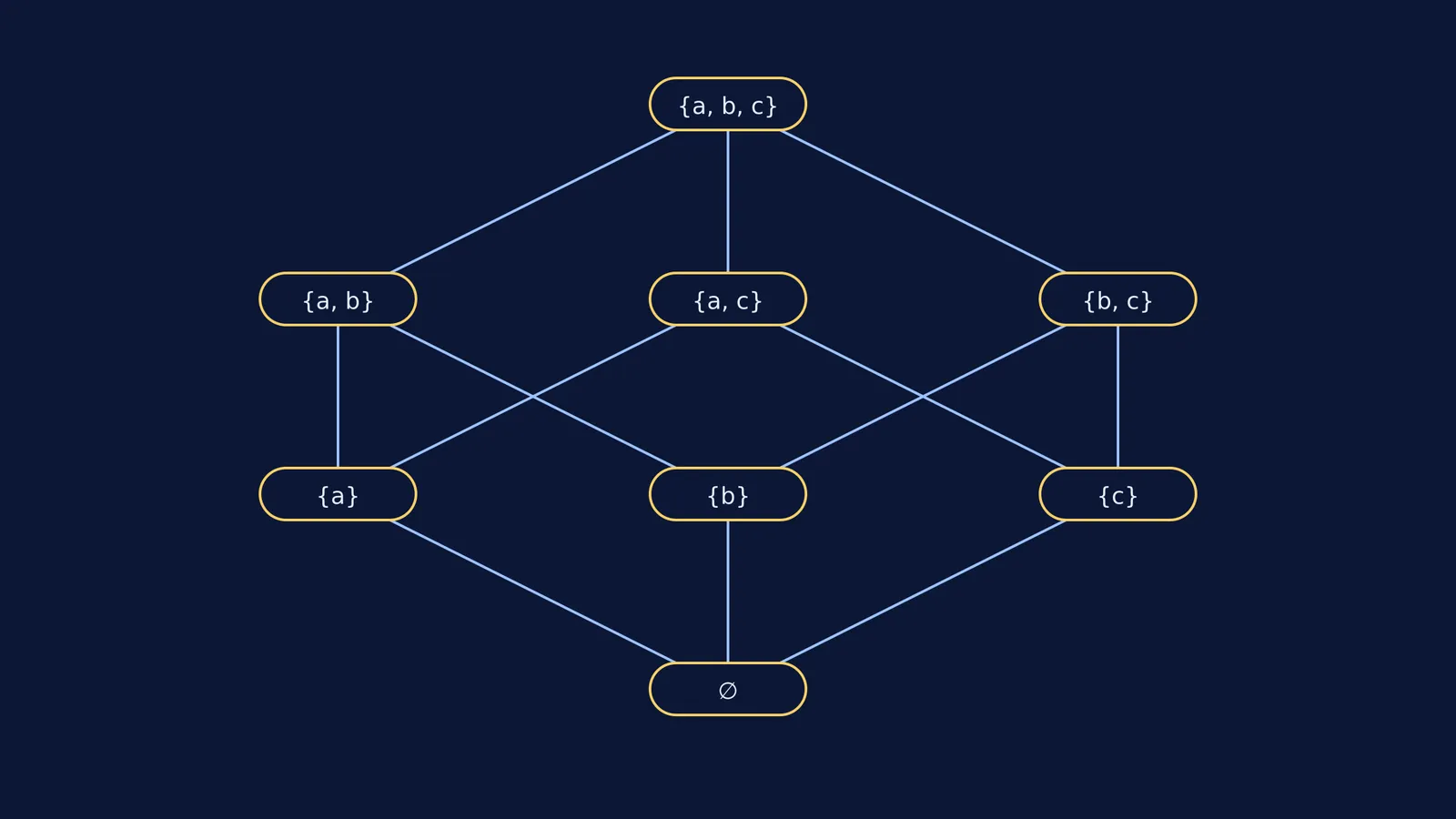
Let us write the power set for a set of three elements: A = {a, b, c}.
Step 0: Subsets with 0 elements There is only one: the empty set.
∅
Step 1: Subsets with 1 element Take each element on its own.
{a}, {b}, {c}
Step 2: Subsets with 2 elements Pair the elements up systematically. Start with a and pair it with the others, then move to b.
{a, b}, {a, c}, {b, c}
Step 3: Subsets with 3 elements This is just the original set itself.
{a, b, c}
Finally, collect all these subsets and put them inside one large pair of curly braces to form the power set: P(A) = { ∅, {a}, {b}, {c}, {a, b}, {a, c}, {b, c}, {a, b, c} }
How many elements are in a power set?
You can always check if you have missed a subset using a simple formula. If a set has n elements, the number of elements in its power set is 2ⁿ.
In our example above, set A has 3 elements (n = 3). The formula tells us the power set should have 2³ = 8 subsets. Counting our final list confirms we found all 8.
If you were asked to find the power set of a 4-element set, you would need to list 2⁴ = 16 subsets. For a 5-element set, it jumps to 32. This is why counting with 2ⁿ is often used in combinatorics and probability when the list becomes too large to write out by hand.
Why does the power set matter in probability?
In probability theory, the sample space is the set of all possible outcomes of an experiment. An event is simply defined as a subset of that sample space. Because the power set is the collection of all subsets, the power set of a sample space contains every single event that could possibly happen.
For instance, if you flip a coin twice, the sample space of outcomes is S = {HH, HT, TH, TT}. The power set P(S) has 16 elements because 2⁴ = 16. These 16 elements represent all 16 possible events, ranging from the impossible event (the empty set) to the certain event (the full sample space S). Being able to list these subsets systematically means you can define complex events without missing any valid outcomes.
If you are dealing with more complicated probability questions, such as three-set Venn problems, listing the power set helps you see the overlap between different events clearly. Each region in a Venn diagram corresponds to a specific subset of the sample space, which means it is an element of the power set. By mastering how to write these sets systematically, you build a strong foundation for both algebra and statistics.
Where can you practice these concepts?
If you need to review the definitions of sets, cardinality, or set operations, you can explore the Fermi Concept Library, which covers every concept in physics, chemistry, biology, mathematics and computing, each with its own lesson and its place in the map. And if you get stuck applying these ideas to harder exam questions, the Fermi Problem Library provides worked problems with a step-by-step solver that explains the reasoning rather than printing an answer, helping you master the logic behind combinations and subsets.


