

On this page
Is the set containing zero an empty set?
A set containing zero, written as {0}, is not an empty set. It is a singleton set because it contains exactly one element: the number 0.
Under the official definitions in the NCERT Class 11 Mathematics textbook, an empty set—also called a null set or void set—contains no elements at all. It is denoted by the Greek symbol ∅ or by empty braces, {}. Its cardinality is n(∅) = 0. In contrast, zero is an integer on the number line. Enclosing 0 inside brackets produces a set with one element, so its cardinality is n({0}) = 1.
This distinction often confuses students new to abstract set notation. In a study of 52 preservice teachers published in the Journal for Research in Mathematics Education, researchers Margariete Montague Wheeler and Issa Feghali found that 15% of participants did not recognise zero as a number. When learners view zero as an absence rather than a number, they easily mistake {0} for an empty container.
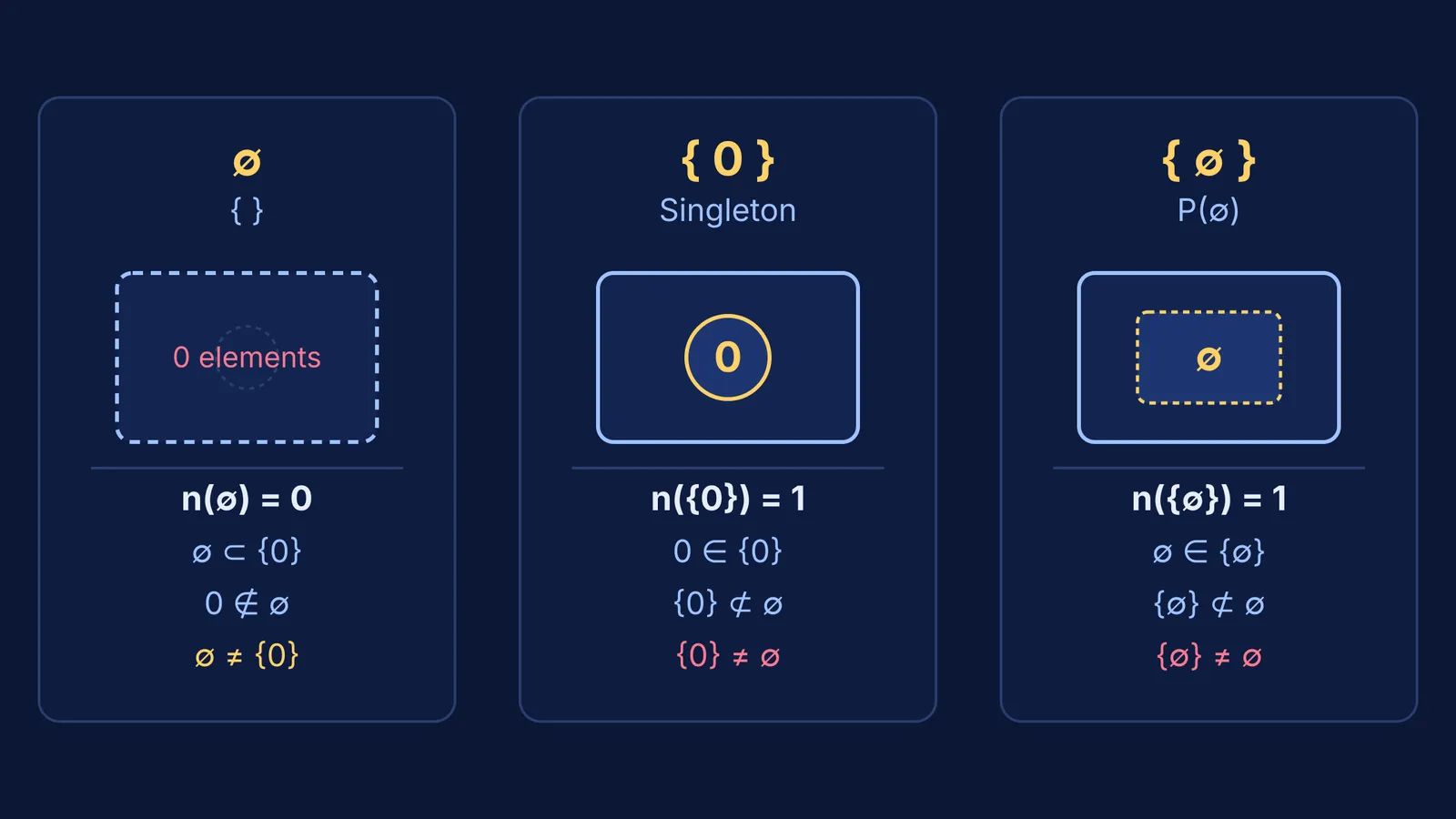
What is the difference between ∅, {0}, and {∅}?
Keeping ∅, {0}, and {∅} distinct requires counting the elements inside each pair of braces:
∅ is the empty set with zero elements, so n(∅) = 0.
{0} is a singleton set containing the number zero, so n({0}) = 1.
{∅} is a singleton set containing the empty set, so n({∅}) = 1.
Writing {∅} to denote the empty set is an error. Putting ∅ inside braces creates a non-empty set that holds the empty set as an element.
As educational theorist Anna Sfard noted in Educational Studies in Mathematics, students must reify mathematical notions, moving from an operational process to seeing a set as an object. Once you treat the empty set as an object, it is natural that another set can contain it.
This distinction is central when counting subsets and constructing the power set. The power set of ∅, denoted P(∅), contains all subsets of ∅. By the 2ⁿ subset rule, P(∅) must contain 2⁰ = 1 element, which yields P(∅) = {∅}.
To explore how set foundations connect across higher mathematics, the Fermi Concept Library maps every concept in physics, chemistry, biology, mathematics and computing, each with its own lesson and its place in the map.
Why does NCERT test ∈ versus ⊂ with nested sets?
Examiners frequently test whether students understand the boundary between the membership symbol (∈) and the subset symbol (⊂).
Membership (∈) connects an element to a set: x ∈ S means x is an item listed directly inside S's outer braces. Subset inclusion (⊂) connects two sets: X ⊂ S means every element of X is also an element of S.
In Chapter 1, NCERT uses the benchmark set A = {1, 2, {3, 4}, 5}. The set A contains four elements: 1, 2, {3, 4}, and 5. This leads to standard true-or-false traps:
{3, 4} ∈ A is TRUE, because {3, 4} is an element listed directly inside A.
{3, 4} ⊂ A is FALSE, because 3 and 4 are not individual elements of A.
{{3, 4}} ⊂ A is TRUE, because the singleton set containing {3, 4} has a member that belongs to A.
∅ ⊂ A is TRUE, because the empty set is a subset of every set.
∅ ∈ A is FALSE, because ∅ is not listed as an element inside A.
{∅} ⊂ A is FALSE, because ∅ ∉ A.
Just as Augustus De Morgan's laws for set operations clarified Boolean logic, maintaining strict element boundaries avoids fallacies.
How do you solve bracket questions step by step?
When evaluating set statements, you can use a three-step audit:
List the direct elements: Strip only the outermost braces of the set S. Write down every item between the top-level commas. For A = {1, 2, {3, 4}, 5}, the list is 1, 2, {3, 4}, and 5.
Test membership (x ∈ S): Check whether x appears verbatim on your list. If it does not appear exactly as written, the claim is false.
Test inclusion (X ⊂ S): Remove the outer braces of X and check whether every item inside X appears on your inventory list for S. If all are present, the claim is true. Remember that ∅ ⊂ S is always true.
This simple check also prevents miscounting when counting relations and functions between finite sets.
For step-by-step guidance on tricky syllabus problems, the Fermi Problem Library has worked problems with a step-by-step solver that explains the reasoning rather than printing an answer.


